
Top 3 GoDaddy.com Hosting Alternatives 2026
Explore the top 3 GoDaddy.com alternatives for reliable hosting solutions. Compare to make an informed decision for your business needs.


TL;DR:
- Most small businesses rely on analytics to identify website issues and optimize lead generation efforts. Proper measurement, analysis, and ongoing review prevent guesswork and support evidence-based design decisions. Implementing a structured analytics process and expert setup ensures sustainable growth and measurable marketing success.
Most small business owners assume their website underperforms because of design or copy. The real culprit is almost always a lack of data. The role of analytics in website optimization is not a bonus feature you add after launch. It is the engine that tells you what is broken, where visitors are leaving, and which pages are quietly killing your leads. Without it, you are running your business on gut instinct and guesswork, spending money on changes that feel right but may do nothing. This article breaks down exactly how analytics works, what to track, and how to turn that data into a lead-generating machine.
Web analytics is the measurement and analysis of data used to understand user behavior across pages. That definition sounds simple, but most businesses stop at the “measurement” part and never reach the “analysis” part. Counting page views tells you nothing actionable on its own. Understanding why visitors leave a pricing page without clicking your contact button, and then fixing it, changes revenue.
The real power is in connecting behavioral data to business outcomes. Think of it as a four-step loop you run repeatedly:
This loop separates businesses that grow from those that stagnate. It also changes how website design impacts leads because design decisions stop being subjective and start being evidence-based. A button color change guided by heatmap data is worth 10 times more than one made by committee.
Knowing analytics matters is one thing. Building a system that actually produces reliable insight is where most small businesses fall short. A practical CRO measurement framework tracks both macro conversions and micro conversions, plus engagement and technical experience metrics, because funnel analysis pinpoints exactly where visitors drop off before converting.
Here is how to think about the four levels:
Pro Tip: Never optimize what you cannot measure. Before running a single test, document every key event you want to track, what it means, and how it connects to a business goal. This tracking plan becomes your source of truth.
Funnel analysis is where this framework pays off. When you map the path from landing page to form submission, you can see the exact step where 60% of visitors disappear. That page becomes your first priority for improvement, not the homepage everyone has an opinion about.

Avoid vanity metrics like total page views or social media followers. They feel good in a monthly report but tell you nothing about lead generation. The website optimization guide for 2026 makes this distinction clear: the metrics that matter are the ones tied to actions visitors take on their way to becoming customers.
Attribution modeling matters here too. If you are running paid ads alongside SEO, you need to know which channel is actually closing leads, not just starting sessions. Last-click attribution, where 100% of the credit goes to the final touchpoint, is a common trap that undersells the value of organic search. Build your custom website design around channels you can actually measure end-to-end.
Google Analytics 4 (GA4) is the current standard, but most small business setups are configured incorrectly, producing data that looks right but leads to bad decisions. Understanding how GA4 handles conversions is non-negotiable.
In GA4, Key Events are the foundation of conversion reporting. When you mark an event as a Key Event in GA4, it appears in your conversion reports. More importantly, if you import those events into Google Ads, they power Smart Bidding, which means your ad spend gets optimized toward the actions that actually matter for your business.
The counting method you choose also changes your data significantly. GA4 offers two options:
For lead-gen forms, once-per-session counting is usually the smarter choice. If someone refreshes a thank-you page or your tracking fires twice due to a technical glitch, once-per-event counting inflates your conversion numbers. Inflated numbers make your results look better than they are and steer optimization in the wrong direction.
Pro Tip: Create a documented event plan before touching GA4 settings. List each event name, the trigger condition, the counting method, and the business reason for tracking it. Without this plan, your GA4 account becomes a graveyard of unused events and conflicting data.
Common pitfalls to watch for:
These errors are not obvious until your data contradicts reality. Fixing them after months of bad data is painful. See the professional website management guide for a breakdown of why proper infrastructure prevents these problems from day one.
Traffic is not revenue. This statement makes agencies uncomfortable, but small business owners need to hear it. You can double your organic traffic and see zero change in leads if that traffic is not qualified, not landing on the right pages, or hitting a site that converts poorly.
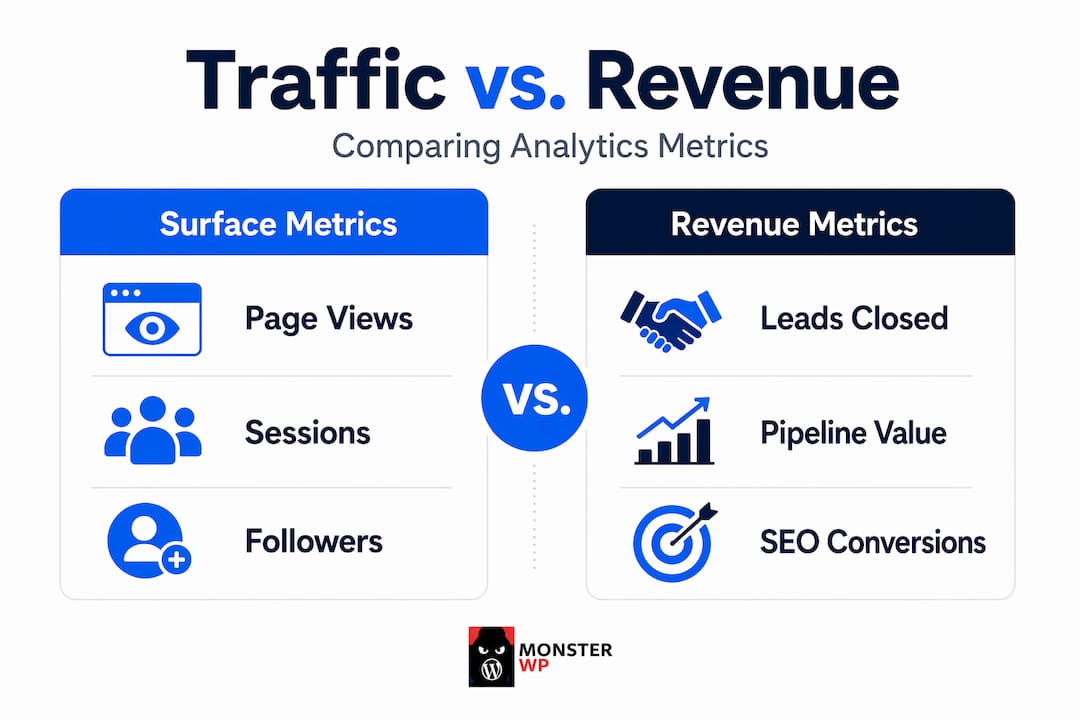
Tying SEO metrics to pipeline outcomes rather than reporting traffic alone is the only way to prove that your website investment is producing real business value. A measurement system that connects crawl data, keyword rankings, and on-page behavior to actual revenue closes the gap between marketing activity and business results.
Here is how surface-level metrics compare to revenue-connected metrics:
| Surface metric | What it tells you | Revenue-connected version |
|---|---|---|
| Organic sessions | How many people visited | Organic sessions that started a lead |
| Keyword rankings | Where you appear in search | Keywords driving pipeline-stage conversions |
| Bounce rate | Whether people stayed | Exit rate on conversion pages specifically |
| Pages per session | How much they browsed | Path completion rate to contact form |
| Time on page | Engagement level | Time on page for visitors who converted |
The right column changes conversations. Instead of reporting “we grew traffic by 20%,” you can say “SEO-driven leads increased by 14% this quarter, accounting for 8 new client contracts.” That is a budget-justifying statement. That is how SEO drives business growth in practice.
Connecting analytics to your CRM is the next step. When a lead from your website enters your pipeline, you want to know which page they came from, which keyword brought them in, and which content they read before converting. Platforms that support AI-driven attribution, like those covered in this lead generation SEO breakdown, are making this connection more accessible for businesses that are not running enterprise-scale technology stacks.
For local businesses especially, this integration changes everything. See how websites drive local business lead generation when the data loop is actually closed from visitor to paying customer.
The biggest failure mode for small businesses with analytics is not starting wrong. It is stopping. Data review falls off the calendar, dashboards go unread, and the entire investment in setup produces nothing because nobody is acting on the information.
A lightweight analytics process paired with a tracking plan, clear KPIs, and a repeatable cadence for turning data into action is what separates businesses that actually improve from those that just install Google Analytics and forget it.
Here is how to build a process that sticks:
Key metrics to watch in your monthly review:
Pro Tip: Build your analytics dashboard around questions, not data. “Which pages are losing us leads?” is a better dashboard prompt than “show me all traffic.” Purpose-built views answer real business questions faster and keep your review sessions focused.
The reason businesses need website platforms built for growth, rather than generic DIY tools, is precisely this. A managed platform keeps your analytics infrastructure working correctly so your monthly reviews produce insight instead of troubleshooting.
Here is the uncomfortable truth we see constantly: most small businesses treat analytics as a reporting tool. They check traffic numbers, feel good or bad about the month, and move on. That is not analytics in website optimization. That is data watching.
The biggest analytics mistake in CRO is treating optimization as a pile of isolated A/B tests. Mature optimization works as a loop: diagnose with behavioral and funnel analytics, prioritize the highest-impact opportunities, run controlled experiments, report what you learned, and iterate. Skipping any step in that loop means your tests are not connected to a diagnosis, your priorities are based on opinion, and your results are not informing future decisions.
We also see another pattern: business owners who invest in analytics setup but not analytics execution. They have GA4 installed. They have events firing. But nobody is reading the data, nobody is acting on it, and the site sits unchanged for a year while leads go elsewhere.
DIY analytics setups compound this problem. Without expert configuration, you get inflated metrics, missing events, and data that looks healthy but reflects broken tracking. The custom website design and optimization work built on that data will optimize in the wrong direction entirely.
Our position is simple. Analytics without process is noise. Process without reliable data is theater. Small businesses that win with website optimization treat it as an ongoing system, not a one-time project. That requires managed infrastructure, consistent expert oversight, and clear accountability for acting on what the data reveals.
Understanding analytics strategy is one thing. Having the infrastructure and team to execute it consistently is another challenge entirely.
At MonsterWP, we build custom WordPress websites designed from day one to track what matters, not just to look good. Every site we launch includes proper GA4 configuration, event tracking aligned to your specific lead-gen goals, and the technical foundation that makes your data trustworthy. Our flat-fee model means no surprise invoices, no bloated retainers, and no agency runaround. You get expert analytics setup, ongoing optimization support, and a team that treats your results as the scorecard. See exactly how it works and find a plan built for businesses that want measurable growth, not monthly meetings about metrics.
Small businesses should track macro and micro conversions like leads and form starts, plus engagement metrics such as time on page and technical metrics including page load speed and error rates. The goal is to answer what changed, where it changed, and what to do next.
GA4 uses Key Events to define conversions that feed directly into conversion reports and enable smarter bidding in Google Ads. Properly configuring these events ensures you are measuring real actions like form submissions rather than accidental page reloads.
Tying SEO to pipeline outcomes rather than just traffic lets you measure true ROI, justify budget decisions, and prioritize changes that actually grow revenue instead of just boosting vanity numbers.
The most costly mistake is treating optimization as isolated A/B tests without connecting each test to a behavioral diagnosis, a clear priority, and a decision log. This produces random results that do not compound into real performance improvement over time.
Explore the top 3 GoDaddy.com alternatives for reliable hosting solutions. Compare to make an informed decision for your business needs.

Unlock the power of content optimization strategies that drive results. Discover how to enhance rankings, leads, and revenue effectively!