
2026 Digital Marketing Trends Guide for Growth
Unlock the future with our 2026 digital marketing trends guide. Discover AI personalization, GEO, and more strategies for lasting growth!


Every growing service-based business in the United States faces one undeniable truth—the website is where real sales conversations begin. While social platforms can shift visibility overnight, your website gives you total control over brand presentation and user experience, making it the single digital asset you truly own. This article highlights why your website sits at the center of your marketing efforts and how optimizing it transforms scattered clicks into reliable, qualified leads.
| Point | Details |
|---|---|
| Website as Central Hub | Your website is the main asset in digital marketing, integrating various channels for lead generation and revenue. |
| Control and Credibility | Unlike other platforms, your website allows complete control over branding and serves as a credibility anchor for potential clients. |
| Lead Generation Mechanics | An optimized website attracts, engages, and captures leads effectively, turning visitors into clients with clear conversion pathways. |
| Importance of Integration | Coordinating SEO, content, and paid advertising enhances visibility and effectiveness, leading to better overall results. |
Your website is not just another marketing channel. It’s the hub that every other channel points toward, and it’s where real business happens.
Unlike social media platforms or paid ad networks that change their algorithms constantly, your website gives you total control over how your brand looks, feels, and functions. No algorithm changes. No surprise visibility drops. No rules rewritten overnight.
Here’s the structure of modern digital marketing:
Every channel feeds traffic back to one place: your website. That’s where visitors read detailed content, compare your services against competitors, review your pricing, and decide whether to hire you.
To clarify how marketing channels support your website, here is a summary table:
| Channel | Main Purpose | Website Role | Typical Outcome |
|---|---|---|---|
| Social Media | Build awareness | Direct traffic inbound | Higher brand visibility |
| Nurture relationships | Drive engagement | Repeat visits and leads | |
| Paid Ads | Capture intent | Funnel prospects | Immediate lead generation |
| Content | Build authority | Strengthen credibility | Improved organic ranking |
A website serves three critical functions that no other channel can handle:
First, it’s your credibility anchor. Founders with $250K to $10M in revenue know that serious buyers verify you online before picking up the phone. They look for professional design, case studies, client logos, and proof you’ve done this before.
Second, it’s your SEO foundation. Search traffic costs nothing after the initial setup, unlike paid ads where you pay per click. A well-built website captures long-tail searches when prospects are actively looking for solutions.
Third, it’s your data collection point. Every visitor interaction on your website generates insights. You see which pages convert, which content resonates, and where prospects drop off. Other platforms don’t give you this level of control.
Your website is the one digital asset you truly own. Everything else rents space on someone else’s platform.
Think of your website as the hub, and every marketing channel as a spoke leading back to it.
Google Ads drive traffic. They land on your website. LinkedIn content establishes thought leadership. It links back to your website. Email campaigns stay warm. They direct to specific landing pages on your website.
Without a strong website, you’re paying for traffic that leads nowhere. With one, every marketing dollar gets multiplied.
Pro tip: Audit where your paid marketing leads. If ads are pointing to landing pages without clear next steps or conversion paths, you’re wasting spend. Every ad should funnel to specific website pages optimized for that audience segment.
For service-based businesses, your website isn’t just a brochure—it’s your primary sales tool. It needs to do specific work that converts prospects into clients.

Your website must clearly communicate what you do and why prospects should choose you over competitors. This is your value proposition, and it needs to be obvious within seconds of landing on your site.
Prospects visiting your website are evaluating three things:
If your website doesn’t answer these questions, you lose the lead.
A strong website for service businesses performs specific functions that drive revenue:
Lead capture is function number one. Your website needs clear pathways to contact through contact forms, phone numbers, or scheduling tools. Every page should have a way for interested prospects to take action.
Trust building happens through strategic content placement. Testimonials, case studies, client logos, and your credentials all signal that you’re legitimate and capable.
Mobile optimization is non-negotiable. Most prospects research services on their phones. If your site is hard to navigate on mobile, they leave.
Content integration ties your website to your broader marketing strategy. Blog posts, service pages, and resources keep visitors engaged and improve your search visibility.
Your website is where trust meets action. Without both, you don’t convert prospects into paying clients.
Social media and advertising create awareness. Your website creates action.
You can run the best LinkedIn campaign or Google Ads ever, but if your website doesn’t move prospects toward a sale, you’ve wasted the budget. Your site needs to be the destination where awareness turns into qualified leads.
For service businesses specifically, this means:
Without these elements, your website becomes a liability instead of an asset.
Pro tip: Set up conversion tracking on your website immediately. Track which pages drive contact form submissions, phone calls, and scheduled consultations. This data tells you exactly which content and pages are actually generating leads versus just consuming server space.
Your website is the machine that turns strangers into leads and leads into clients. Without a clear lead generation strategy, you’re leaving revenue on the table.
The mechanics are straightforward: prospects land on your site, engage with your content, and give you their contact information. Then you nurture that relationship until they’re ready to buy. This process works when every element of your website is optimized for conversion.
A website that generates leads performs these specific functions:
Without this structure, your website becomes a dead end.
Attraction comes first. Your website needs to rank for searches your prospects actually perform. This is where SEO matters. When someone searches for your service, your site should appear.
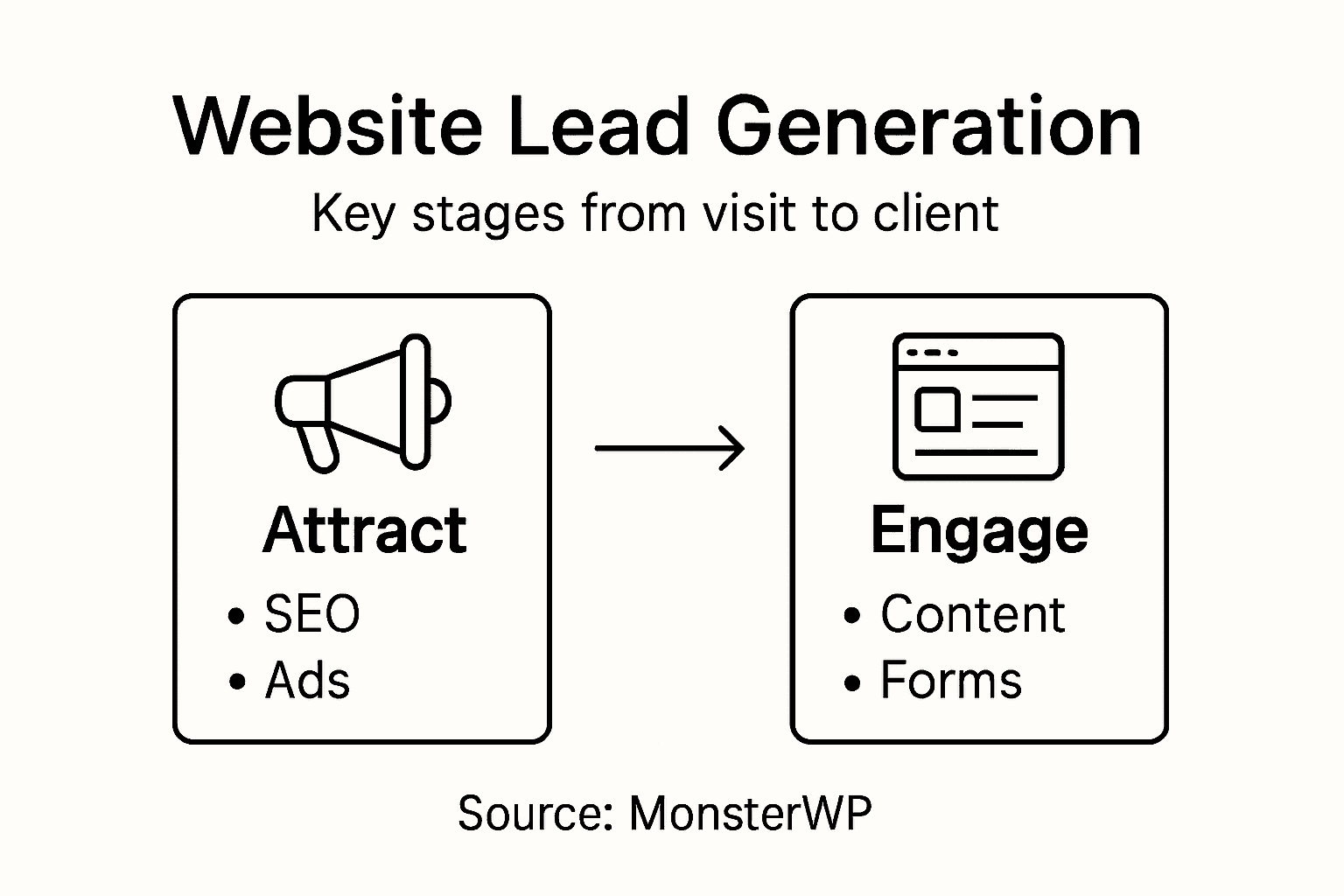
Engagement happens through content. Blog posts, case studies, and resource guides keep visitors on your site longer and build trust. The longer they stay, the more likely they convert.
Capture requires friction-free forms. A contact form that asks for too much information kills conversions. Ask for email and phone number. That’s it. Everything else is a barrier.
Once you capture a lead, the real work begins. Strategic lead management improves your ability to qualify which prospects are sales-ready and which need more nurturing.
A website isn’t just a marketing tool anymore. Sales teams depend on it to deliver relevant content and streamline the sales process.
When a prospect enters your sales funnel, your website should give your sales team everything they need to close the deal. Case studies, pricing, testimonials, and detailed service descriptions reduce objections before the conversation even starts.
This is what separates amateur operations from professional ones:
Your website pre-qualifies prospects. It answers common questions. It demonstrates credibility. By the time someone picks up the phone, they already believe you can solve their problem.
Lead generation isn’t about volume. It’s about qualified prospects who understand your value before they contact you.
Without a website optimized for lead capture and qualification, your sales team spends time on unqualified prospects who weren’t ready to buy anyway.
Pro tip: Create separate landing pages for different service offerings or audience segments. Track which pages generate the most qualified leads, then double down on messaging and traffic to those high-performing pages.
Most businesses treat SEO, content, and paid ads like separate channels. That’s a mistake. They work best when coordinated.
Imagine SEO as your long-term asset, content as your credibility builder, and paid ads as your acceleration pedal. When you run them in isolation, each underperforms. When you integrate them strategically, they amplify each other.
Here’s why integration matters:
Running these separately is like having different sales teams that don’t talk to each other. Chaos. Wasted budget. Missed opportunities.
SEO identifies what your prospects are searching for. Content addresses those search queries and builds your site’s authority. Paid ads amplify your best-performing content to reach more qualified prospects faster.
Your content strategy should start with SEO keyword research. What are your prospects actually typing into Google? Build content around those terms. When someone searches that term organically, your content ranks. When you run paid ads targeting the same keywords, your ads land on people actively searching.
This coordinated approach to content optimization increases organic traffic while your paid campaigns build immediate visibility.
Integration requires coordination between teams and systems. Your SEO strategy informs your content calendar. Your content performance data informs your paid ad targeting. Your paid ad data reveals which keywords are converting, so you prioritize those in your SEO efforts.
Most businesses don’t do this. They hire an SEO person, a content writer, and a paid ads manager. Three separate contractors working independently. No wonder the results are mediocre.
Proper integration means:
Without this coordination, you’re essentially running three separate marketing experiments and hoping they somehow work together.
Integration isn’t optional. It’s the difference between a coordinated system that compounds results and three isolated channels that compete for budget.
When done right, a visitor who sees your paid ad, reads your blog post, and later finds your site through organic search has encountered your brand three times. That repetition builds trust faster.
Pro tip: Start with your highest-performing paid ads. Identify the ad copy and messaging that converts best. Then create organic content around those same messages and keywords. You’re letting paid data validate what your audience actually cares about before you invest heavily in organic ranking.
Most business websites fail silently. They look professional, but they don’t convert. They rank nowhere. They leak security risks. Nobody measures what actually matters.
These failures don’t happen by accident. They result from predictable mistakes that happen when founders build websites without expert guidance.
A slow website costs you leads. Every second slower loads means fewer conversions. A website that doesn’t work on mobile abandons 60% of your traffic. A site without proper analytics means you’re flying blind.
These aren’t theoretical problems. They’re revenue leaks.
The worst mistake is treating DIY website builders as viable solutions. You can launch something fast, but speed doesn’t equal functionality. What starts as a cost-saving measure becomes a liability that damages your reputation and wastes marketing spend.
Common website pitfalls include:
Each of these is fixable. But they compound when ignored.
Your website and marketing strategy must work together. If your paid ads promise something your website doesn’t deliver, you waste budget. If your content doesn’t match what prospects are searching for, you get traffic that doesn’t convert.
Aligning website functionality with marketing goals requires ongoing coordination between teams. Most founders skip this step because it seems invisible. Until it isn’t.
You run ads. Traffic arrives. Nothing happens. You blame the ads. The real problem was the landing page. Or the form asked for too much information. Or the call-to-action wasn’t clear.
A website without measurement is a black box. You’re spending money and hoping it works instead of knowing it works.
Implement analytics immediately. Track which pages convert. Track where visitors come from. Track where they drop off. This data reveals exactly where your system is failing.
Websites require ongoing work. Content updates. Security patches. Performance optimization. Broken link fixes. Plugin updates. Backup management.
Many founders build a site, launch it, then ignore it for two years. By then, it’s slow, outdated, and potentially compromised. Every month of neglect makes your site less effective.
This is the hidden operational cost nobody mentions when you choose DIY. You’re not just building once. You’re committing to continuous maintenance with tools you probably don’t understand.
For business owners, understanding website maintenance costs is crucial. Here is a comparison of website upkeep approaches:
| Approach | Initial Cost | Ongoing Maintenance | Risk Level |
|---|---|---|---|
| DIY Builders | Low | Requires self-upkeep | High, prone to issues |
| Professional Setup | Medium-High | Managed by experts | Low, reliable support |
| No Maintenance | None | Neglected | Very high, serious risk |
Pro tip: Audit your current website right now. Test it on mobile. Check load speed. See if forms actually work. Verify your analytics are tracking conversions. These four things reveal whether your site is an asset or a liability. If three or more are broken, you’re leaking money every day.
Many businesses struggle with turning their website into the central hub that truly drives lead generation and sales. You may feel frustrated by poor conversions, slow load times, or unclear pathways for prospects to take the next step. The challenge is that successful digital marketing demands a website optimized for speed, SEO, and seamless user experience. It requires more than just a pretty design or generic templates.
At MonsterWP, we understand these pain points and offer a fully managed WordPress growth platform designed for business owners like you who want to stop wasting money on ineffective solutions. From custom-built sites optimized from day one for SEO and performance to unlimited updates that ensure your site never falls behind, we deliver the digital backbone your business needs. Discover how to build your digital engine that amplifies every marketing channel and generates qualified leads consistently by exploring our Website & Design Archives – MonsterWP and deepening your SEO and performance strategy at SEO & Performance Archives – MonsterWP.
Take control of your online presence now with MonsterWP. Visit https://monsterwp.com to get started and transform your website into the lead-generating asset it is meant to be.
A website serves as the central hub for all digital marketing efforts, directing traffic from various channels like social media, email, and paid ads, and ultimately converting visitors into leads or customers.
A well-designed website enhances credibility by showcasing professional design, case studies, client testimonials, and relevant credentials, which helps to build trust with potential customers seeking your services.
SEO is crucial as it helps the website rank for relevant search queries, attracting organic traffic at no cost after the initial setup, and allowing prospects to discover your services when they actively search for solutions.
Essential elements include clear value propositions, friction-free lead capture forms, mobile optimization, trust-building content (like testimonials), and fast load times to ensure a smooth user experience.
Unlock the future with our 2026 digital marketing trends guide. Discover AI personalization, GEO, and more strategies for lasting growth!

Discover what is predictable pricing in web services and learn how fixed costs can empower your SMB’s budget. Gain financial control today!