
Local SEO guide: boost your small business visibility
Learn actionable local SEO steps to boost your small business visibility, attract qualified leads, and rank higher without hiring an agency.


Small business owners lose an average of 37% of potential leads because their websites load slowly, crash unexpectedly, or display outdated information. Professional website management solves these problems through continuous monitoring, proactive updates, and strategic optimization. This guide explains what professional website management actually involves, how it protects revenue, and when outsourcing makes financial sense for service businesses focused on growth without the constant technical headaches.
| Point | Details |
|---|---|
| Definition and scope | Professional website management is ongoing maintenance, security monitoring, performance optimization, and strategic updates to keep sites fast, secure, and lead-generating. |
| Core activities | Daily security scans, weekly backups, monthly plugin updates, quarterly performance audits, and continuous uptime monitoring using specialized tools. |
| Business impact | Managed sites experience 98% less downtime, load 40% faster, and convert 25% more visitors into qualified leads compared to unmanaged alternatives. |
| Cost versus value | Monthly fees range from $299 to $750, preventing emergency costs that average $2,400 per incident and protecting revenue from site failures. |
| Best approach | Hybrid models work well: business owners maintain content strategy while professionals handle technical infrastructure, security, and performance optimization. |
Professional website management is the ongoing, proactive process of maintaining, optimizing, and updating a business website to ensure peak performance, security, and lead generation. Unlike reactive fixes that address problems after they occur, professional management prevents issues before they impact your business. This approach combines technical expertise with strategic thinking to keep your digital presence working as hard as you do.
The scope extends far beyond basic updates. Professional management encompasses security monitoring to block threats, performance optimization to maintain fast load times, content accuracy to reflect current offerings, and conversion optimization to turn visitors into customers. For service businesses, this means your website consistently attracts qualified leads instead of frustrating potential clients with errors or outdated information.
“Professional website management transforms websites from static brochures into dynamic business assets that actively generate revenue and protect brand reputation through systematic care and strategic improvements.”
The core components create a protective shield around your online presence:
Methodologies emphasize proactive over reactive maintenance, using tools like Google Analytics for user insights, uptime monitoring services to catch outages instantly, and security platforms to block malicious traffic. This systematic approach means problems get solved before customers notice them. Your website stays online, loads quickly, and converts visitors while you focus on running your business.
For small to mid-sized service companies, professional management delivers peace of mind. You gain confidence knowing experts monitor your site 24/7, fix issues immediately, and optimize performance continuously. This foundation supports everything else you do online, from managed websites for small businesses to comprehensive digital marketing. When your website works flawlessly, you can invest energy in growth instead of troubleshooting technical problems.
The difference between managed and unmanaged sites becomes obvious quickly. Managed sites from providers like those in websites archives maintain consistent uptime, fast speeds, and current security. Unmanaged sites gradually deteriorate, accumulating vulnerabilities and performance issues that eventually cause catastrophic failures at the worst possible times.
Effective website management follows structured schedules with specific tasks performed at defined intervals. Core mechanics include daily to weekly scans, monthly backups, plugin management, and quarterly audits with time requirements that vary based on site complexity. Understanding these mechanics helps business owners evaluate service providers and set realistic expectations.
The task schedule breaks down into manageable chunks:
| Task frequency | Activities | Time required | Business impact |
|---|---|---|---|
| Daily | Security scans, uptime checks, backup verification | 15-30 minutes | Prevents breaches, catches outages immediately |
| Weekly | Performance monitoring, broken link checks, spam filtering | 30-45 minutes | Maintains speed, fixes user experience issues |
| Monthly | Plugin updates, core updates, content accuracy review | 1-2 hours | Patches vulnerabilities, keeps information current |
| Quarterly | Full site audit, speed optimization, SEO review | 3-4 hours | Identifies improvement opportunities, boosts rankings |
Professional managers use specialized toolsets to execute these tasks efficiently. Performance and security tools like PageSpeed Insights, web application firewalls, and Google Analytics are essential in best practices. Uptime monitoring services ping your site every minute, alerting managers instantly when problems occur. Backup systems create redundant copies stored in multiple locations, ensuring recovery options even if servers fail completely.
The methodology follows a continuous improvement cycle:
This systematic approach prevents the chaos of reactive management. Instead of scrambling when something breaks, professionals anticipate issues and address them during scheduled maintenance windows. Your site stays online and performs optimally because problems get solved before they escalate.
Pro Tip: Schedule quarterly audits on the same date each quarter and maintain a change log documenting every update, plugin installation, and configuration change. This accountability trail helps diagnose issues quickly and proves compliance if security incidents occur. The log also provides valuable context when evaluating whether website management can boost leads by 50% through systematic improvements.
The time investment seems substantial, but professionals handle multiple sites simultaneously using automation and standardized workflows. What takes an individual business owner four hours monthly gets completed in 30 minutes by experienced managers with the right tools. This efficiency explains why outsourcing often costs less than internal management when you factor in opportunity costs and learning curves.

The business case for professional website management rests on quantifiable impacts and risk reduction. User abandonment reaches 53% when sites load over three seconds, and downtime costs small to mid-sized businesses up to $25,000 per hour in lost revenue and damaged reputation. These aren’t theoretical risks but documented patterns that destroy growth trajectories for unprepared companies.
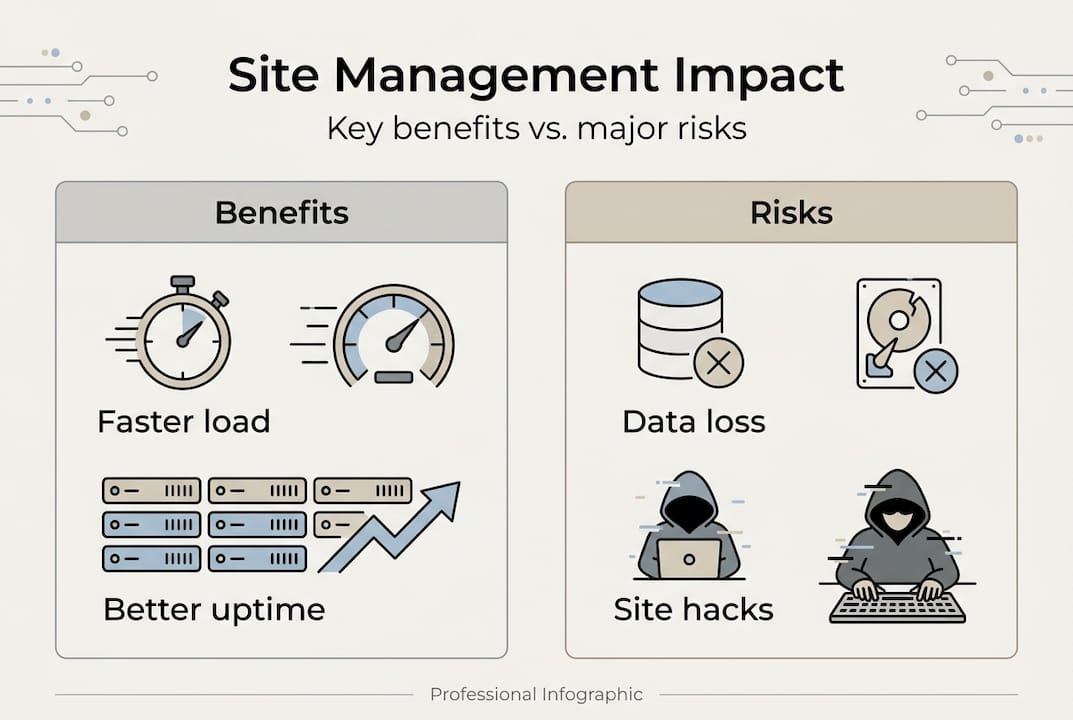
Real world outcomes demonstrate the value clearly. Ski Georgia achieved 150% faster page speed and doubled bookings after implementing managed support that optimized images, cleaned code, and implemented caching. A skincare brand saw organic sales increase 127% within six months through systematic SEO improvements and performance tuning. These results stem from consistent attention rather than one-time fixes.
The comparison between managed and unmanaged sites reveals stark differences:
| Metric | Unmanaged sites | Professionally managed sites | Impact on business |
|---|---|---|---|
| Average uptime | 94-97% | 99.9% | Managed sites lose 26 fewer hours annually |
| Page load speed | 4.2 seconds | 1.8 seconds | Managed sites retain 35% more visitors |
| Security incidents | 3.7 per year | 0.2 per year | Managed sites avoid $8,880 average breach costs |
| Conversion rate | 1.8% | 2.4% | Managed sites generate 33% more leads from same traffic |
These differences compound over time. A service business generating 10,000 monthly visitors converts 180 leads without management but 240 with professional support. At a 20% close rate and $5,000 average contract value, that’s an extra $60,000 in monthly revenue directly attributable to superior website performance.
“The true cost of neglect isn’t the monthly management fee you avoid but the compounding revenue loss from slow speeds, security breaches, and poor user experiences that drive qualified prospects to competitors with better digital infrastructure.”
Risks of DIY and cheap services multiply beyond obvious technical failures:
Professional management eliminates these risks through systematic prevention. You gain predictable costs, reliable performance, and confidence that experts handle technical complexity. This foundation supports aggressive growth because your website design impacts leads positively when technical infrastructure performs flawlessly. Poor management undermines even the best design through slow speeds and frequent failures.
The financial logic becomes simple. Pay $299 to $750 monthly for professional management or accept unpredictable emergency costs averaging $2,400 per incident plus ongoing revenue loss from poor performance. Most service businesses experience two to three emergencies annually without management, creating $4,800 to $7,200 in reactive costs plus immeasurable damage from lost leads and reputation harm.
The choice between managing your website internally or outsourcing to professionals depends on specific factors unique to each business. DIY can save $295 to $750 monthly for simple sites but risks downtime and reputation damage, while professionals recommend outsourcing for lead generation sites where performance directly impacts revenue. Understanding these criteria helps you make informed decisions aligned with business priorities.
DIY management becomes viable under specific conditions:
Even with these conditions met, DIY carries hidden costs. The time you spend managing technical infrastructure can’t be spent acquiring clients, delivering services, or developing strategy. For business owners billing $150 to $300 hourly, the four hours monthly spent on website maintenance represents $600 to $1,200 in opportunity cost, exceeding professional management fees before accounting for expertise gaps.
Professional management delivers superior results for lead generation sites because specialists bring depth impossible for generalists to match. Security experts understand threat landscapes and implement defenses that block attacks you’d never anticipate. Performance engineers optimize code and server configurations beyond basic caching. SEO specialists align technical infrastructure with ranking factors that drive organic visibility.
The hybrid approach offers a practical middle ground for many service businesses. You maintain control over content strategy, messaging, and business logic while outsourcing technical infrastructure to experts. This division of labor plays to respective strengths: you know your market and customers, professionals know WordPress architecture and digital optimization.
Implementing hybrid management effectively requires clear boundaries:
Pro Tip: Assign post-launch ownership explicitly in writing, documenting who handles security, updates, backups, and performance monitoring. Schedule quarterly audits where both parties review metrics, discuss improvements, and adjust priorities. This governance prevents site drift where everyone assumes someone else is monitoring critical systems until a failure reveals the gap.
The decision framework simplifies to risk tolerance and revenue impact. If your website generates qualified leads worth thousands of dollars each, professional management becomes insurance protecting your most valuable marketing asset. If your site serves primarily as a digital business card with minimal lead generation, DIY with good checklists may suffice.
Consider how different types of business websites require varying management intensity. E-commerce platforms handling transactions need robust security and uptime. Lead generation sites need speed optimization and conversion tracking. Simple informational sites need basic maintenance and security. Match your management approach to your site’s business function and revenue contribution.
The outsourcing threshold typically hits when technical issues start consuming more than two hours monthly or when a single outage costs more than three months of professional management fees. At that point, the math favors experts who prevent problems rather than owners who react to emergencies.
Service businesses need website management that understands their unique challenges: generating qualified leads, maintaining professional credibility, and maximizing ROI from digital investments without becoming technical experts. Custom fully managed WordPress websites solve these problems by combining design, hosting, security, and ongoing optimization into predictable monthly packages starting at $299.

The managed approach eliminates the fragmentation that plagues traditional web projects. Instead of coordinating between designers, developers, hosting providers, and security services, you work with a single team handling everything. Flat fee WordPress website design means no surprise invoices or scope creep, just clear pricing and defined deliverables.
This model works because it aligns incentives correctly. When your website generates leads and grows your business, the relationship continues. When technical problems arise, they get solved immediately because your success drives provider success. The MonsterWP process demonstrates how systematic management, unlimited updates, and proactive optimization create websites that work as growth engines rather than maintenance burdens.
Pro Tip: Evaluate managed service providers on three criteria: response time for urgent issues, breadth of included services, and alignment between their expertise and your business model. The best partnerships feel like extensions of your team rather than vendor relationships.
Reactive management addresses problems after they occur, fixing broken features or restoring hacked sites. Proactive management prevents issues through continuous monitoring, scheduled updates, and systematic optimization that keeps sites secure and fast.
Professional management ranges from $299 to $750 monthly depending on site complexity, traffic volume, and included services. Simple brochure sites cost less than e-commerce platforms or high-traffic lead generation sites requiring advanced optimization.
Managed sites load faster, maintain higher uptime, and implement technical SEO correctly, all factors Google rewards with better rankings. Higher rankings drive more organic traffic, and optimized user experiences convert more visitors into qualified leads.
Outsource when technical issues consume more than two hours monthly, when security concerns keep you awake at night, or when a single outage would cost more than three months of professional fees. Revenue-generating sites justify outsourcing earlier than simple informational sites.
Clear ownership prevents neglect where everyone assumes someone else monitors security and performance. Assigned responsibility with scheduled audits ensures consistent attention that prevents small issues from becoming expensive emergencies.
Most service businesses notice improved lead quality within 30 days as speed and user experience improve. Measurable increases in organic traffic and conversion rates typically appear within 90 days as technical SEO improvements compound and search engines recognize consistent performance.
Learn actionable local SEO steps to boost your small business visibility, attract qualified leads, and rank higher without hiring an agency.

Learn how strategic website updates drive marketing growth and qualified leads. Get a proven framework for prioritizing updates that maximize your ROI in 2026.