
Website content examples that boost business growth in 2026
Discover proven website content examples that drive qualified leads and business growth in 2026. Learn criteria, see real examples, and get a practical decision guide.


Many small business owners believe building an effective website requires expensive agencies or complex technical skills. This misconception keeps countless businesses from establishing the strong online presence they need to compete in 2026. Modern website platforms have transformed this landscape entirely. Today’s tools make creating professional, lead-generating websites accessible and affordable for businesses of any size. This guide explains why your business needs a website platform, how these solutions drive measurable growth, and what features matter most for converting visitors into customers without breaking your budget.
| Point | Details |
|---|---|
| Platform accessibility | Modern website platforms eliminate the need for expensive agencies through intuitive no-code tools and AI assistance. |
| Mobile optimization | Over 50% of web traffic comes from mobile devices, making responsive design essential for capturing leads. |
| SEO integration | Built-in SEO tools can increase organic traffic by up to 40%, driving more qualified visitors to your site. |
| Conversion focus | Optimized landing pages achieve average conversion rates of 5.9%, turning visitors into valuable leads. |
| Cost predictability | Flat fee models provide budget certainty while delivering professional results and ongoing support. |
The belief that website creation requires significant investment or technical expertise prevents many small businesses from building the digital presence they need. This outdated thinking stems from an era when custom development was the only option. However, user-friendly platforms and AI tools have made website creation accessible and affordable for businesses without technical teams.
Modern no-code platforms eliminate the complexity that once justified high agency fees. You can now build professional websites using drag-and-drop editors, pre-designed templates, and intelligent automation. These tools handle the technical heavy lifting while you focus on your business message and goals.
Consider these realities that challenge common myths:
Flat fee WordPress websites offer predictable monthly costs that replace unpredictable project quotes and surprise maintenance bills. This pricing model makes budgeting straightforward and eliminates the financial anxiety that keeps businesses from investing in their online presence.
The barrier to entry for professional websites has collapsed. What once required a $10,000 investment and months of development now takes days and costs less than your monthly coffee budget.
The technical skills gap has closed dramatically. Modern platforms anticipate user needs and guide you through every step. Updates happen automatically. Security patches apply without your involvement. Performance optimization runs in the background. You get enterprise-level capabilities without enterprise-level complexity or cost.
Website platforms deliver specific advantages that directly impact your bottom line. Understanding these benefits helps you evaluate options and maximize your investment in digital presence.
Mobile responsiveness stands as the most critical feature. Over 50% of all website traffic comes from mobile devices, and this percentage continues growing. If your site fails to display properly on smartphones and tablets, you lose more than half your potential leads before they read a single word. Modern platforms build mobile optimization into every template and design element automatically.

SEO capabilities transform how customers find your business. Platforms offering built-in SEO tools help SMBs improve search rankings with up to 40% increases in organic traffic. This means more qualified visitors discovering your services through Google searches instead of expensive advertising. The right platform handles technical SEO requirements like site speed, structured data, and XML sitemaps without requiring you to understand these concepts.
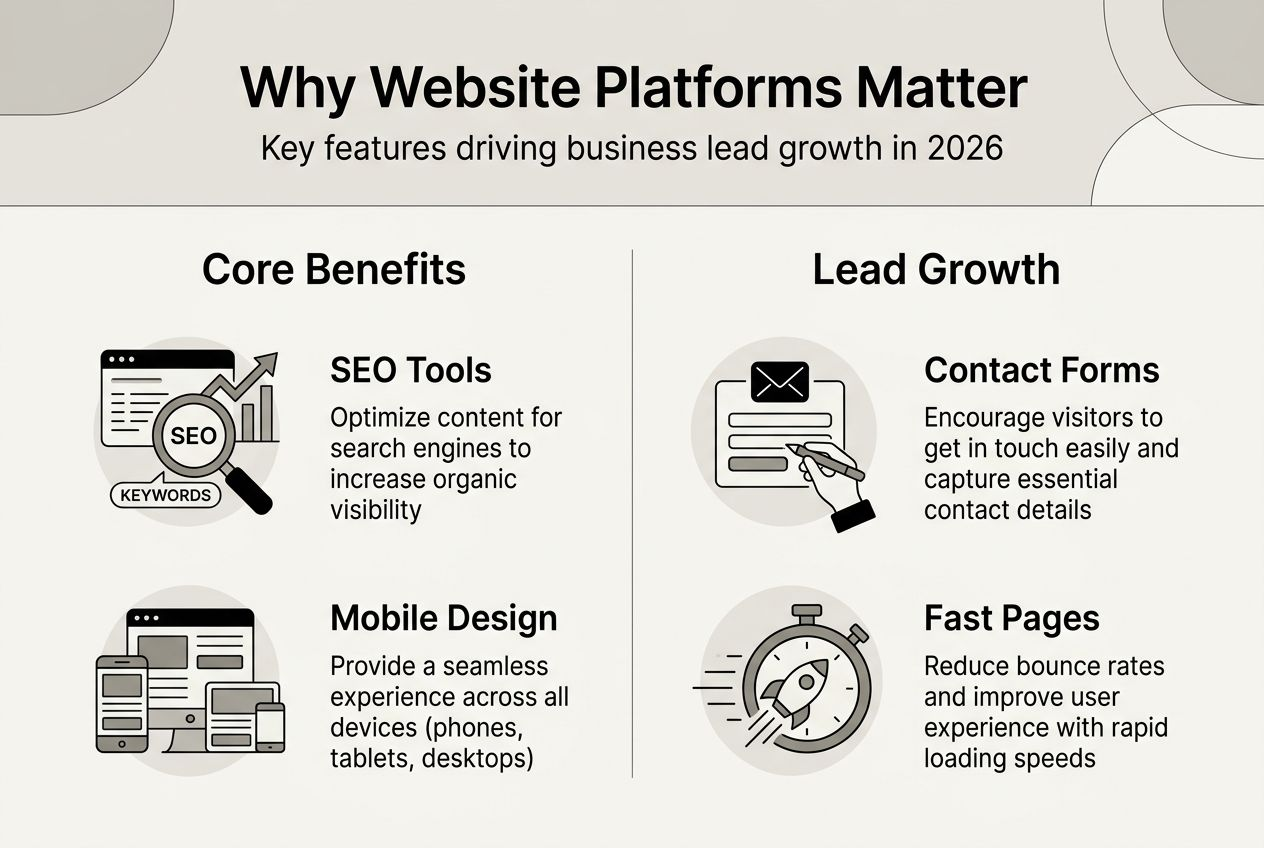
Lead conversion optimization directly impacts revenue. Strategic design guides visitors toward specific actions, whether that means filling out contact forms, scheduling consultations, or making purchases. Research shows landing pages achieve average conversion rates of 5.9% across industries. Platforms with conversion-focused templates and A/B testing capabilities help you reach or exceed these benchmarks.
Key platform advantages include:
Pro Tip: Track three metrics weekly to measure platform effectiveness: unique visitors, form submissions, and bounce rate. These numbers reveal whether your site attracts the right audience and converts them into leads.
Content freshness maintains search visibility and engagement. Platforms that simplify regular updates help you publish new information consistently. Search engines favor sites that demonstrate ongoing activity and relevance. A blog section or news area gives you space to address customer questions, showcase expertise, and target additional keywords that bring qualified traffic.
| Benefit | Impact | Business Value |
|---|---|---|
| Mobile optimization | Captures 50%+ of traffic | Doubles potential lead pool |
| SEO tools | 40% organic traffic increase | Reduces advertising dependency |
| Conversion design | 5.9% average conversion rate | Transforms visitors into customers |
| Easy management | Weekly content updates | Maintains search rankings |
The website optimization guide for 2026 provides deeper strategies for maximizing these platform benefits. Understanding why small businesses need managed websites clarifies the ongoing support that amplifies initial platform advantages.
Selecting the right platform requires evaluating specific features against your business goals. Not all platforms serve small business needs equally, and understanding key differences prevents costly mistakes.
SEO capabilities vary significantly across platforms. Look for built-in features like customizable meta descriptions, automatic sitemap generation, clean URL structures, and image optimization. Some platforms offer basic SEO while others provide comprehensive tools that rival dedicated SEO software. The difference impacts how easily potential customers find you through search engines.
Mobile design approaches differ in important ways. Some platforms use responsive design that automatically adjusts layouts for different screen sizes. Others require separate mobile versions or offer limited mobile customization. Choose platforms that prioritize mobile-first design, ensuring your site looks professional and functions perfectly on every device without additional work.
Cost structures affect long-term budgeting. Compare these common pricing models:
Ease of use determines whether you can manage your site independently or need ongoing technical support. Platforms with visual editors, drag-and-drop functionality, and clear documentation empower you to make changes confidently. Complex platforms with steep learning curves negate the cost savings of avoiding agencies.
| Platform Type | SEO Tools | Mobile Design | Typical Cost | Best For |
|---|---|---|---|---|
| DIY Builders | Basic | Automatic | $15-50/month | Simple sites, tight budgets |
| WordPress Platforms | Advanced | Customizable | $30-100/month | Content-rich sites, blogs |
| Managed Solutions | Comprehensive | Optimized | $299+/month | Businesses wanting full support |
| E-commerce Focused | Moderate | Built-in | $29-299/month | Online stores, product catalogs |
Pro Tip: Test platform editors before committing. Most offer free trials. Spend 30 minutes building a sample page to assess whether the interface matches your technical comfort level.
Lead generation features separate platforms that simply display information from those that actively convert visitors. Look for built-in contact forms, email capture tools, call-to-action buttons, and integration with marketing automation systems. Different types of business websites serve specific lead generation purposes, and your platform should support your particular approach.
Support and maintenance options range from self-service knowledge bases to dedicated account managers. Consider your technical confidence and available time. Platforms offering managed services handle updates, backups, security monitoring, and troubleshooting, letting you focus on running your business instead of maintaining your website.
Implementing a website platform effectively requires strategic thinking beyond simply choosing features. Follow these proven steps to maximize lead generation results.
Define specific visitor actions before building anything. Ask yourself what you want visitors to do and how to make that action easy. This clarity shapes every design decision. If you want phone calls, make your number prominent and clickable. If you prefer form submissions, position contact forms strategically on every relevant page. Clear goals prevent building attractive sites that fail to generate business.
Choose a no-code platform that matches your technical skill level and business needs. Evaluate platforms based on:
Prioritize mobile optimization throughout your build process. Test every page on actual smartphones and tablets, not just desktop preview modes. Verify that buttons are large enough to tap easily, text remains readable without zooming, and forms work smoothly on touch screens. Mobile users abandon sites that frustrate them within seconds.
Implement SEO best practices from day one. Write descriptive page titles and meta descriptions for every page. Use heading tags logically to structure content. Add alt text to images describing what they show. Create clean, readable URLs that include relevant keywords. Regularly update website content and ensure SEO-friendliness to maintain high search engine rankings.
Plan a content calendar for ongoing updates. Fresh content signals search engines that your site remains active and relevant. Blog posts addressing customer questions establish expertise while targeting long-tail keywords that bring qualified traffic. Aim for at least one substantial update monthly, whether that means new blog posts, updated service descriptions, or added case studies.
Pro Tip: Set up conversion tracking immediately. Google Analytics and platform-specific analytics show which pages generate leads and which need improvement. This data guides optimization efforts toward changes that actually impact results.
Monitor performance metrics weekly during your first three months, then monthly afterward. Track visitor numbers, traffic sources, popular pages, and conversion rates. Look for patterns revealing what works and what needs adjustment. A custom website design focused on boosting online leads applies these insights systematically to improve results over time.
Building an effective website platform doesn’t require choosing between quality and affordability. MonsterWP delivers custom WordPress websites designed specifically for small businesses seeking lead generation without agency price tags. Starting at $299 monthly, you get professionally designed sites built with Elementor Pro, optimized for speed and SEO from launch day.
Our flat fee WordPress packages eliminate budget uncertainty with predictable monthly costs covering design, hosting, security, and unlimited content updates. No surprise bills. No maintenance headaches. Just a high-performance website that works while you focus on serving customers. Beyond websites, our digital marketing services integrate SEO, social media management, and paid advertising to amplify your lead generation across multiple channels. We build complete digital growth systems that protect revenue and increase visibility.
Mobile devices generate over half of all web traffic, meaning most potential customers view your site on smartphones or tablets. Sites that display poorly on mobile lose these visitors immediately, cutting your lead potential in half. Modern platforms build mobile responsiveness automatically, ensuring your site looks professional and functions perfectly regardless of device.
Website platforms cost dramatically less than traditional agencies while delivering comparable results. DIY platforms start around $15 monthly, managed solutions run $299 to $500 monthly, while agencies typically charge $5,000 to $15,000 upfront plus ongoing maintenance fees. Platforms provide better value for small businesses focused on lead generation rather than complex custom development.
Built-in SEO tools handle technical requirements like site speed optimization, XML sitemaps, structured data, and mobile-friendliness that search engines prioritize. They guide you in writing effective meta descriptions, using proper heading structures, and creating keyword-rich content. These features help your site rank higher in search results, bringing more organic traffic without paid advertising.
Focus on mobile responsiveness, integrated contact forms, clear call-to-action buttons, fast page loading speeds, and analytics showing visitor behavior. These features directly impact whether visitors become leads. Secondary priorities include blog capabilities for content marketing, email marketing integrations, and A/B testing tools for optimizing conversion rates over time.
Modern platforms specifically design interfaces for non-technical users. Visual editors let you modify text, swap images, and adjust layouts by clicking and typing, similar to using word processors. Most platforms offer video tutorials and support documentation walking you through common tasks. Managed platforms provide direct assistance when you need help, eliminating technical barriers entirely.
Discover proven website content examples that drive qualified leads and business growth in 2026. Learn criteria, see real examples, and get a practical decision guide.

Discover the 7 critical website essentials every small business needs in 2026 to drive leads, optimize performance, and maximize ROI without technical headaches.