
The Role of Google Search Ranking for Business Growth
Discover the crucial role of Google search ranking in driving business growth. Learn how to optimize your online presence and boost visibility!


Seventy-five percent of users judge a company’s credibility based on website design alone. For service businesses competing online, this instant judgment can make or break lead generation efforts. Website design encompasses far more than aesthetics; it includes layout, navigation, content structure, calls to action, and visual hierarchy that together shape how visitors perceive your business and whether they convert into leads.
| Point | Details |
|---|---|
| Design drives trust and behavior | Professional website design establishes credibility, guides user actions, and directly influences lead conversion rates. |
| Speed and mobile are critical | Poorly designed navigation increases bounce rates by 50%, while slow load times push visitors away before they engage. |
| Simplicity beats complexity | Clear calls to action and streamlined content outperform flashy, cluttered designs for converting visitors into qualified leads. |
| Data proves design impact | Structured content boosts clicks by 20 to 30%, while regular updates increase returning leads by 25%. |
| Ongoing optimization matters | Continuous monitoring of metrics and iterative improvements keep lead generation efforts performing at peak levels. |
Website design shapes every aspect of how potential customers experience your business online. At its core, effective design combines several foundational elements that work together to guide visitors toward becoming leads. Understanding these components helps service businesses address common challenges and capitalize on opportunities to generate more qualified prospects.
Key website design elements include:
Small to mid-sized service businesses face distinct lead generation challenges. Limited budgets often mean choosing between DIY solutions that lack polish or expensive agencies that overpromise. Without clear metrics, owners struggle to know whether their website actually generates leads or just sits idle. Competition from larger firms with bigger marketing budgets makes standing out harder.
First impressions online happen in seconds. Visitors form opinions about your credibility, professionalism, and trustworthiness almost instantly. A confusing layout or outdated appearance signals unreliability, even if your services are exceptional. Conversely, clean design with clear messaging builds confidence and encourages visitors to take the next step.
For context on how different types of business websites for lead generation serve specific goals, understanding your website’s core purpose helps align design decisions with business outcomes. Your website functions as a crucial component within your broader website role digital marketing strategy, connecting all channels and converting interest into action. Proper website management boost leads 50 wordpress 2026 demonstrates how ongoing attention to design and performance compounds lead generation results over time.
The first 15 seconds a visitor spends on your website determine whether they stay or leave. During this critical window, design elements either build confidence or create doubt. Clean visual hierarchy guides eyes naturally from headline to key benefits to conversion opportunities. Clear calls to action positioned prominently give visitors an obvious next step without hunting.
Navigation complexity directly correlates with lost leads. When visitors cannot quickly find service details, pricing information, or contact options, they abandon the site. Poorly designed navigation leads to a 50% higher bounce rate, drastically reducing lead opportunities from site visitors. Every extra click required to reach important information increases the chance someone gives up and checks out a competitor instead.

Page speed represents another major factor influencing visitor retention. Slow loading times frustrate users and signal technical problems, eroding trust before anyone even reads your content. Mobile optimization matters equally, as most visitors now access websites from phones and tablets. Sites that load slowly on mobile or display awkwardly on smaller screens lose leads immediately.
Specific design elements guide users toward conversion points:
Pro Tip: Test your website navigation and load times monthly using free tools like Google PageSpeed Insights and by asking friends unfamiliar with your business to find specific information. Fresh eyes reveal obstacles you have become blind to through familiarity.
For practical guidance on improving these elements, the website optimization guide 2026 boost conversions provides actionable steps to address speed, mobile responsiveness, and conversion bottlenecks systematically.
Many service business owners believe flashy, complex designs automatically attract more leads. The opposite often proves true. Animated backgrounds, auto-playing videos, and excessive visual effects distract visitors from your core message and slow down page performance. Simplicity wins because it reduces cognitive load and keeps focus on what matters.
Another persistent myth suggests that more content always improves conversion rates. Walls of text overwhelm visitors and bury important calls to action. Effective design prioritizes quality over quantity, presenting essential information clearly while making it easy to dive deeper for those who want details. Concise, scannable content with clear headings converts better than lengthy paragraphs.
Mobile optimization remains surprisingly overlooked despite dominating web traffic. Some business owners assume a desktop-focused design will work adequately on phones. This false assumption costs leads daily. Mobile users expect fast loading, easy navigation with thumbs, and readable text without zooming. Sites failing these basics lose visitors immediately to competitors who invested in responsive design.
The misconception that personal preference should guide design decisions leads many astray. What the business owner likes aesthetically may not match what converts visitors into leads. User-centric design focuses on what target customers need, expect, and respond to based on research and testing rather than subjective taste.
Key false beliefs to avoid:
Pro Tip: Base design decisions on user behavior data and conversion testing rather than personal aesthetics or the latest trends. What works for your specific audience matters more than what looks impressive.
Business owners attempting DIY website solutions often encounter these misconceptions firsthand. The challenges and hidden costs outlined in avoid diy website headaches demonstrate why professional, user-focused design typically outperforms well-intentioned amateur efforts.
Data confirms that professional website design significantly improves trust and credibility metrics. Studies show visitors form credibility judgments within milliseconds, and businesses with modern, clean designs see trust scores 40% higher than those with outdated appearances. This trust translates directly into higher inquiry rates and more qualified leads entering sales funnels.
Conversion rate improvements from design interventions prove substantial. Service businesses that addressed speed issues and added clear trust signals measured conversion rate increases between 15% and 35% within the first quarter after implementation. Structured content and schema markup increase click-through rates by 20 to 30%, improving lead acquisition potential by making search listings more compelling and informative.
Real-world case studies demonstrate measurable lead growth following targeted redesigns. One mid-sized consulting firm redesigned their website focusing on user experience, mobile optimization, and clearer service descriptions. Within six months, they documented a 47% increase in contact form submissions and a 28% reduction in bounce rate. Another local service provider simplified their navigation and improved page speed, resulting in 53% more phone inquiries and doubling their monthly qualified leads.
| Metric | Before Design Intervention | After Design Intervention | Improvement |
|---|---|---|---|
| Bounce Rate | 68% | 42% | 38% reduction |
| Average Session Duration | 1:23 | 2:47 | 101% increase |
| Lead Form Submissions | 12 per month | 28 per month | 133% increase |
| Mobile Conversion Rate | 1.2% | 3.8% | 217% increase |
| Page Load Time | 5.4 seconds | 1.8 seconds | 67% faster |
These numbers illustrate how specific design improvements create compound effects. Faster loading reduces bounce rates, which increases time on site, which exposes visitors to more conversion opportunities, which generates more leads. Each improvement reinforces others.
Businesses investing in strategic redesigns see returns within months rather than years. The key involves focusing improvements on elements with proven impact rather than cosmetic changes. Understanding why website redesign drives business growth 2026 helps prioritize investments that deliver measurable lead generation improvements rather than just aesthetic updates.
Effective website design for lead generation balances three critical components in what we call the Lead Generation Triad. This framework combines user experience design, technical performance, and trust elements into a cohesive system. Each leg supports the others, and weakness in any area undermines overall lead generation effectiveness.
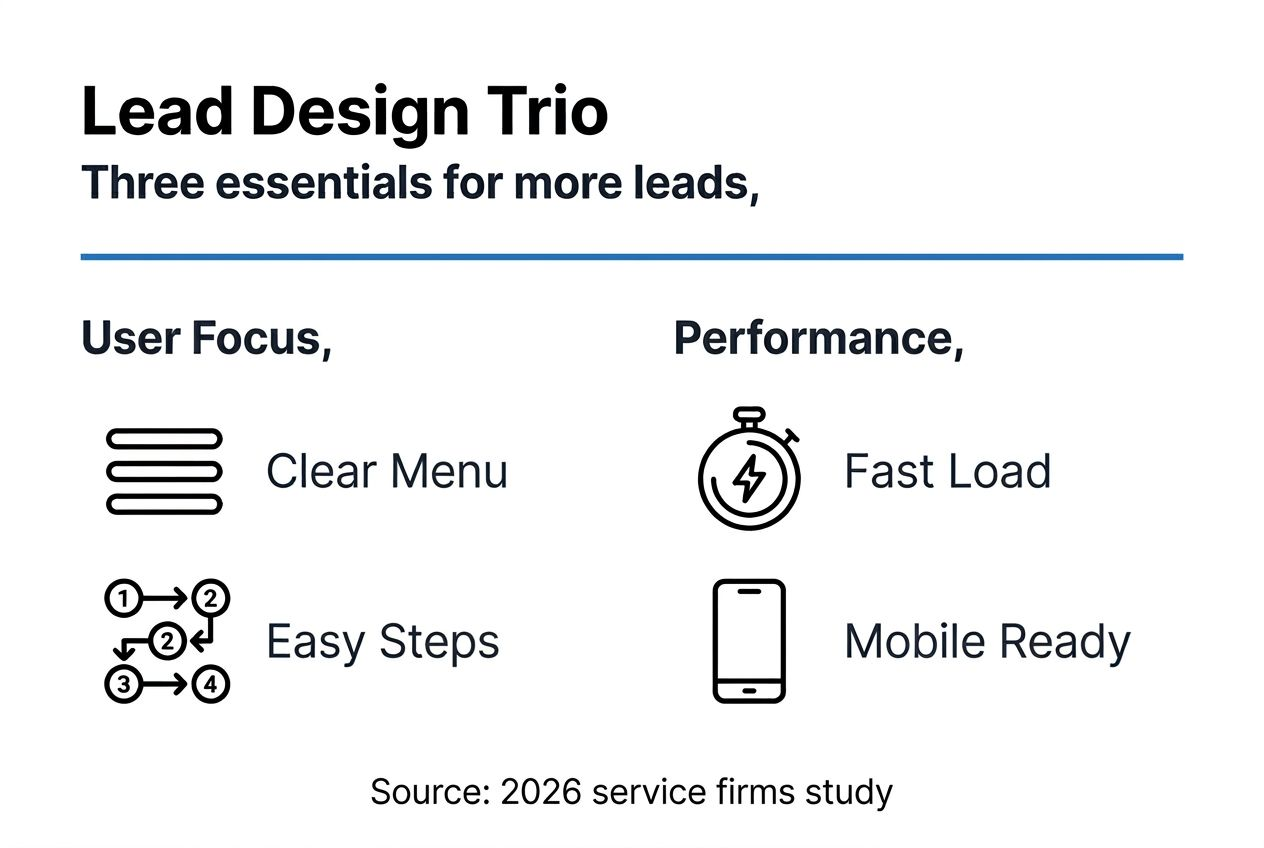
User experience design focuses on how visitors interact with your website. Clear navigation, logical information architecture, and intuitive interfaces reduce friction. Technical performance encompasses page speed, mobile responsiveness, and SEO optimization that makes your site discoverable and fast. Trust elements include social proof, credentials, security signals, and professional presentation that build confidence.
Websites that use structured content and schema markup see 20 to 30% higher click-through rates from search results, improving lead acquisition potential by making listings more informative and compelling before visitors even arrive.
| Aspect | Custom Design | Template Design |
|---|---|---|
| Lead Conversion Optimization | Tailored specifically to business goals and audience | Generic conversion paths may not match business model |
| Brand Differentiation | Unique appearance that stands out from competitors | Risk of looking similar to other businesses using same template |
| Technical Performance | Optimized code and minimal bloat for fast loading | Often includes unused features that slow performance |
| Flexibility for Growth | Easily adapted as business needs evolve | Limited by template structure and available customization |
| Initial Investment | Higher upfront cost but better long-term ROI | Lower initial cost but potential redesign needed sooner |
Key evaluation criteria to assess your current website:
Prioritize fixes based on common failure points. Start with speed and mobile issues since these affect every visitor. Next, address navigation confusion and unclear calls to action. Finally, enhance trust signals and content quality. This sequence maximizes impact per hour invested.
Schema markup and structured content deserve special attention. They help search engines understand your offerings better, leading to enhanced search listings that attract more qualified clicks. This technical enhancement works invisibly but powerfully to improve lead quality.
For comprehensive optimization strategies, consult the website optimization guide 2026 boost conversions and explore emerging website design trends 2026 for founders to stay ahead of shifting user expectations. Advanced businesses may also leverage ai capabilities to personalize experiences and predict visitor needs.
Taking action to improve your website design for lead generation follows a logical sequence. Start with foundational issues that affect all visitors, then refine specific conversion elements. These steps prioritize quick wins while building toward comprehensive optimization.
Audit current website speed using Google PageSpeed Insights and aim for scores above 85 on both mobile and desktop. Compress images, enable caching, and minimize code to reduce load times below 3 seconds.
Test mobile responsiveness on actual devices, not just browser tools. Verify that buttons are easily tappable, text remains readable without zooming, and forms work smoothly on phones and tablets.
Simplify navigation to three primary menu items plus a clear contact option. Remove nested menus and ensure visitors can reach any page within three clicks maximum.
Implement prominent calls to action on every page, positioned above the fold and repeated contextually throughout content. Use contrasting colors and action-oriented language like “Schedule Your Free Consultation” rather than generic “Submit.”
Add trust signals near conversion points, including client testimonials, industry credentials, case study results, or security badges. Position these where visitors naturally experience doubt.
Update content monthly with fresh information, new case studies, or insights addressing current client questions. Businesses that maintain continuous website content updates experience a 25% increase in returning visitor leads, supporting ongoing lead funnel growth.
Monitor key metrics weekly including bounce rate, conversion rate, and lead source attribution. Use this data to identify underperforming pages and test improvements systematically.
Set up conversion tracking for all lead generation forms, phone calls, and important page visits. Understanding which sources and pages generate leads helps allocate resources effectively.
Consistent attention to these elements compounds results over time. Small improvements stack, creating significant advantages over competitors who launch websites and never refine them. The businesses generating the most leads treat their websites as living assets requiring regular care rather than static brochures.
For sustained results, consider how website management boost leads 50 wordpress 2026 through systematic attention to performance, content freshness, and conversion optimization rather than one-time fixes.
Website design profoundly impacts lead generation through multiple interconnected mechanisms. Speed, mobile optimization, clear navigation, compelling calls to action, and trust signals work together to convert visitors into qualified prospects. The data proves that businesses investing in user-focused design see measurable improvements in conversion rates and lead quality.
Continuous measurement and optimization separate high-performing websites from stagnant ones. Markets evolve, user expectations shift, and competitors improve. Regular testing, content updates, and performance monitoring keep your lead generation engine running efficiently.
Professional services accelerate results for businesses lacking time or expertise to manage these improvements internally. Platforms like MonsterWP provide fully managed solutions that handle design, optimization, and ongoing refinement so founders can focus on serving clients rather than troubleshooting websites.
Transforming website design insights into lead generation results requires expertise, time, and ongoing attention. MonsterWP specializes in building high-performance WordPress websites optimized specifically for service business lead generation. Every site launches fast, mobile-ready, and conversion-focused from day one.
Our custom website solutions start at $299 monthly with unlimited content updates and rapid revisions included. For businesses seeking comprehensive growth, our managed WordPress website with SEO & PPC packages integrate website management with search optimization and paid advertising to maximize visibility and leads. Learn how MonsterWP works and discover how a properly designed and managed website becomes your most effective lead generation tool.
Website design shapes first impressions, establishes trust, and determines how easily visitors can take action. Poor design creates friction that drives potential leads away, while professional design removes obstacles and guides visitors naturally toward conversion. Within seconds, your design communicates credibility and professionalism that either build confidence or create doubt.
Mobile optimization ensures seamless experiences across all devices, which reduces bounce rates and increases conversions significantly. Most service business website visitors now access sites from mobile devices, making responsive design essential rather than optional. Sites that fail mobile users lose the majority of potential leads before anyone reads the content.
Complex navigation confuses visitors and increases bounce rates dramatically. Slow page loading times frustrate users and signal technical problems. Missing or unclear calls to action leave visitors uncertain about next steps. Cluttered layouts and walls of text overwhelm rather than inform, pushing potential leads toward simpler competitor websites.
Monitor bounce rate, time on site, and conversion rate for lead forms and contact requests. Use analytics tools to track how design changes affect visitor behavior and lead submission patterns. Regular A/B testing of different design elements reveals which variations generate more qualified leads and higher conversion rates over time.
Discover the crucial role of Google search ranking in driving business growth. Learn how to optimize your online presence and boost visibility!

Discover what is Elementor Pro and how it elevates your website design with advanced features, powerful tools, and seamless customization!