
What Is Elementor Pro? Features, Benefits, and Worth It?
Discover what is Elementor Pro and how it elevates your website design with advanced features, powerful tools, and seamless customization!

TL;DR:
- Google search ranking determines a webpage’s visibility and traffic by passing through multiple filtering and evaluation stages.
- Business success relies on ongoing SEO efforts that address technical, authority, user experience, and regional signals, all interconnected.
- AI-driven search amplifies the importance of traditional ranking, making integrated local and organic SEO strategies essential for sustained visibility.
Google search ranking is the system that determines which web pages appear, and in what order, when a user submits a query. For business owners and marketers, that order is not a technicality. It is the difference between being found by qualified buyers and being invisible to them entirely. The role of Google search ranking in 2026 extends far beyond a position number. It governs your traffic, your brand authority, your lead pipeline, and increasingly, whether AI-powered search surfaces your business at all. Understanding how this system works is the first step toward competing seriously in organic search.
Google’s ranking process is a multi-stage pipeline, not a single algorithm. Content must pass through crawling, indexing, retrieval eligibility, and ranking evaluation before it ever appears in results. Each stage is a gate. Fail one, and the subsequent stages never apply to your content.

The retrieval gate is where most businesses unknowingly lose the game. Retrieval eligibility filters pages based on technical and semantic criteria before ranking signals are even evaluated. A page with broken crawl paths, thin content, or poor site architecture never competes for position one, regardless of how many backlinks it has. This is the hidden work that most DIY SEO efforts miss entirely.
Once a page clears retrieval, Google evaluates it against hundreds of ranking signals, including backlinks, technical SEO health, user engagement metrics, and brand authority. No single signal dominates. The weight of each signal shifts depending on query type, user intent, and competitive context. A local service query weights proximity and Google Business Profile data heavily. An informational query weights topical depth and structured content.
Ranking positions vary by context, shifting based on user location, device type, and personalized query data. A business ranking third in Chicago may rank ninth in Dallas for the same keyword. Single-browser rank tracking gives a misleading picture of true search presence across your actual market.
Pro Tip: Track rankings using a tool like Google Search Console segmented by location and device, not a single desktop check. The variance will surprise you.
The traffic math behind search rankings is stark. The top organic result captures 27.6% of all clicks for a given query. Moving from position four to position two nearly doubles your click share. The difference between ranking first and ranking tenth is roughly a 10x gap in click-through rate. For a business generating leads through organic search, that gap translates directly into revenue.
“Moving from position 3 to 2 increases clicks by 44%.” This single data point reframes how businesses should think about ranking improvements. A one-position gain is not a vanity metric. It is a measurable revenue event.
The picture gets more complex when you factor in zero-click behavior. Nearly 49% of Google searches end without a click to any website. Users get their answer from a featured snippet, a Knowledge Panel, or an AI Overview directly on the results page. This does not make ranking irrelevant. It makes it more important. Businesses that rank in the top positions are the ones whose brand names appear in those zero-click answers, building recognition and trust even when no click occurs.
Revenue impact compounds at scale. A 1% increase in organic visibility can produce six to seven figures in incremental revenue for enterprise brands. For smaller businesses, the proportional impact is just as significant. A local law firm moving from page two to the top three results for a high-intent keyword can double its inbound inquiry volume without spending an additional dollar on paid advertising. That is the real impact on lead generation that ranking improvements deliver.
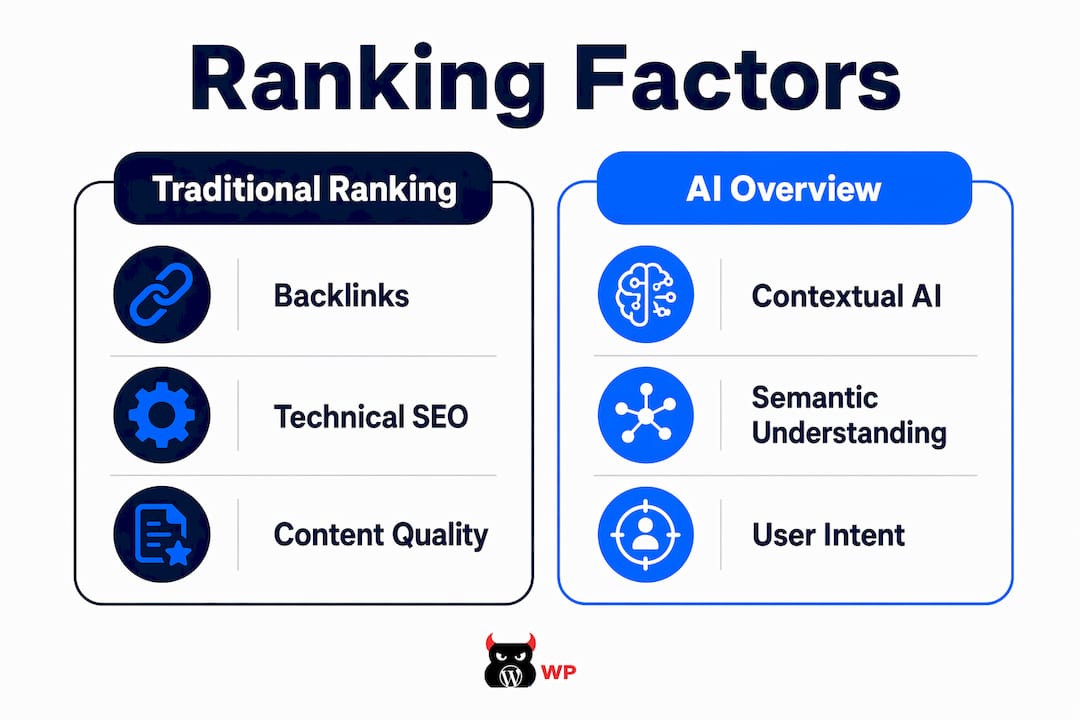
AI search has not replaced traditional ranking. It has built on top of it. Google’s Jeff Dean confirmed that AI search relies on classic ranking and retrieval infrastructure. AI Overviews retrieve, re-rank, and synthesize from a candidate set of documents that were already ranked through classic indexing. If your page does not rank well organically, it will not appear in AI-generated answers either. AI visibility is a downstream reward for clearing traditional ranking gates first.
The table below contrasts how traditional organic ranking and AI-driven visibility differ in their requirements and outputs.
| Factor | Traditional organic ranking | AI Overview visibility |
|---|---|---|
| Primary signal | Backlinks, technical SEO, content depth | Retrieval eligibility, passage-level authority |
| Content format | Full-page relevance | Structured, quotable passages |
| Click behavior | Direct page visits | Often zero-click, brand impression |
| Local signals | Moderate weight | Integrated with Google Business Profile |
| Speed to visibility | Weeks to months | Dependent on organic ranking first |
Local SEO has undergone its own transformation. The divide between local search and organic search is collapsing. Google Business Profile optimization now directly influences both Maps rankings and organic search results. Businesses with active profiles, consistent contact information, recent reviews, and regular posts rank higher across both surfaces. A business that treats its website SEO and its Google Business Profile as separate projects is leaving ranking equity on the table.
Pro Tip: Treat your Google Business Profile as a second website. Update it with the same frequency and strategic intent you apply to your main site content.
For a deeper look at how local signals and organic ranking intersect, the local SEO visibility guide from Monsterwp covers the integrated approach in detail.
Improving your search position is not a checklist exercise. It is a multi-dimensional system where neglecting one layer undermines the others. Here is how the major levers interact in practice.
Technical accessibility and retrieval eligibility. Your site must be crawlable, indexable, and technically sound before any other optimization matters. Misconfigured robots.txt files, slow server response times, and broken internal link structures disqualify pages from ranking competition entirely.
Authority through backlinks and topical depth. Google’s algorithm still weights backlinks and topical authority heavily. A site that covers a subject comprehensively and earns links from credible sources signals expertise and trustworthiness to Google’s systems.
Core Web Vitals and user experience. Sites loading under 2.5 seconds hold a measurable ranking advantage. Core Web Vitals, which measure loading speed, interactivity, and visual stability, are direct ranking inputs. A slow site is not just a bad user experience. It is a ranking penalty.
Content aligned with search intent. Semantic matching and structured content determine whether your page answers the specific question behind a query. Ranking for a keyword you do not actually address in depth is not a sustainable strategy. Google’s systems are sophisticated enough to distinguish between topical coverage and keyword stuffing.
Reputation and engagement signals. Reviews, click-through rates, dwell time, and brand search volume all feed into Google’s understanding of whether users find your business credible and relevant.
Ongoing measurement and adaptation. Rankings vary by context and shift constantly as Google updates its systems and competitors optimize their content. Treating SEO as a one-time project is how businesses fall off page one and stay off.
Pro Tip: The businesses that sustain top rankings are not the ones who did SEO once. They are the ones who treat it as an ongoing operational function, not a campaign.
For a current view of how these factors play out in 2026 specifically, Monsterwp’s SEO strategies for 2026 breaks down the updated competitive picture.
Google search ranking determines business visibility, traffic volume, and lead generation capacity across both traditional and AI-powered search surfaces.
| Point | Details |
|---|---|
| Ranking is a multi-stage pipeline | Content must clear crawling, indexing, and retrieval before ranking signals apply. |
| Top positions capture disproportionate traffic | Position one earns 27.6% of clicks; moving from four to two nearly doubles click share. |
| AI visibility depends on organic ranking | Google’s AI Overviews pull from already-ranked pages, making core SEO non-negotiable. |
| Local and organic SEO are now integrated | Google Business Profile signals influence both Maps and organic rankings simultaneously. |
| Ranking requires ongoing adaptation | Google’s systems shift constantly; sustained visibility demands continuous measurement and adjustment. |
Here is what I have seen consistently: business owners treat Google ranking like a finish line. They invest in an SEO audit, fix the obvious issues, publish a few blog posts, and then wait for results to compound. When rankings plateau or drop after a Google core update, they are genuinely surprised. They should not be.
The ranking system is not a formula you solve once. Treating Google’s algorithm as a single formula is a mistake that costs real money. Different query types trigger different ranking systems. A local intent query and an informational query are evaluated by different signal sets, even when the keywords look similar. Most businesses optimize for one and ignore the other.
The retrieval eligibility problem is even more damaging. I have seen companies spend thousands on content and link building while their site had technical issues that prevented key pages from ever entering Google’s candidate pool. Every dollar spent on ranking a page that cannot be retrieved is wasted. The pipeline must be clean before the optimization work pays off.
The integration of local SEO, AI-driven search, and traditional organic ranking is not optional anymore. Businesses running siloed strategies, where one team handles the website and another handles the Google Business Profile, are creating gaps that competitors exploit. The AI-driven SEO strategies that work in 2026 treat all three surfaces as one connected system.
The businesses winning in search right now are not the ones with the biggest budgets. They are the ones with the most operationally sound digital infrastructure. That means clean technical foundations, consistent content authority, and active local presence, all maintained without gaps.
— Vector
The layers behind Google search ranking are exactly why Monsterwp exists. Technical retrieval eligibility, Core Web Vitals performance, structured content, local SEO integration, and AI search readiness are not tasks you configure once and forget. They require ongoing management, expertise, and adaptation as Google’s systems evolve.
Monsterwp builds and manages high-performance WordPress websites that are optimized for speed, security, and SEO from day one. Every site we deliver is built for retrieval eligibility, not just aesthetics. We handle the technical infrastructure, the content structure, and the local and AI search alignment that keeps your business visible and competitive. No bloated retainers. No guesswork. Just a digital engine that generates qualified leads while you run your business.
Google search ranking is the process by which Google orders web pages in response to a user’s query, based on relevance, authority, and user experience signals. The higher your page ranks, the more likely users are to find and visit your site.
The top organic result captures approximately 27.6% of all clicks for a query, while pages beyond position three receive dramatically less traffic. A single position improvement can produce a measurable increase in qualified visitors.
If a page fails Google’s retrieval gate due to technical or semantic issues, it never enters the ranking evaluation process at all. Retrieval eligibility is the prerequisite that most SEO strategies overlook.
No. Google’s AI Overviews are built on top of classic ranking and retrieval systems. Pages that rank well organically are the source material for AI-generated answers, making strong organic ranking more important than ever.
Google Business Profile optimization directly influences both Maps and organic search rankings. Active profiles with consistent information, reviews, and regular posts rank higher across both surfaces, making local and organic SEO inseparable strategies.
Discover what is Elementor Pro and how it elevates your website design with advanced features, powerful tools, and seamless customization!

Discover the crucial role of your website in revenue protection. Learn to secure your digital assets and prevent revenue loss today!