
2026 Digital Marketing Trends Guide for Growth
Unlock the future with our 2026 digital marketing trends guide. Discover AI personalization, GEO, and more strategies for lasting growth!


TL;DR:
- Effective online branding builds trust, enhances recognition, and directly increases revenue for businesses. It involves consistent visual identity, messaging, and a owned website that serve as a sustainable foundation. Small businesses can leverage strong branding to compete on reputation, reduce customer acquisition costs, and grow organically over time.
Online branding is the strategic process of shaping how your business is perceived across every digital channel to build trust, stand out from competitors, and drive measurable growth. Most business owners treat it as a logo and a color palette. That misunderstanding costs them customers every day. The reality is that digital branding encompasses your website, social media presence, content strategy, user experience, and the consistency of every touchpoint a prospect encounters before they ever contact you. According to Made Good Designs, every online interaction influences brand perception, positively or negatively. The gap between businesses that understand this and those that don’t is widening fast.
Strong online branding is not a soft marketing concept. It is a direct driver of revenue. B2B companies with strong brands outperform weaker competitors by 20% and achieve up to 30% gains in marketing efficiency. That means your paid ads, email campaigns, and content all perform better when your brand is recognized and trusted before the click.
The pricing power effect is just as significant. Customers consistently pay more for brands they recognize and trust. Strong brands command a 13% price premium over competitors offering comparable products or services. That premium is not driven by features. It is driven by perceived value, and perceived value is entirely a branding outcome.
Customer acquisition cost is where the numbers get uncomfortable for unbranded businesses. Unknown brands face higher acquisition costs because every interaction requires trust-building from scratch. A recognized brand shortens the sales cycle because the prospect already has a mental model of who you are and what you stand for. Less friction means faster conversions and lower cost per lead.
Brand clarity also reduces cognitive load for customers. When your positioning is sharp and your messaging is consistent, customers pay more for perceived value shaped by brand identity rather than just comparing feature lists. This is why two businesses offering nearly identical services can have dramatically different close rates.
Pro Tip: If you run paid advertising on Google or Meta, a consistent brand identity across your landing pages, ad creative, and social profiles directly lowers your cost per click. Platforms reward relevance and recognition. A fragmented brand pays more for the same eyeballs.
Digital brand management is the ongoing practice of maintaining consistency, protecting equity, and governing how your brand appears across every platform you operate on. It is not a one-time setup. It is an operational discipline.
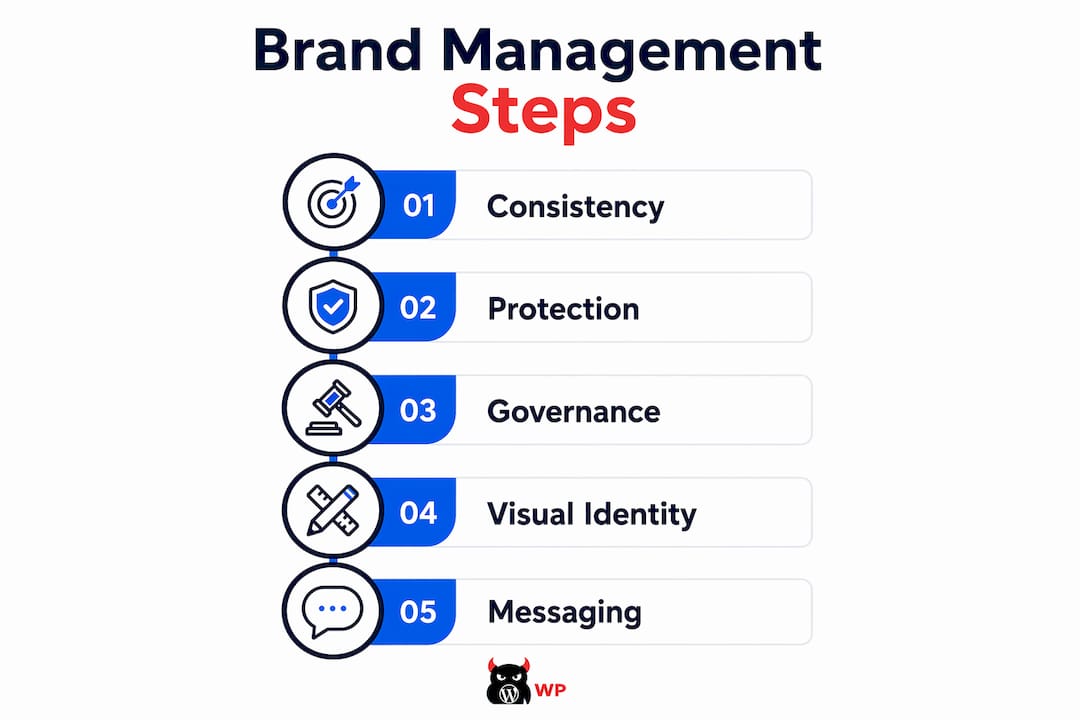
Visual identity is the most visible layer. Your color palette, typography, logo usage, and imagery style must be consistent across your website, social media profiles, digital ads, and email templates. Consistent visual identity elements build cumulative brand recognition in digital ads and platforms, directly impacting recall and preference. When a prospect sees your ad on LinkedIn and then lands on your website, the visual continuity signals professionalism and builds confidence before they read a single word.

Messaging cohesion is equally critical and far more commonly broken. Your tone of voice, value proposition, and core messaging must align whether someone reads your homepage, your Instagram bio, or a Google review response. Inconsistency creates doubt. Inconsistent branding across platforms erodes trust and fragments the cumulative recognition effect that makes branding compound over time.
Your website is the single most important asset in your digital brand stack. Social platforms limit your control over design, audience relationships, and data. Owning a website is critical because it is the definitive expression of your brand’s digital identity, one that no algorithm change or platform policy can take away from you. Businesses that rely primarily on Instagram or LinkedIn for their brand presence are building on rented land.
Governance is the layer most entrepreneurs skip entirely. Effective governance empowers marketing, sales, HR, and partners to present a unified brand voice, preventing dilution and inconsistent messaging as your team grows. Without it, every new hire or contractor becomes a potential source of brand fragmentation.
| Platform | Pros | Cons |
|---|---|---|
| Owned website | Full design control, data ownership, SEO authority | Requires technical management and ongoing maintenance |
| Social media platforms | Built-in audience, discovery tools, engagement features | Algorithm dependency, limited design control, no data ownership |
Pro Tip: Audit your brand across every digital touchpoint once per quarter. Search your business name on Google, check your social profiles, and review your website. Treat inconsistencies as revenue leaks, because they are.
Small and growing businesses have a specific advantage that most founders fail to exploit. Smaller businesses gain faster, stronger advantages from consistent online branding compared to larger competitors. Large companies move slowly. Their brand governance is bureaucratic. A focused founder can build a sharper, more memorable brand identity in months, not years.
The competitive reality for most small businesses is that they cannot outspend larger rivals on advertising. Branding is the mechanism that lets you compete on reputation rather than budget. When your digital presence communicates clarity, credibility, and consistency, prospects trust you before they compare prices. That trust is the competitive advantage in crowded digital markets that no ad spend can manufacture overnight.
Here is what disciplined online branding does for a growing business specifically:
For startups and entrepreneurs, the window to establish brand positioning is narrow. Early-stage brand decisions, your name, visual identity, messaging framework, and website experience, compound over time. Getting them right early is dramatically cheaper than rebranding after you have built an audience on a confused foundation. Read more about website design in branding to understand how these decisions play out in practice.
Branding and digital marketing are not the same thing. Digital marketing is the set of tactics you use to reach and convert customers. Branding is the foundation those tactics are built on. When the foundation is weak, every tactic underperforms.
The most direct integration point is SEO. Strong online branding increases branded search volume, backlinks, and engagement, all of which are authority signals that search engines use to determine rankings. A business with a recognized brand earns more unsolicited backlinks, more direct traffic, and more branded queries, all of which compound its organic visibility over time. This is why two websites with similar content can have dramatically different search rankings.
Content strategy is the second integration point. When your brand has a clear point of view and a consistent voice, your content builds authority faster. Readers recognize your perspective, return for more, and share it within their networks. Generic content from an unbranded source disappears. Content from a recognized brand accumulates trust.
Here is a practical framework for integrating branding into your marketing efforts:
The website hub point deserves emphasis. Every paid click, every social post, and every piece of content should ultimately drive traffic to a platform you own and control. Your digital visibility strategy depends on having a high-performance website that converts the traffic your branding generates. Without that, you are filling a leaking bucket.
Online branding is a direct revenue driver: businesses with strong digital brand presence outperform competitors by 20%, command 13% price premiums, and reduce customer acquisition costs through trust and recognition.
| Point | Details |
|---|---|
| Branding drives measurable ROI | Strong brands outperform competitors by 20% and achieve up to 30% marketing efficiency gains. |
| Price premiums are a branding outcome | Customers pay 13% more for recognized brands, driven by perceived value, not features. |
| Your website is your brand anchor | Owned websites provide control, data, and SEO authority that social platforms cannot replicate. |
| Small businesses gain outsized advantages | Consistent branding lets smaller firms compete on reputation rather than ad budget. |
| Branding compounds over time | Brand equity builds cumulative returns in reputation, lower churn, and organic growth. |
Most entrepreneurs I work with underestimate what effective online branding actually requires to maintain. They see the surface: a logo, a website, a social profile. What they don’t see is the operational layer underneath. Website performance directly affects brand perception. A slow-loading site signals an unreliable business before the visitor reads your headline. Security vulnerabilities can destroy brand trust overnight. SEO structure determines whether your brand appears when prospects search for what you sell.
The businesses I’ve seen struggle most with branding are not the ones that chose the wrong colors. They are the ones that built their digital presence on fragile infrastructure and then wondered why their marketing wasn’t working. A beautiful brand on a poorly configured website is like a luxury storefront with a broken front door.
Branding is an investment that compounds. The businesses that treat it as a strategic asset from day one, not a cosmetic exercise, are the ones that find their customer acquisition costs dropping, their close rates rising, and their referral volume growing without proportional increases in ad spend. That compounding effect is real, and it starts with getting the foundation right. Your 2026 growth playbook should treat brand infrastructure as a non-negotiable line item, not a future consideration.
— Vector
If this article made one thing clear, it’s that effective online branding is more operationally complex than most business owners expect. The visual identity, the website performance, the SEO structure, the content consistency — none of it happens automatically, and all of it requires ongoing management to protect the brand equity you’re building.
MonsterWP builds and manages the digital infrastructure that makes strong branding possible. Every custom WordPress website we deliver is built for speed, security, and SEO from day one, giving your brand a foundation that performs as well as it looks. We also handle social media management to keep your brand consistent across every platform without adding to your workload. No bloated retainers. No technical headaches. Just a brand platform that works.
Small businesses gain faster competitive advantages from consistent online branding than larger rivals because they can move quickly and build sharp positioning. Consistent branding reduces customer acquisition costs and allows competing on reputation rather than ad budget.
Strong brands command a 13% price premium and reduce sales cycle friction by building trust before the first contact. B2B companies with strong brands outperform weaker competitors by 20% in measurable business performance.
Branding is the foundation that shapes perception and trust. Digital marketing is the set of tactics built on top of that foundation. Without strong branding, every marketing tactic costs more and converts less.
Your website is the only digital platform you fully own and control. Social media platforms limit your design options, own your audience data, and can change their algorithms at any time, making them unreliable as a primary brand platform.
Strong branding increases branded search volume, earns more unsolicited backlinks, and generates higher engagement rates, all of which search engines interpret as authority signals that improve organic rankings over time.
Unlock the future with our 2026 digital marketing trends guide. Discover AI personalization, GEO, and more strategies for lasting growth!

Discover what is predictable pricing in web services and learn how fixed costs can empower your SMB’s budget. Gain financial control today!