
Predictable Pricing in Web Services: What SMBs Need to Know
Discover what is predictable pricing in web services and learn how fixed costs can empower your SMB’s budget. Gain financial control today!


TL;DR:
- In 2026, successful digital marketing hinges on AI-driven personalization, GEO, and owned-asset growth. Marketers must focus on clean data, structured content, and platforms like short-form video, while building infrastructure that supports scalable, sustainable growth. Effective measurement and automation rely on rapid insights, with infrastructure almost as critical as creative strategies.
The 2026 digital marketing trends guide is defined by three non-negotiable pillars: AI-driven personalization, Generative Engine Optimization (GEO), and owned-asset compounding. According to HubSpot’s 2026 report of 1,500+ global marketers, 48.57% now prioritize AI for personalized content, 47.38% are leaning into automation, and 46.84% are building campaigns around brand values. Email marketing still delivers $36 to $42 per dollar spent, making it the highest-ROI channel available. The marketers winning in 2026 are not chasing tools. They are building systems.

AI personalization is the practice of using machine learning to deliver the right message to the right person at the right moment, based on real-time behavioral signals rather than static demographic profiles. Hyper-personalized orchestration across platforms using real-time data signals now defines competitive marketing, replacing the old model of broad demographic targeting that served everyone and converted no one.
The practical applications are already mature. Predictive lead scoring uses AI to rank prospects by conversion probability, letting sales teams focus on the 20% of leads that generate 80% of revenue. Dynamic content personalization adjusts email subject lines, landing page headlines, and ad creative in real time based on a user’s browsing history, purchase behavior, or CRM data. Tools like HubSpot’s AI features and Salesforce Einstein are doing this at scale for mid-market companies right now.
The catch is data quality. Synthetic data accuracy has reached 94 to 95%, which means AI models can now generate reliable audience insights even when first-party data is thin. But that accuracy ceiling drops fast when your CRM is full of duplicates, your email list hasn’t been cleaned in two years, and your website analytics are firing incorrectly. AI amplifies what you feed it. Garbage in, garbage out.
Here is what separates teams executing AI personalization from teams just talking about it:
Pro Tip: Before investing in AI personalization tools, audit your existing data infrastructure. A clean, well-structured CRM will outperform an expensive AI platform built on messy data every single time.
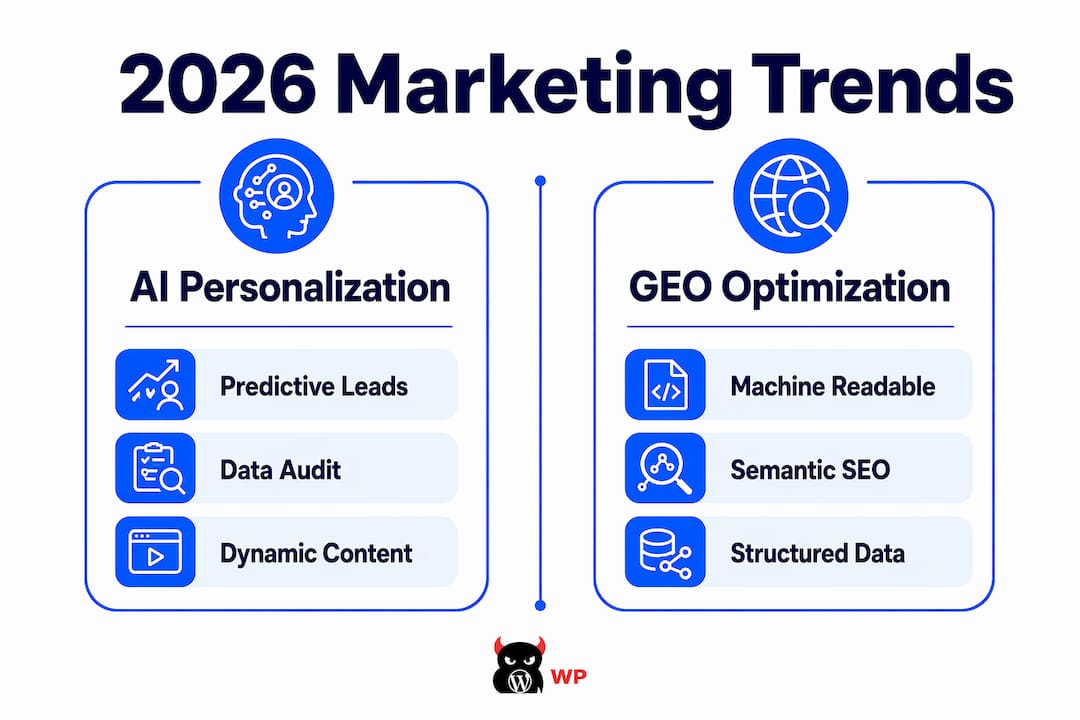
Generative Engine Optimization, or GEO, is the practice of structuring content so that AI-powered search systems like Google AI Overviews, ChatGPT, and Gemini select and cite it in generated responses. This is not a refinement of traditional SEO. It is a parallel discipline with different rules.
Traditional SEO optimizes for keyword relevance and backlink authority. GEO optimizes for machine legibility, semantic clarity, and topic authority. Only 33% of marketing teams invest in structured data despite its direct impact on AI citation rates. That gap is a competitive opening. The teams that implement schema markup, clean site architecture, and entity-rich content now will dominate AI-generated results for years.
Here is a direct comparison of the two approaches:
| Factor | Traditional SEO | Generative Engine Optimization (GEO) |
|---|---|---|
| Primary signal | Keyword density and backlinks | Semantic authority and structured data |
| Content format | Long-form keyword-optimized pages | Entity-rich, clearly structured answers |
| Discovery mechanism | Google Search ranking | AI Overview citations and generative responses |
| Measurement | Rankings and organic traffic | Citation frequency and AI visibility |
| Technical requirement | Meta tags and page speed | Schema markup, clean architecture, topic clusters |
GEO requires clear content authority, consistent terminology, and structured data to be selected by AI overview systems. That means writing about a topic with enough depth and consistency that an AI model recognizes your site as the authoritative source, not just a page that mentions the right keywords. 42% of queries now feature AI Overviews, which means nearly half of all searches are being answered before a user clicks anything. If your content is not in that answer, you are invisible to nearly half your potential audience.
For AI search optimization, the technical requirements go deeper than most marketing teams realize. Machine-legible structured data, semantic topic authority, and clean site architecture are not one-time tasks. They require ongoing governance, regular content audits, and a site infrastructure that does not fight you every time you try to update a page.
Pro Tip: Build topic clusters around your core service areas rather than isolated blog posts. AI systems favor sites that demonstrate consistent, deep expertise on a subject, not sites that publish one article on every trending keyword.
Short-form video is the highest-ROI marketing investment for 2026, according to HubSpot’s industry report. That ranking is not based on vanity metrics. It reflects actual conversion data from thousands of marketing teams. TikTok, Instagram Reels, and YouTube Shorts are not entertainment platforms with a marketing side hustle. They are the primary discovery channels for an enormous segment of buyers.
Platform dynamics have shifted in ways that matter for budget allocation. Instagram has overtaken Facebook as the preferred platform for brand discovery among users under 45. TikTok’s user base continues to grow despite regulatory pressure, and its ad platform has matured significantly. Paid social budgets now allocate 20 to 30% to AI-driven ad campaigns, and the biggest performance driver is no longer targeting precision. It is creative quality and offer strength. The algorithm finds your audience. Your job is to give it something worth showing them.
Effective content strategy in 2026 looks like this:
The brands gaining ground in 2026 are investing in owned assets like email lists and content authority rather than relying solely on paid media. Paid media amplifies what you already own. Without owned assets, you are renting your audience from platforms that can change their algorithm or their pricing at any moment.
Data-driven campaign management in 2026 is defined by the speed of the insight-to-action cycle. Marketing performance depends on rapid insight-to-action cycles supported by data governance, shared KPIs, automated reporting, and a culture of structured experimentation. Teams that review performance monthly are already behind. The standard is now weekly or real-time dashboards tied to revenue outcomes, not vanity metrics.
AI has fundamentally shifted the marketer’s role in paid advertising. The job is no longer to manually adjust bids and audiences. It is to configure the system correctly and then let it learn. Here is how that plays out in practice:
2026 is a turning point where data becomes core marketing infrastructure, not siloed reports. The companies that treat their data layer as a strategic asset, with governance, shared definitions, and clean pipelines, will make faster, more confident decisions than competitors still working from spreadsheets and gut instinct.
Winning in 2026 requires AI-ready data infrastructure, GEO-optimized content, and owned-asset compounding, not just better tools or bigger ad budgets.
| Point | Details |
|---|---|
| AI personalization requires clean data | Audit your CRM and analytics before investing in AI marketing tools. |
| GEO is a parallel discipline to SEO | Structured data and semantic authority determine AI citation rates, not keyword density. |
| Short-form video leads on ROI | TikTok, Instagram Reels, and YouTube Shorts deliver the highest returns among content formats. |
| Owned assets compound over time | Email lists and content authority reduce dependence on paid media and platform algorithm changes. |
| Measurement must be real-time | Weekly or live dashboards tied to revenue KPIs outperform monthly reporting cycles. |
Most marketing teams underestimate how much of their 2026 strategy depends on infrastructure they do not control. You can have the best content strategy in your industry, but if your site loads slowly, your schema markup is broken, your analytics are misfiring, and your CRM is not talking to your ad platforms, none of it performs at the level it should.
I have seen this pattern repeatedly. A business invests in a solid content and SEO strategy, sees early traction, then hits a ceiling they cannot explain. The culprit is almost always the technical layer underneath. Hosting that throttles under traffic spikes. A WordPress installation that has not been updated in eight months. Structured data that was implemented once and never maintained. These are not glamorous problems, but they are the ones that quietly kill campaigns.
The future digital marketing strategies that actually compound over time are built on infrastructure that does not require constant firefighting. That means managed hosting with real performance guarantees, a site architecture that supports GEO and traditional SEO simultaneously, and a content system that can scale without breaking. Paid media and creative strategy get the attention. Infrastructure does the actual work.
The brands I respect most in 2026 are not the ones with the flashiest campaigns. They are the ones that built a sustainable digital growth engine and then let it run. That requires patience, governance, and a willingness to invest in the unsexy parts of digital marketing that most agencies never talk about because they cannot charge a premium for them.
— Vector
The emerging marketing trends for 2026 are clear. AI personalization, GEO, short-form video, and owned-asset compounding are not optional upgrades. They are the baseline for competitive visibility. The question is whether your website and digital infrastructure can actually support them.
MonsterWP builds and manages high-performance WordPress websites designed to support every layer of your 2026 marketing strategy. From structured data and SEO architecture to speed optimization and security, every site is built to perform from day one. No bloated retainers. No technical chaos. Just a fully managed digital marketing system that works while you focus on strategy. Starting at $299 per month, MonsterWP gives growth-focused teams the infrastructure they need without the overhead they do not.
The top trends are AI-driven personalization, Generative Engine Optimization, short-form video content, and owned-asset compounding through email and content authority. HubSpot’s 2026 report confirms that 48.57% of marketers now prioritize AI personalization as their leading strategy.
GEO optimizes content for AI-generated search responses by prioritizing structured data, semantic authority, and consistent terminology, while traditional SEO focuses on keyword rankings and backlinks. With 42% of queries now featuring AI Overviews, GEO has become a required discipline alongside conventional search optimization.
Short-form video on TikTok, Instagram Reels, and YouTube Shorts ranks as the highest-ROI content investment for 2026 according to HubSpot’s industry data. Creative quality and offer strength now drive performance more than targeting precision.
Cookie deprecation has eliminated reliable third-party tracking, making first-party data the primary fuel for retargeting and AI personalization. Email marketing, which yields $36 to $42 per dollar spent, depends entirely on owned first-party audiences to maintain that return.
Teams should define conversion events at the revenue level, launch campaigns with five to eight creative variants, and protect the learning phase budget for two to four weeks. AI tools like Google Performance Max and Meta Advantage+ require correct configuration and patience before they optimize effectively.
Discover what is predictable pricing in web services and learn how fixed costs can empower your SMB’s budget. Gain financial control today!

Discover why branding matters online and how it drives business growth. Learn to shape perceptions and boost your revenue effectively!