
2026 Digital Marketing Trends Guide for Growth
Unlock the future with our 2026 digital marketing trends guide. Discover AI personalization, GEO, and more strategies for lasting growth!


TL;DR:
- A comprehensive business visibility strategy combines SEO, AI content formatting, social engagement, and earned media as interconnected pillars to drive consistent leads. Success depends on structuring content for AI citation, platform-specific presence, and funnel mapping, with measurable results over weeks or months. Proper architecture, brand consistency, and multi-channel integration are essential for long-term visibility and growth.
A business visibility strategy is the intentional, multi-channel effort to make your brand discoverable where your customers search, compare, and decide. It spans Google, AI answer engines like ChatGPT and Perplexity, social platforms, and earned media. Without it, you are invisible at the exact moment a buyer is ready to act. Brand visibility measures prominence across all these surfaces, not just brand recall, which means the bar for execution is far higher than most business owners realize. The businesses generating consistent leads in 2026 are not running louder campaigns. They are running smarter, more integrated systems.
Most founders treat visibility as a marketing task. It is infrastructure. The difference matters because infrastructure requires architecture, not just effort. A modern visibility strategy blends SEO, AI visibility, social and community engagement, and digital PR as connected pillars. Isolated channel efforts waste resources. Integrated pillars compound results over time.
The surface assumption is that a website and some social posts are enough. The hidden reality is that your content must be structured for Google, readable by AI assistants, consistent across platforms, and validated by third parties before it generates reliable discovery. That is four distinct layers of work, each with its own failure modes.
Here is what each pillar actually demands:
Pro Tip: Start with an audit of where your ideal customers actually research decisions. Map LinkedIn, Reddit, YouTube, and Google separately. Your visibility gaps will become obvious fast.
| Pillar | What it requires |
|---|---|
| SEO | Topic clusters, schema markup, evergreen content |
| AI visibility | Structured Q&A, explicit definitions, verifiable data |
| Social search | Consistent publishing on YouTube, LinkedIn, TikTok |
| Earned media | Third-party mentions, original research, PR outreach |
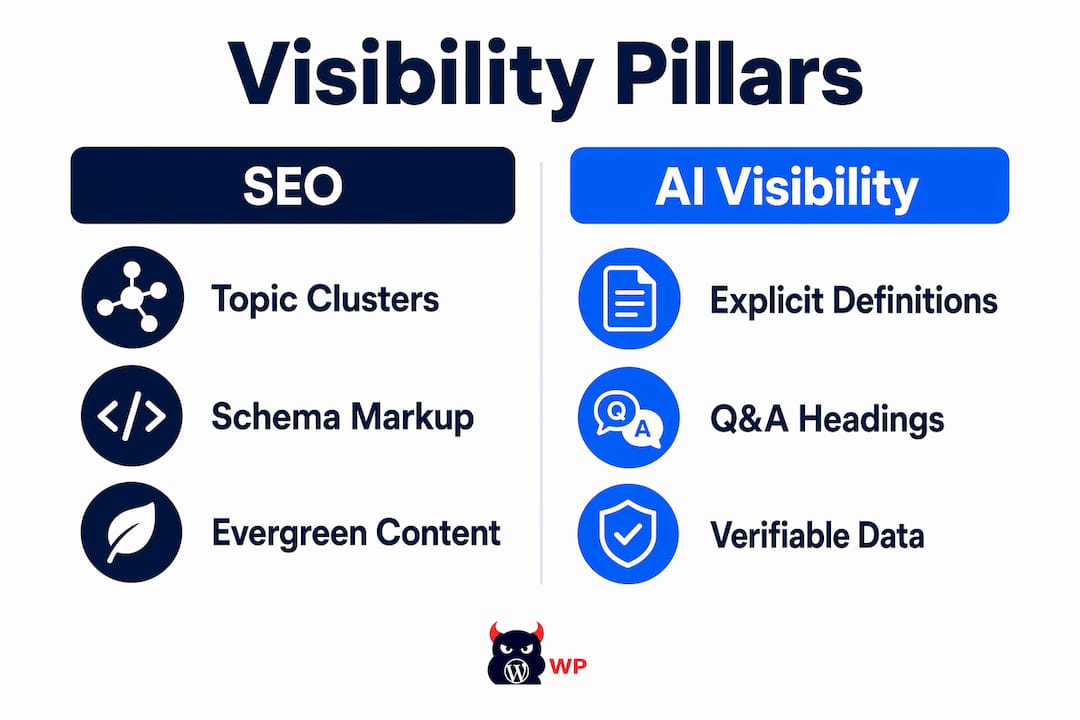
SEO is the base layer. Everything else sits on top of it. Without indexed, authoritative content, your AI visibility efforts have nothing to amplify, and your social content has nowhere to send traffic.

Evergreen indexed content outperforms ephemeral social posts because search engines prioritize authoritative, updated content. A single well-structured case study or FAQ page can generate discovery for months. A social post disappears in 48 hours. This is why businesses in 2026 are shifting budget away from one-time visibility spikes and toward content that compounds.
Building topical authority means owning a subject area, not just ranking for one keyword. A service business targeting CFOs, for example, should publish interconnected content covering financial reporting, audit preparation, and compliance trends. Each piece reinforces the others. Google reads the cluster as a signal of genuine expertise.
AEO-ready content requires explicit definitions, Q&A headings, verifiable data, and schema markup for AI citation. FAQ schema and HowTo schema are not optional extras. They are the formatting signals that tell AI assistants your content is worth quoting. Without them, your content may rank but never get cited in an AI-generated answer.
Pro Tip: Every pillar page you publish should include at least one explicit definition sentence formatted as “X is defined as…” This single structural choice dramatically increases your chances of appearing in AI Overviews and Perplexity answers.
Optimizing for featured snippets and People Also Ask boxes follows the same logic. Short, direct answers placed at the top of sections get pulled. Long, meandering paragraphs do not. The content that wins in AI search is the same content that wins in featured snippets. Structure is the common denominator.
The search everywhere approach is now a core discipline. Mapping where your ICP researches on platforms like LinkedIn, Reddit, and YouTube informs targeted visibility efforts. You cannot optimize for surfaces you have not mapped.
Here is how to build presence across the platforms that matter most in 2026:
Brand consistency across all these platforms is not cosmetic. AI recognition depends on entity consistency and third-party validation across all platforms. Your brand name, description, and core claims must match everywhere. Inconsistency confuses AI systems and weakens your entity authority.
Pro Tip: Use social listening tools like Brandwatch or Mention to identify creators and communities already talking about your category. Partnering with micro-influencers in your niche generates the kind of third-party mentions that AI systems treat as validation.
Paid media stops the moment you stop paying. Owned media depends on your own distribution. Earned media compounds. A mention in Forbes, a citation in an industry newsletter, or a guest appearance on a podcast with 10,000 listeners creates a trust signal that neither you nor your ad budget can manufacture.
Brand awareness signals heavily influence AI assistant trust. Untrusted brands may never appear in AI-generated answers, regardless of how well their content is structured. This means earned media is no longer just a PR vanity metric. It is a direct input into AI visibility.
Thought leadership content that earns media attention shares specific characteristics:
Visibility compounds when your brand appears consistently across Google, AI answers, social platforms, and third-party publications. Each mention reinforces the others, building an entity footprint that search engines and AI systems treat as authority.
Measuring earned media impact has evolved beyond counting press clippings. Share of voice, mention quality, and the authority of the publications citing you all matter. More importantly, AI visibility measurement now requires brand mention and citation monitoring beyond traditional rankings, using prompt-based testing. Running queries in ChatGPT and Perplexity to see whether your brand appears is now a standard visibility audit step.
Visibility without conversion is just noise. The businesses that win treat their visibility and lead generation as a single system, not two separate departments.
Full-funnel marketing integrating visibility, consideration, and conversion correlates visibility efforts directly to revenue metrics. Mapping top, middle, and bottom funnel tactics to track pipeline and customer acquisition cost is the standard in 2026. The businesses that skip this mapping end up with traffic they cannot explain and leads they cannot attribute.
| Funnel stage | Visibility tactic | Metric to track |
|---|---|---|
| Top of funnel | SEO content, YouTube, social publishing | Branded search volume, impressions |
| Middle of funnel | Case studies, webinars, email nurture | Assisted conversions, return visits |
| Bottom of funnel | PPC, retargeting, reviews | Conversion rate, cost per lead |
The most common pitfall is investing heavily in top-of-funnel visibility without building the middle. A buyer who discovers your brand through an AI answer or a YouTube video needs somewhere to go next. That means case studies, comparison content, and social proof positioned at the consideration stage.
Visibility gains build over weeks to months, especially with AI visibility. Setting expectations around indexation velocity and early AI citations, rather than immediate revenue, prevents the premature abandonment of strategies that are actually working. Most visibility campaigns are killed at the three-month mark, right before they would have compounded.
Pro Tip: Track branded search volume in Google Search Console monthly. Rising branded search is the earliest leading indicator that your visibility efforts are building genuine recognition, often weeks before you see it in lead volume.
A business visibility strategy only generates consistent leads when SEO, AI optimization, social presence, and earned media operate as one connected system, not four separate efforts.
| Point | Details |
|---|---|
| Visibility is infrastructure | Treat it as a system requiring architecture, not a campaign requiring budget. |
| AI readiness requires structure | Use explicit definitions, Q&A headings, and schema markup so AI assistants can cite your content. |
| YouTube drives AI visibility | YouTube presence correlates more strongly with AI citations than backlinks or domain rating. |
| Earned media builds AI trust | Third-party mentions and brand consistency are direct inputs into AI recommendation systems. |
| Funnel mapping prevents waste | Connect every visibility tactic to a funnel stage and a measurable metric to protect ROI. |
Here is what I have seen repeatedly: business owners launch a website, post on LinkedIn twice a week, and wonder why leads are not coming in. The problem is not effort. It is architecture.
Executing a real visibility strategy in 2026 means managing SEO structure, AI content formatting, platform-specific publishing cadences, earned media outreach, and funnel-stage content simultaneously. Each layer has its own technical requirements and its own failure modes. Miss the schema markup and your content never gets cited by AI. Ignore YouTube and your competitors own the AI visibility surface you cannot see. Publish without a content cluster strategy and Google treats your site as a collection of unrelated pages.
The measurement layer alone is more complex than most teams realize. You are now tracking traditional rankings, AI citations via prompt testing, branded search volume, share of voice, and assisted conversions. Vanity metrics like total traffic or social followers tell you almost nothing about whether your visibility strategy is working.
What I find most underappreciated is the compounding effect of getting all four pillars right at the same time. A single well-structured case study, published on a fast-loading site, repurposed to YouTube, cited in a trade publication, and linked from a Reddit thread, does more visibility work than 20 disconnected blog posts. The architecture matters more than the volume.
— Vector
If reading this made you realize your visibility strategy has gaps, you are not alone. Most businesses are running one or two pillars in isolation and wondering why growth feels unpredictable.
MonsterWP builds the infrastructure behind consistent visibility. Every custom WordPress website we launch is structured for SEO and AI readiness from day one, with schema markup, performance optimization, and content architecture built in. We also run managed social media marketing across LinkedIn, Meta, TikTok, and more, so your brand stays active on the platforms where buyers research. No bloated retainers. No guesswork. Just a fully managed digital growth system that works without constant babysitting. See our plans and get started today.
A business visibility strategy is the deliberate, multi-channel plan to make your brand discoverable across search engines, AI answer platforms, social media, and earned media. It combines SEO, content structure, platform presence, and third-party validation into one connected system.
AI assistants like ChatGPT and Perplexity cite content that uses explicit definitions, Q&A headings, verifiable data, and schema markup. Structured content increases the likelihood of appearing in AI-generated answers, making content architecture a core visibility requirement.
YouTube. YouTube brand mentions correlate more strongly with AI visibility in ChatGPT and AI Overviews than backlinks or domain authority, making video presence the highest-leverage platform investment for most businesses.
Visibility gains typically build over weeks to months, with AI citation visibility often lagging behind traditional search rankings. Track indexation velocity and branded search volume as early indicators rather than waiting for direct revenue attribution.
Track branded search volume, share of voice, AI citation frequency via prompt testing, assisted conversions, and mention quality across third-party publications. Traditional traffic volume alone does not reveal whether your visibility strategy is generating real business impact.
Unlock the future with our 2026 digital marketing trends guide. Discover AI personalization, GEO, and more strategies for lasting growth!

Discover what is predictable pricing in web services and learn how fixed costs can empower your SMB’s budget. Gain financial control today!