
2026 Digital Marketing Trends Guide for Growth
Unlock the future with our 2026 digital marketing trends guide. Discover AI personalization, GEO, and more strategies for lasting growth!


TL;DR:
- AI-driven SEO enhances tasks like keyword research and content analysis but relies on traditional SEO fundamentals.
- Human oversight remains crucial to ensure content quality, factual accuracy, and brand voice when using AI tools.
- A hybrid approach combining AI efficiency with expert review maximizes results while minimizing risks for SMBs.
AI-driven SEO gets talked about like it’s a magic switch. Flip it on, watch the traffic pour in, and fire your strategist. But that picture is dangerously incomplete. The reality is that AI tools are multipliers, not replacements, and knowing the difference between leveraging AI for SEO tasks versus optimizing for AI-powered search engines is the starting point every business owner needs. This guide cuts through the noise, breaks down what AI-driven SEO actually is, what it can and cannot do, and hands you a practical framework for using it to grow your site without falling into the traps that trip up most small and mid-sized businesses.
| Point | Details |
|---|---|
| AI enhances, not replaces | AI-driven SEO multiplies effectiveness but only when paired with proven fundamentals. |
| Beware generic content | Relying solely on AI tools risks publishing bland or inaccurate content without review. |
| Hybrid strategy wins | The most effective SMBs blend AI automation with human expertise and brand voice. |
| Measure real impact | Track not just rankings but also lead quality and engagement to judge true SEO success. |
Let’s get one thing straight right away. AI-driven SEO is not one single tool or tactic. It refers to using artificial intelligence and machine learning technologies to automate, accelerate, and enhance traditional SEO workflows. That means tasks like keyword research, content gap analysis, topic clustering, technical site audits, and on-page optimization can now happen faster and at a scale that would be impossible for a small team manually.
There are two distinct concepts you need to keep separate. The first is AI for SEO, which means using AI-powered tools to improve your own SEO processes. Think of platforms that scan thousands of competitor pages in minutes or suggest content structures based on what currently ranks. The second is SEO for AI, which means optimizing your site so that AI-powered search engines like Google’s Search Generative Experience or tools like ChatGPT cite and surface your content. Confusing these two is surprisingly common, and AI-driven SEO is frequently confused with optimizing for AI search and can produce non-deterministic results. Non-deterministic simply means the output isn’t always predictable or consistent, which adds a layer of risk.
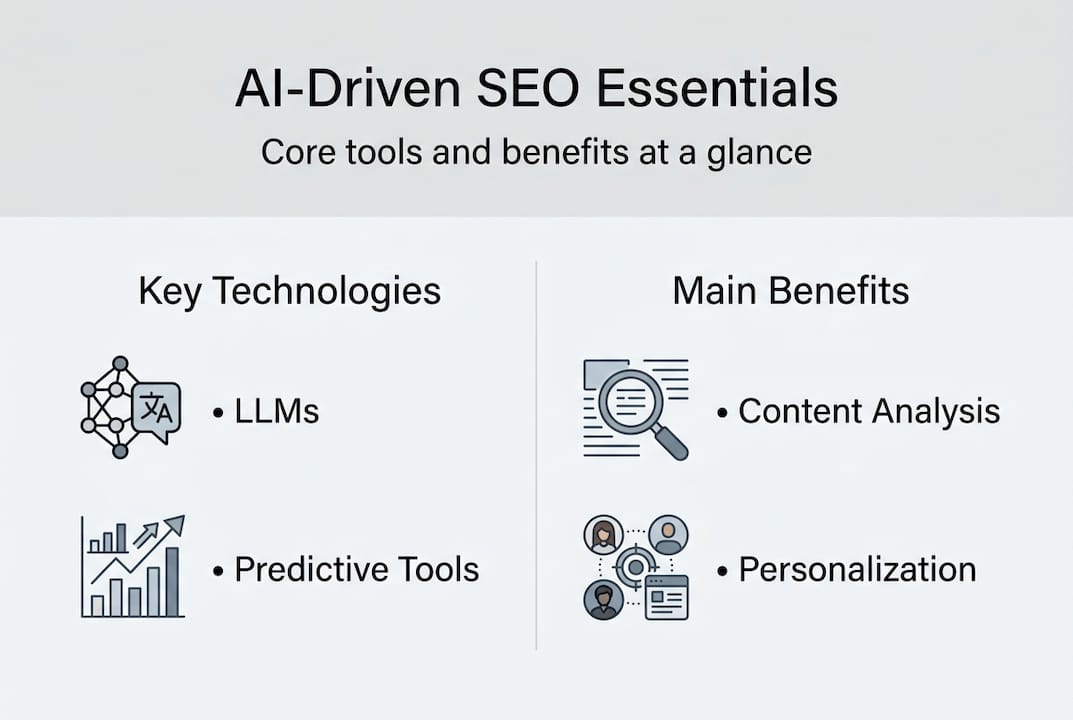
Common technologies powering AI-driven SEO include large language models (LLMs) that generate and analyze text, predictive analytics platforms that forecast keyword opportunity and traffic shifts, and automation tools that handle repetitive tasks like meta tag generation or internal link mapping. Explore how AI in marketing is reshaping the full growth stack for businesses.
| Task | Traditional SEO | AI-driven SEO |
|---|---|---|
| Keyword research | Manual research tools | Predictive, intent-based clustering |
| Content creation | Human-written briefs | AI-assisted drafts with human editing |
| Technical audits | Periodic manual reviews | Continuous automated monitoring |
| Competitor analysis | Spreadsheet tracking | Real-time pattern recognition |
| Personalization | Segment-based | Dynamic, individual-level optimization |
AI-driven SEO improves these areas specifically:
The catch? AI-driven SEO excels at predictive analytics and personalization but risks content hallucination without human oversight. That risk is real and consequential for any brand that publishes at scale.
Once you grasp what AI-driven SEO is, the next step is understanding which core SEO principles still matter the most. The short answer: almost all of them.
Google’s ranking systems are still built on the same foundational signals they’ve relied on for years. High-quality content, authoritative backlinks, and E-E-A-T (Experience, Expertise, Authoritativeness, and Trustworthiness) are not optional extras. They are the infrastructure on which everything else sits. AI tools don’t replace this infrastructure. They use it. Traditional SEO fundamentals remain foundational because AI relies on Google indices for retrieval, meaning AI search surfaces content that already ranks well by traditional measures.
“AI accelerates but doesn’t replace human strategy. The businesses winning in search right now are the ones that use AI to move faster while keeping experienced humans in the decision seat.”
Understanding SEO for business growth starts with recognizing that no tool, no matter how advanced, can manufacture genuine authority. That authority is built through consistent, expert-level content, credible links from trusted sources, and a track record of serving users well.
Here are the non-negotiables that even the most advanced AI-driven strategy must respect:
Building strong content-driven SEO strategies and staying current with SEO ranking factors are still the core work. AI just helps you do that core work faster and smarter when applied correctly.
With fundamentals understood, it’s vital to evaluate what makes AI-driven SEO both a remarkable opportunity and a potential risk, especially for small and mid-sized businesses that don’t have the budget to absorb costly mistakes.

AI-driven SEO enables predictive analytics and personalization but may generate generic or hallucinated content without oversight. That sentence captures the entire promise and peril of AI tools in one breath.
| Strengths | Risks |
|---|---|
| Speed: audits and research in minutes | Generic content that damages brand voice |
| Scalability across large content libraries | Hallucinated facts that erode trust |
| Predictive keyword and trend insights | Non-deterministic rankings that fluctuate unpredictably |
| Personalization at individual user level | Big-brand bias in AI search results |
| Continuous technical monitoring | Overreliance leading to strategic blind spots |
For SMBs focused on boosting SMB visibility, the speed and scalability benefits are genuinely exciting. You can now analyze competitor content gaps in an afternoon rather than a week. However, the risks are equally real for smaller operations without dedicated editorial oversight.
Here’s how to avoid the most common mistakes:
For businesses investing in local SEO for SMBs, the risk of generic content is especially sharp. Local audiences respond to specificity, and a page that reads like it was written for any city in America will not convert as well as one that reflects genuine local knowledge.
Pro Tip: Use AI for research and ideation, but never let it have the final word on content that represents your brand publicly. Human oversight is the quality gate, not an optional luxury.
To achieve the best results and avoid the pitfalls, it’s time to look at how to craft a hybrid approach that actually moves the needle for your business.
A balanced hybrid AI/SEO approach is recommended to maximize results and prevent problems like visibility loss. Pure automation without strategic oversight leads to content drift. Manual-only SEO is too slow to compete at scale. The winning combination sits squarely in the middle.
Here’s how to build your hybrid framework:
When you’re updating your website content regularly, the hybrid model keeps your output consistent without burning out your team. AI handles the volume; humans handle the quality filter.
Pro Tip: Schedule a monthly hybrid review where you compare AI-assisted pages against your best-performing human-written content. The patterns you find will sharpen your entire strategy faster than any tool alone can.
Here’s our honest take, drawn from working with founders and growth teams across dozens of industries. AI tools are genuinely powerful. They save time, surface opportunities, and help small teams punch above their weight. But the businesses that win long-term are not the ones that automate the most. They’re the ones that automate smartly.
Uncritical adoption is a real trap. We’ve seen sites publish hundreds of AI-generated pages only to watch rankings collapse when Google’s quality signals catch up. Generic content is easy to produce and easy for algorithms to discount. Your brand voice, your specific expertise, and your genuine understanding of your customer’s problems are things no LLM can replicate on its own.
The real edge in SMB SEO goes to businesses that keep what works, skip the hype, and use AI as a servant rather than a substitute. Explore how AI vs. managed web design plays out when you compare pure automation against a hands-on growth approach.
“Never confuse convenience with genuine results. AI multiplies both good and bad strategies, so make sure your foundation is solid before you scale.”
If you’re ready to get more from your SEO with less risk and more confidence, here’s how MonsterWP can help.
We build and manage high-performance WordPress sites that are optimized for both traditional search and AI-powered engines from day one. Our fully managed SEO services combine expert strategy with smart automation so you get scale without sacrificing quality. Whether you need a custom WordPress site built on a foundation that ranks, or a full-service growth system that handles SEO, content, and paid ads, we have a plan that fits. No bloated retainers. No guesswork. Just a clear, measurable path to more visibility and more qualified leads.
AI-driven SEO automates tasks like keyword research and content optimization using machine learning tools that analyze data faster than any human team could manually.
No. Traditional SEO fundamentals remain foundational because AI search systems still rely on quality content, backlinks, and Google indices to determine what gets surfaced.
AI-driven SEO can result in generic or hallucinated content without human oversight, which can erode trust and cause rankings to drop when search quality filters catch up.
Build a hybrid strategy that uses AI for research and scale, but routes all published content through human editorial review to protect accuracy, brand voice, and genuine expertise.
Unlock the future with our 2026 digital marketing trends guide. Discover AI personalization, GEO, and more strategies for lasting growth!

Discover what is predictable pricing in web services and learn how fixed costs can empower your SMB’s budget. Gain financial control today!