
2026 Digital Marketing Trends Guide for Growth
Unlock the future with our 2026 digital marketing trends guide. Discover AI personalization, GEO, and more strategies for lasting growth!


TL;DR:
- Rapid website revision enables updates within hours or days, not weeks, improving agility and competitiveness.
- It’s made possible by modular tools, managed services, and standardized templates, reducing costs and turnaround times.
- Successful implementation requires a strategic approach, a trustworthy partner, and ongoing analytics review.
Most business owners assume that changing their website means weeks of waiting, bloated agency bills, and a project that somehow never ends. That assumption is costing you leads right now. Rapid website revision flips that model on its head. It gives small and mid-sized businesses the ability to update, test, and improve their sites in hours or days, not months. In this guide, we break down what rapid website revision actually means, why it’s a growth lever most businesses ignore, and exactly how to put it to work for your company starting today.
| Point | Details |
|---|---|
| Faster website updates | Rapid website revision lets you make important changes in hours or days instead of weeks. |
| Boosts business agility | Quick revisions help you react faster to market shifts and improve results from your online efforts. |
| Supports ongoing growth | Frequent, well-planned updates drive more leads and keep your website relevant. |
| Choose partners carefully | A reliable managed service ensures speed without sacrificing website quality. |
Let’s cut through the noise. Rapid website revision means making website changes in days or hours, not weeks. It is the operational capability to update your site quickly, without breaking things or waiting on a slow agency queue.
Many business owners still believe that any website work requires a developer, a project brief, a two-week sprint, and a hefty invoice. That was true in 2010. It is not the reality today. Modern platforms, modular design systems, and fully managed services have completely changed the game.
Here is what makes rapid revisions possible right now:
Rapid revision covers a wide range of tasks: swapping out headline copy, adding a new service page, refreshing imagery before a product launch, or rebuilding a landing page for a new campaign. None of these require a three-week turnaround.
Pro Tip: If your current web setup takes more than 48 hours to push a simple text change live, you do not have a website problem. You have a process problem. Switching to managed website services solves it at the root.
“A website that can not keep up with your business is not an asset. It is a liability.”
The shift toward rapid revision is not just about convenience. It is about competitive survival. When a competitor drops prices on a Friday afternoon, can you update your homepage messaging by Monday morning? If the answer is no, you are already behind.
With a definition in hand, let’s look at why adopting rapid website revision directly benefits your business.
The numbers make the case plainly. Businesses that make frequent updates see significantly higher lead growth, with 200 or more website tests a year potentially driving 2 to 4 times more leads compared to static sites. And regular updates are directly tied to improved conversion rates and stronger marketing performance.
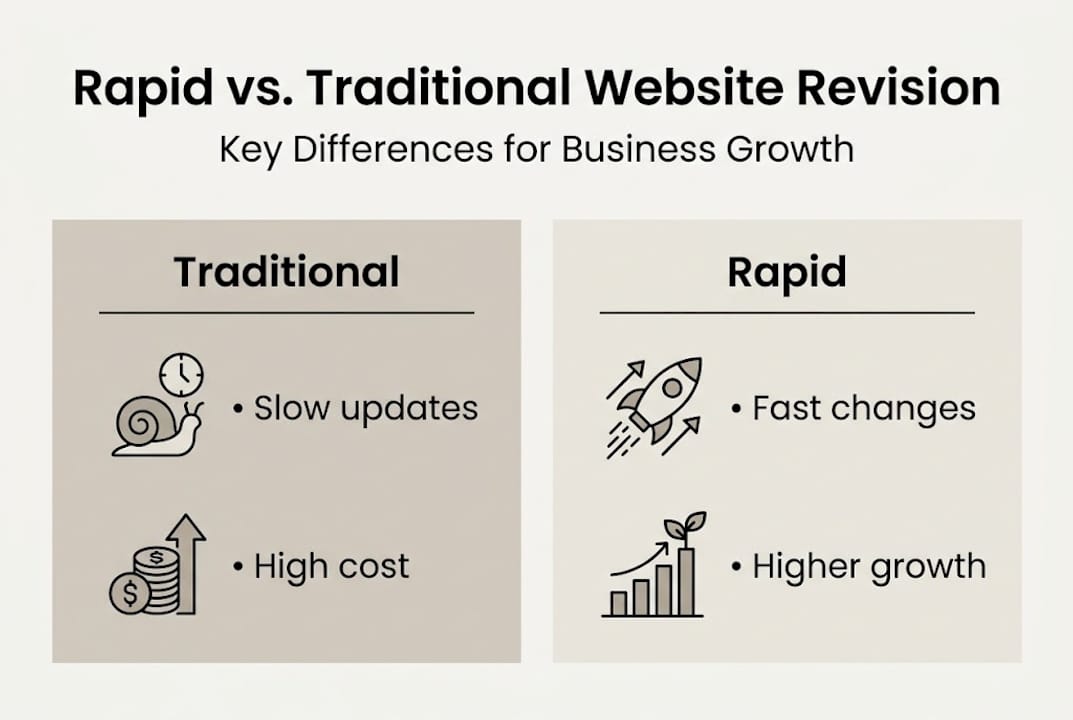
| Factor | Traditional revision | Rapid revision |
|---|---|---|
| Update speed | 2 to 6 weeks | Hours to 2 days |
| Average cost | High, often unpredictable | Flat fee or included |
| Impact on leads | Delayed, hard to measure | Faster feedback loops |
| Staff time required | High, multiple handoffs | Minimal, often handled for you |
| Market agility | Low | High |
The table tells the story. Traditional revision cycles burn time and money. Rapid revision reclaims both.
Here is what your business gains when you make the switch:
Marketing agility is underrated. When your team can test a new offer headline this week, review the results next week, and iterate the week after, you are running a smarter growth engine. Explore efficient website content updates to see how this works in practice. Static sites simply can not compete with that pace.

Knowing the benefits, it’s key to understand the methods and tools that make such agility possible.
The process is more straightforward than most people expect. Here is a practical five-step workflow:
Here is a realistic look at revision types and turnaround times:
| Revision type | Turnaround time | Resources needed |
|---|---|---|
| Text or copy update | 1 to 4 hours | Writer, CMS access |
| Image swap | 1 to 2 hours | Designer or asset library |
| New landing page | 1 to 3 days | Designer, copywriter |
| Form integration | 4 to 8 hours | Developer or plugin |
| Layout restructure | 1 to 2 days | Designer |
Practical scenarios bring this to life. Imagine you’re running a law firm and need a new landing page before a Google Ads campaign goes live Monday. With the right WordPress solutions and a managed team behind you, that page can be built, reviewed, and live by Friday.
Pro Tip: Standardize your page templates early. When every service page follows the same structure, updating one section automatically speeds up updates across all similar pages. This is one of the most overlooked efficiency gains in web management.
Or consider an e-commerce store swapping hero images and promotional banners before a Black Friday push. With a modular system, that is a one-hour task, not a week-long project.
Understanding the process leads to a critical question: how do you pick a partner you can trust to deliver on rapid website revision?
Not every agency or platform is built for speed. Most are built for scope creep. Here is how to evaluate your options:
When evaluating any web partner, look for these must-have features:
“The right web partner is your competitive edge.”
Beware of red flags. Slow support response times, one-size-fits-all contracts, and agencies that talk about “timelines” instead of turnaround times are warning signs. Managed web services designed for small businesses eliminate most of these frustrations by design, not by accident.
The right partner is not just a vendor. They are part of your growth team.
Here is something most rapid revision advocates won’t tell you. Speed without strategy is just chaos with a faster clock.
We have seen businesses sprint into rapid revision mode, pushing changes every few days, and end up with an inconsistent brand, confusing messaging, and a homepage that no longer tells a coherent story. The problem was not the pace. It was the absence of a plan.
Pitfalls of moving too fast include incomplete messaging that confuses visitors, overlooked accessibility issues that alienate users, and off-brand visuals that quietly erode trust. None of these show up immediately. They accumulate.
The real lesson is this: sustainable growth comes from iterating quickly and evaluating results just as fast. Pair your rapid revision systems with regular analytics reviews. Look at what changed, measure the impact, and make the next decision with data, not gut instinct.
Review your website update strategies at least monthly. Rapid revision is a powerful engine, but you still need to steer.
Pro Tip: Set a monthly “revision review” meeting. Look at what changed, what moved the needle, and what to prioritize next. Speed plus strategy is where real growth lives.
If your website feels like a bottleneck instead of a growth engine, MonsterWP is built to fix that. We design, build, and fully manage high-performance custom WordPress websites starting at $299 per month, with unlimited content updates and fast turnarounds included from day one.

Whether you need a simple website package to get moving quickly or a flat fee managed website that handles everything without the bloated agency bills, we have a solution built for your pace. No long contracts. No slow queues. Just fast, measurable results that protect your revenue and generate real leads. Let’s build something that works as hard as you do.
Rapid website revisions include content edits, adding new pages, design tweaks, or integrating new features, all typically completed within hours or a few days.
Frequent, small updates, ideally weekly or monthly, can help maximize lead growth. Frequent website updates are shown to improve lead generation and keep your content relevant to both users and search engines.
No, rapid revision applies to any site with a flexible CMS or managed web service. Rapid revision applies to modular and managed CMS platforms broadly, though WordPress remains one of the most capable options available.
Yes, if changes are made without a quality check process. Rapid changes require careful oversight to prevent negative impacts on branding, accessibility, and site functionality.
Unlock the future with our 2026 digital marketing trends guide. Discover AI personalization, GEO, and more strategies for lasting growth!

Discover what is predictable pricing in web services and learn how fixed costs can empower your SMB’s budget. Gain financial control today!