
The Role of Google Search Ranking for Business Growth
Discover the crucial role of Google search ranking in driving business growth. Learn how to optimize your online presence and boost visibility!

TL;DR:
- Your website is a vital revenue asset that requires comprehensive protection beyond aesthetics and uptime. Cybersecurity, brand integrity, and conversion optimization must work together to prevent direct losses from attacks and clone sites, ensuring consistent revenue retention. Integrating these layers into a unified infrastructure maximizes growth and safeguards profit from online threats.
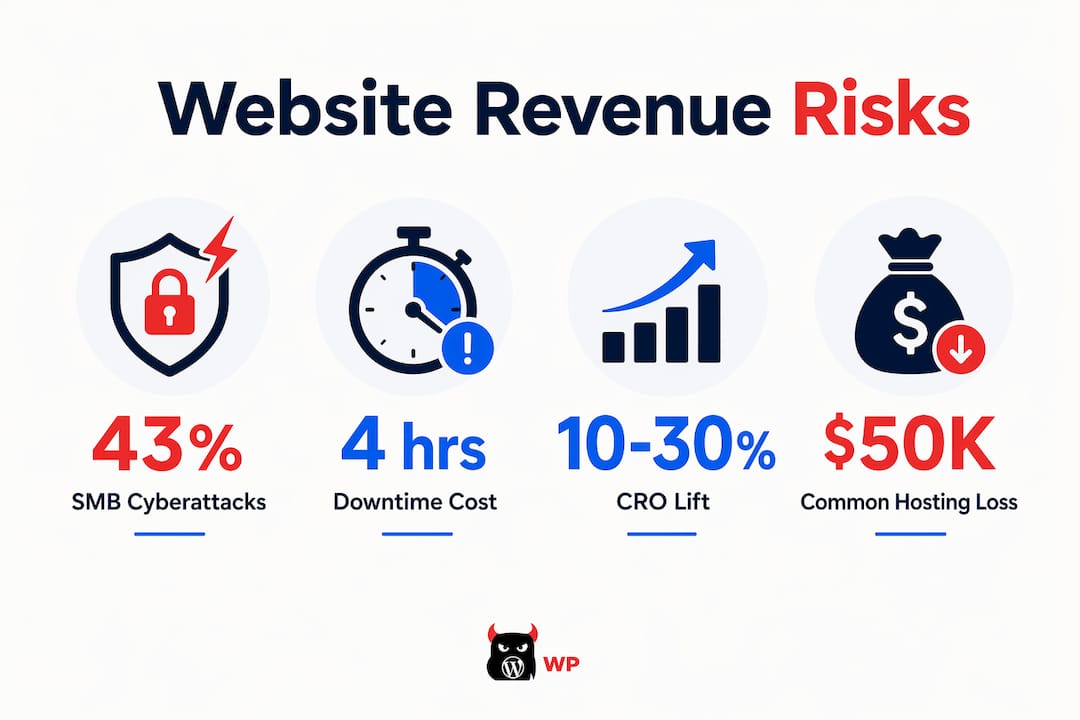
Your website is the single most exposed revenue asset your business owns, and most owners treat it like a brochure. The role of website in revenue protection goes far beyond uptime and aesthetics. It spans cybersecurity, brand integrity, conversion performance, and real-time threat response. 43% of all cybersecurity incidents target small and mid-sized businesses, which means the odds are not in your favor if your site is running on default settings and good intentions. This article breaks down exactly where revenue bleeds out through your website, and what a properly managed digital infrastructure actually prevents.
Cybersecurity is not an IT problem. It is a revenue problem. When your website goes down due to a malware infection, a DDoS attack, or a SQL injection exploit, you are not just losing traffic. You are losing transactions, eroding customer trust, and potentially triggering compliance penalties that compound the damage for months.
The three most common attack vectors targeting business websites are:
Each of these has a direct line to your bottom line. A site that is down for four hours during a product launch does not recover that revenue. Customers who land on a compromised page and see a browser warning do not come back. The trust damage outlasts the technical fix by weeks.
Multi-layered security infrastructure including daily scans, automated patching, and web application firewalls (WAFs) is the baseline defense against these threats. SiteLock, for example, offers automated malware detection, vulnerability patching, and firewall protection scaled for SMBs who cannot afford a dedicated security team. The point is not to become a cybersecurity expert. The point is to have systems in place that catch threats before they cost you money.

Pro Tip: Review your website security checklist at least quarterly. Most breaches exploit vulnerabilities that have had patches available for months.
The operational cost of reactive security is always higher than proactive defense. A single breach investigation, site restoration, and customer notification campaign can cost more than a full year of managed security infrastructure.
Revenue leakage from brand abuse is one of the least visible and most damaging threats to online sales. Unauthorized sellers, counterfeit product listings, and cloned websites do not just steal customers. They intercept high-intent traffic that your marketing budget already paid to generate.
Here is how the leakage typically unfolds:
“Clone sites create parallel acquisition funnels outside of a brand’s control, often using paid ads and social signals to hijack traffic before it reaches the official website.” — Red Points
This is not a fringe problem. Fake stores and unauthorized sellers not only reduce marketplace conversion but inflate customer acquisition costs and diminish return on ad spend. Every dollar you spend on Google Ads becomes less efficient when a counterfeit competitor is bidding on your own brand name.
The measurement framework that CMOs at growth-focused companies now use tracks two specific metrics: revenue at risk and estimated revenue recovered. Tracking these metrics reveals how removing online abuse directly improves marketing efficiency and bottom-line revenue. Tools like Remove.tech and Counterfake use AI to monitor marketplaces, social platforms, and search engines simultaneously, identifying and removing counterfeit listings faster than any manual legal process.
| Threat Type | Revenue Impact | Detection Method |
|---|---|---|
| Clone websites | Lost sales, trust erosion | Domain monitoring, visual similarity scanning |
| Unauthorized sellers | Reduced ROAS, price undercutting | Marketplace crawlers, seller ID tracking |
| Counterfeit listings | Customer acquisition cost inflation | AI-driven listing analysis |
| Brand keyword hijacking | Wasted ad spend | Paid search monitoring |
Proactive brand protection shifts the model from reactive legal takedowns to continuous revenue recovery by redirecting demand back to authorized channels. That shift is the difference between chasing fires and preventing them.
Conversion rate optimization, or CRO, is the practice of improving how effectively your existing website traffic converts into paying customers. It is not about driving more visitors. It is about extracting more value from the visitors you already have. In revenue protection terms, a low conversion rate is a slow, invisible leak.
CRO programs typically produce a 10% to 30% conversion lift within three to six months. That range compounds over time, meaning a business generating $500,000 in annual online revenue could recover $50,000 to $150,000 without spending an extra dollar on advertising. That is not growth spend. That is recovered revenue.
The practical improvements that drive these gains are less glamorous than they sound:
Data-driven UX improvements reduce guesswork and improve long-term profitability by building a feedback loop between visitor behavior and site design. Platforms like Site OptimizR quantify these gains so you can measure the financial return on each change rather than relying on intuition.
Pro Tip: Optimizing for existing traffic is almost always more cost-effective than increasing ad spend. Before you raise your Google Ads budget, check whether your revenue-driven website features are actually converting the traffic you already pay for.
The deeper point is this: a website that converts at 1.5% when the industry average is 3% is not a minor underperformer. It is a machine that wastes half its fuel. CRO closes that gap and keeps revenue inside the business instead of letting it evaporate at the checkout page.
Most businesses treat website threats in isolation. Security is handled by one vendor. Brand abuse is handled by legal. Conversion is handled by marketing. None of these teams talk to each other, and the gaps between them are where revenue disappears.
Effective revenue protection requires holistic monitoring across search, social, ads, and marketplaces, not isolated actions. A clone site detected by your security team but not flagged to your paid search manager means you are still funding ads that compete with your own counterfeit. A brand abuse takedown that does not feed back into your CRO data means you cannot measure the revenue recovered.
One underestimated threat sits inside the browser itself. Browser-injected ads and coupon extensions can divert approximately 5% of web traffic away from checkout pages. Real-time blocking of these distractions can improve revenue by 2% to 3% without any additional traffic spend. That is a meaningful gain hiding in plain sight, and most businesses have no idea it is happening.
| Infrastructure Layer | Threat Addressed | Revenue Impact |
|---|---|---|
| Web application firewall | Malware, DDoS, injections | Prevents downtime revenue loss |
| Brand monitoring AI | Clone sites, counterfeit listings | Recovers diverted sales |
| CRO analytics | Conversion friction | Lifts revenue from existing traffic |
| Browser injection blocking | Coupon extension diversion | Recovers 2-3% of checkout revenue |
| Managed hosting | Performance degradation | Reduces bounce-related revenue loss |
The operational reality is that managing all of these layers simultaneously requires either a dedicated internal team or a managed infrastructure partner that handles it as a system. Trying to bolt these protections onto a DIY website after the fact is expensive, slow, and almost always incomplete.
Pro Tip: Treat your website infrastructure the way you treat your accounting system: as a financial control function, not a technical afterthought. CMOs who measure brand protection ROI as a revenue metric consistently outperform those who treat it as a cost center.
A website that is not actively protected is a revenue liability, not a revenue asset. Security, brand integrity, conversion performance, and infrastructure monitoring must operate as a connected system to protect profit effectively.
| Point | Details |
|---|---|
| Security is a revenue function | Cyberattacks cause direct revenue loss through downtime, trust erosion, and compliance costs. |
| Clone sites drain marketing spend | Unauthorized sellers and fake stores inflate acquisition costs and reduce ROAS on your own campaigns. |
| CRO recovers hidden revenue | A 10-30% conversion lift from existing traffic is more cost-effective than increasing ad spend. |
| Browser injections are invisible leaks | Coupon extensions divert up to 5% of checkout traffic, recoverable through real-time blocking. |
| Isolation is the biggest risk | Security, brand protection, and CRO must connect as one system, not operate as separate silos. |
I have watched business owners spend $50,000 on a website redesign and then leave it running on a shared hosting plan with no security monitoring, no brand abuse detection, and a checkout flow that converts at 0.8%. The site looks great. It is hemorrhaging money.
The conventional wisdom says “get a good website and drive traffic.” That framing is broken. Traffic without protection is just exposure. Every visitor you pay to acquire is a potential revenue event that can be intercepted by a clone site, lost to a slow-loading page, or diverted by a browser coupon extension before they ever reach your checkout.
What I find most overlooked is the compounding effect of getting all three layers right simultaneously. Security prevents catastrophic loss. Brand protection recovers diverted demand. CRO extracts maximum value from what remains. When these three work together, the revenue impact is not additive. It is multiplicative. A business that fixes all three can realistically recover 20% to 40% of revenue it was silently losing without acquiring a single new customer.
The businesses that treat their website as a strategic revenue asset rather than a digital brochure are the ones that build durable, defensible growth. The ones that treat it as a one-time expense find out the hard way that the internet does not leave unprotected assets alone for long.
— Vector
Most managed website platforms give you hosting. MonsterWP gives you a revenue protection system. Every site we build is custom-engineered on WordPress with Elementor Pro, configured for speed, security, and SEO from the first day it goes live. We handle the hosting configuration, security hardening, performance optimization, and ongoing maintenance that most business owners do not realize they are missing until something breaks.
Our custom WordPress websites start at $299 per month with no bloated retainers and no long contracts. You get unlimited content updates, rapid revisions, and a team that monitors your site as a financial asset, not a technical project. If you are serious about protecting your revenue online, the first step is a website infrastructure that was built to do exactly that.
A website protects revenue by preventing cyber threats that cause downtime, blocking brand abuse that diverts sales, and optimizing conversion rates to extract maximum value from existing traffic. All three functions must operate together to protect profit effectively.
43% of cybersecurity incidents target SMBs, and attacks like malware and DDoS cause direct revenue loss through site downtime, customer trust erosion, and potential compliance penalties that extend well beyond the initial incident.
Revenue leakage occurs when clone sites use paid ads and social media to intercept high-intent traffic before it reaches your official website, resulting in lost sales and damaged brand reputation that your marketing budget cannot recover.
Conversion rate optimization programs typically produce a 10% to 30% conversion lift within three to six months, meaning a business with $500,000 in online revenue could recover $50,000 to $150,000 without increasing ad spend.
Website infrastructure connects security, brand monitoring, and conversion performance into one system. Gaps between these layers, such as browser-injected coupon extensions that divert 5% of checkout traffic, create invisible revenue drains that isolated fixes cannot address.
Discover the crucial role of Google search ranking in driving business growth. Learn how to optimize your online presence and boost visibility!

Discover what is Elementor Pro and how it elevates your website design with advanced features, powerful tools, and seamless customization!