
What Is a Website Revenue Asset? A Guide for Business Owners
Discover what is a website revenue asset and how it can transform your business. Learn to turn your site into a valuable income-generating tool!


TL;DR:
- Clear pricing improves lead qualification, shortens sales cycles, and enhances client relationships.
- Publishing transparent prices builds trust, credibility, and gives SMBs a competitive market advantage.
- Choose a pricing model suited to your business, communicate it clearly, and regularly update your pricing.
Most small business owners don’t realize they’re bleeding leads every day, not because their service is weak, but because their pricing is invisible. Visitors land on your site, like what they see, and then hit a wall: no numbers, no ranges, no starting points. So they leave. Visible pricing boosts conversions by qualifying leads, shortening sales cycles, and removing friction before a single conversation starts. This article breaks down exactly why transparent pricing is one of the most powerful growth moves an SMB can make, how it builds trust, and the practical steps to get it right on your website.
| Point | Details |
|---|---|
| Higher quality leads | Clear pricing filters out poor-fit prospects, saving you time and money. |
| Greater customer trust | Visible pricing builds credibility and sets your small business apart. |
| Shorter sales cycle | Transparent pricing allows qualified clients to make decisions faster. |
| Customizable approaches | Different services require different types of pricing disclosure—choose what earns the most trust. |
Let’s be direct: confusing pricing is a lead killer. When a visitor can’t figure out what you charge, their brain defaults to one of two conclusions. Either you’re too expensive, or you’re hiding something. Neither is good for your business.
Clear pricing acts as a filter. It works for you around the clock, pre-qualifying every visitor before they ever fill out a contact form. The people who reach out already know your price range fits their budget. That changes everything about the conversation that follows.
“Pricing transparency is one of the most underused tools in a small business’s conversion toolkit. When buyers know what to expect financially, they arrive at the sales conversation ready to decide, not just explore.”
Think about what that means in practice. Instead of spending 45 minutes on a discovery call only to hear “that’s out of our budget,” you get straight to the real conversation: fit, timeline, and scope. Qualified lead generation becomes dramatically more efficient when your pricing page does the heavy lifting.
Here’s what SMBs consistently report after adding clear pricing to their websites:
The website design’s effect on leads goes far beyond aesthetics. How you present your pricing is part of your design strategy, and it directly shapes who contacts you.
Pro Tip: Add a simple pricing range or “starting at” figure to your services page. Even a ballpark number dramatically reduces low-fit inquiries and signals confidence in your value.
The bottom line is simple. Hiding your prices doesn’t protect you from price shoppers. It just makes serious buyers go elsewhere.
Improving lead quality is only the beginning. Transparent pricing deeply impacts how clients perceive your business and your position in the market.
When you publish your prices, you send a clear message: we respect your time, and we’re confident in what we offer. That confidence is magnetic. It signals that you’re not scrambling to customize a number based on how much the client seems willing to spend. You stand behind your value.
Pricing transparency is a competitive edge for SMBs, signaling confidence and respect for customer time. In a market where most service providers still hide behind “request a quote” buttons, showing your prices is a bold move that immediately sets you apart.
Consider this: a large percentage of B2B buyers say they want pricing information during the initial research phase, yet most service websites force them to jump through hoops to get it. That gap is your opportunity.
Here’s what visible pricing does for your credibility and competitive position:
For SEO for SMBs, a well-structured pricing page also creates indexable content that helps you rank for high-intent searches. Buyers searching “web design pricing” or “SEO service cost” are ready to buy. If your page answers that question clearly, you capture them.
Pairing strong local visibility strategies with transparent pricing creates a powerful one-two punch. You get found, and then you convert. That’s the growth engine every SMB needs.
While it’s clear pricing transparency is essential, the right way to implement it depends on the unique structure of your business.

Not every service lends itself to a flat published rate. A plumber replacing a faucet can post a price. A custom software agency building a $500,000 platform cannot. The key is choosing the transparency model that fits your offering without creating false expectations.
Full transparency works best for productized services, while hybrid models make more sense for highly custom scopes. Here’s a comparison to help you decide:
| Model | Best for | Pros | Cons |
|---|---|---|---|
| Full pricing | Productized services, subscriptions | Maximum trust, fastest qualification | May scare off large custom deals |
| “Starting at” pricing | Services with variable scope | Sets expectations, filters low budgets | Can feel vague if not supported by detail |
| Request a quote | Highly complex, custom projects | Flexibility, no ceiling on deal size | High friction, slower lead qualification |
For most SMBs, a hybrid approach works well. Publish a base rate or package price, then clearly explain what’s included and what costs extra. This gives visitors enough information to self-qualify while leaving room for scope conversations.
For inspiration, look at how other service pricing approaches handle this in practice. You’ll notice that the most effective pages combine clear numbers with plain-language explanations of what drives cost.
If you’re in the web design or SEO space, reviewing SEO pricing models and the WordPress agency pricing shift can give you a real-world framework to follow.
Pro Tip: Whatever model you choose, always explain what’s not included. Surprises kill trust faster than high prices ever will. A simple “what’s not included” section prevents scope disputes and sets the tone for a professional relationship.
Once you’ve chosen your ideal pricing model, ensuring it’s communicated simply and effectively is the final key to converting visitors into clients.
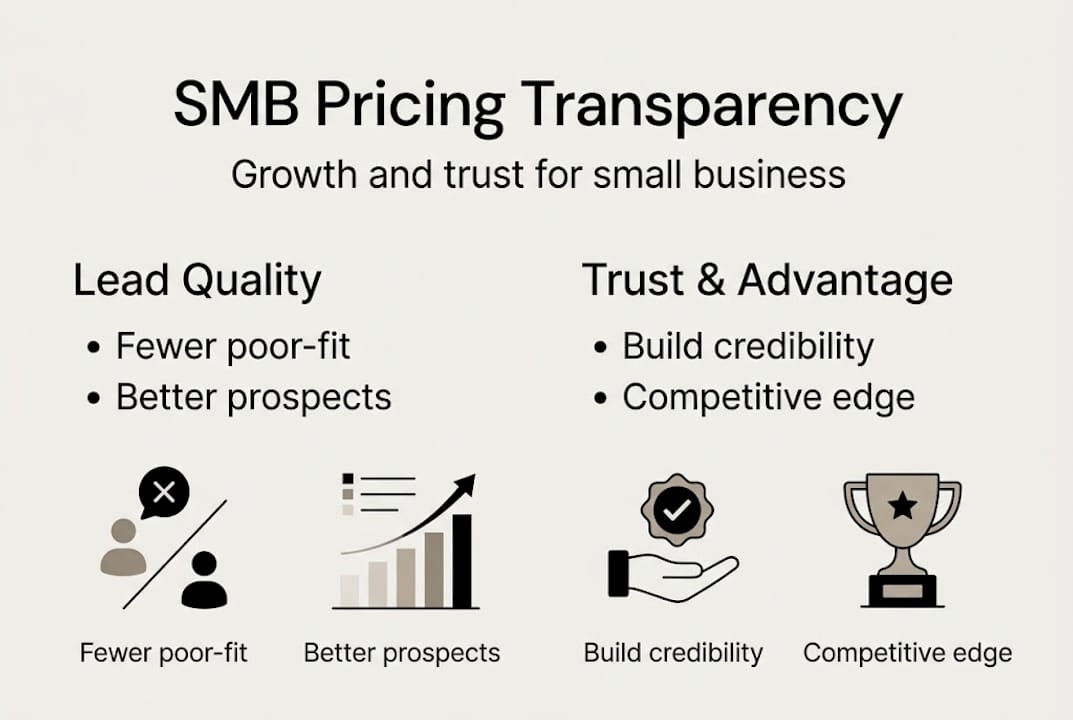
Visible pricing boosts conversion rates by qualifying leads, shortening sales cycles, and reducing friction. But only if it’s actually clear. Burying a price in fine print or surrounding it with legal language defeats the purpose entirely.
Here’s a step-by-step checklist to roll out or improve your pricing transparency:
Here’s what the data looks like when businesses make this shift:
| Metric | Before transparent pricing | After transparent pricing |
|---|---|---|
| Bounce rate on pricing page | 72% | 41% |
| Qualified lead conversion | 8% | 19% |
| Average sales cycle | 28 days | 18 days |
| Unqualified inquiry rate | 55% | 22% |
Common pitfalls to avoid: hiding extra fees in footnotes, using complex legal language, and failing to update pricing after rate changes. Each of these erodes the trust you worked to build.
For a deeper look at structuring this process, the service pricing checklist and client content and process policies offer practical frameworks you can apply directly.
Here’s what most marketing consultants won’t tell you: many agencies hide their prices not because their projects are too complex to quote, but because they’re afraid. Afraid that showing a number will send prospects running to a cheaper competitor.
That fear is understandable. It’s also wrong.
Clients who leave because they see your price were never going to buy from you anyway. They were shopping on price alone, and no amount of sales skill was going to change that. Transparent pricing doesn’t lose you those clients. It just stops wasting your time on them.
The real magic of fixed-pricing models is that they attract clients who are buying on value, not just cost. When your niche is well-defined and your offer is clear, your price becomes a signal of quality, not a barrier. The right clients see it and think, “That’s exactly what I need.” The wrong ones move on. That’s not a loss. That’s efficiency.
Pricing clarity is your filter, your brand statement, and your competitive weapon all at once. Use it.
If you’ve been nodding along to everything above, here’s the good news: you don’t have to figure this out alone.
At MonsterWP, we practice exactly what this article preaches. Our custom WordPress website pricing is published, clear, and built to help you compare with confidence. No bloated retainers, no surprise invoices, no “let’s hop on a call to discuss budget.” We also offer flat-fee WordPress sites for businesses that want a fast, predictable path to a high-performance website. Transparent pricing isn’t just a strategy we recommend. It’s how we run our business. Explore our plans and see exactly what you get for every dollar you invest.
You lose trust and miss qualified leads, as most buyers skip companies that hide their prices. Visible pricing reduces friction and keeps serious prospects from bouncing to a competitor who is more upfront.
Productized services suit full pricing, while custom projects work better with base rates plus clearly explained add-ons. The goal is to give visitors enough information to self-qualify without creating unrealistic expectations.
Not at all. Service businesses of every type benefit from transparent pricing by attracting better-fit prospects and closing faster. Pricing transparency is a competitive edge across industries, not just retail.
Sales cycles are typically 20 to 30% shorter when website pricing is visible, because prospects arrive at conversations already informed and budget-aligned.
Discover what is a website revenue asset and how it can transform your business. Learn to turn your site into a valuable income-generating tool!

Discover what is measurable digital marketing and learn how data-driven insights can boost your strategy and budget decisions in 2026.