
What Is Measurable Digital Marketing? A 2026 Guide
Discover what is measurable digital marketing and learn how data-driven insights can boost your strategy and budget decisions in 2026.


TL;DR:
- Most business owners view their website as a cost rather than an asset, missing its potential to generate ongoing, measurable revenue. A website revenue asset compiles value through organic traffic, leads, and sales, functioning like a silent salesperson working continuously, unlike one-time marketing expenses. Proper management, optimization, and accounting recognition transform a website from a necessary expense into a strategic business asset that compounds in value over time.
Most business owners treat their website as a cost center. They write the check, launch the site, and file it under “marketing expenses” without a second thought. That mental model is costing them real money. A website revenue asset, more precisely called a digital intangible asset, is a web property that generates measurable, compounding economic value over time through organic traffic, lead generation, e-commerce, or recurring memberships. Understanding what is website revenue asset means recognizing that your site can function less like a billboard and more like a silent salesperson working every hour of every day.
| Point | Details |
|---|---|
| Websites can be assets, not just expenses | A properly built website generates compounding revenue through traffic and leads, not just brand visibility. |
| Accounting recognition matters | Under IAS 38 and US GAAP ASC 350-40, qualifying website development costs can be capitalized as intangible assets on your balance sheet. |
| Valuation follows a clear framework | Website values typically range from 3x to 10x annual net income, driven by sustainability, scalability, and revenue model. |
| SEO is the compounding engine | Organic search traffic is the highest-value, lowest-cost revenue driver that separates assets from digital brochures. |
| Professional management reduces risk | Mismanaged websites lose organic rankings, security integrity, and conversion performance, destroying asset value fast. |
The industry term for this concept is a digital intangible asset. The phrase “website revenue asset” is how most business owners describe it when they start asking the right questions, and that framing is exactly right.
A standard marketing expense produces a result once. You run a paid ad campaign, get leads during the campaign window, and when the budget stops, so does the flow. A digital intangible asset works differently. Every page you build, every piece of optimized content you publish, every backlink you earn compounds. Six months from now, that work still drives traffic. Three years from now, it may drive ten times the traffic.
Here is what actually distinguishes a revenue-generating website from a digital brochure:
Take a local law firm as an example. If their site ranks on page one of Google for ten high-intent keywords, that organic presence generates consultation inquiries every week without ongoing ad spend. Compare that to a firm paying $5,000 a month in Google Ads for the same volume. The revenue-driven website features that produce this result are not accidental. They are engineered.
Pro Tip: If your website goes dark tomorrow and you feel no financial pain, it is not functioning as an asset. A true revenue-generating site should be missed the same way a top-performing salesperson would be.
This is where most entrepreneurs get surprised. Your accountant and your web designer are not having the same conversation, but they should be.
Under IAS 38 Intangible Assets, website development costs can be recognized on your balance sheet as an intangible asset. The requirement is straightforward in principle: you must demonstrate probable future economic benefits, technical feasibility, intent to complete and use the asset, and reliable cost measurement. If those criteria are met, the development cost is capitalized, meaning it is treated as an asset rather than written off as an immediate expense.

The US standard, FASB ASC 350-40, takes a slightly different approach. Capitalization begins when management documents a probable-to-complete authorization, eliminating the older stage-gating model. The practical implication is that your development team’s project tracking and your finance team’s bookkeeping need to align from day one.
Here is a comparison that clarifies what gets capitalized versus what gets expensed:
| Cost Type | Accounting Treatment | Examples |
|---|---|---|
| Initial website build and development | Capitalized as intangible asset | Custom design, core functionality, CMS setup |
| Ongoing content updates and blog posts | Expensed as incurred | Writing, image uploads, copy edits |
| Platform rebuilds or major feature additions | Potentially capitalized | New e-commerce module, booking system |
| Hosting, maintenance, and security | Expensed as operating costs | Monthly hosting fees, plugin licenses |
| Promotional redesigns and campaign pages | Expensed as revenue costs | Landing pages for seasonal campaigns |
HMRC uses a memorable analogy that clarifies the split: website construction is capital like building a shop window, but changing what is displayed in the window is an ongoing revenue expense. That framing translates cleanly to any business context.
The practical challenge most entrepreneurs face is documentation. Audit-quality documentation showing the transition from early research to committed development is the single hardest hurdle in capitalizing website costs. Without it, everything defaults to an expense.
Pro Tip: Before your next major website rebuild, ask your accountant whether it qualifies for capitalization under your applicable accounting standard. A $30,000 redesign treated as an intangible asset changes your tax position and your balance sheet in ways a $30,000 expense never will.
Once you accept that your website generates revenue, the natural next question is: what is it worth? Knowing how to value a website is not just useful when you are thinking about selling. It informs investment decisions, partnership negotiations, and even how seriously you take maintenance.
Website valuation commonly uses three methods, and the right one depends on how your site makes money:
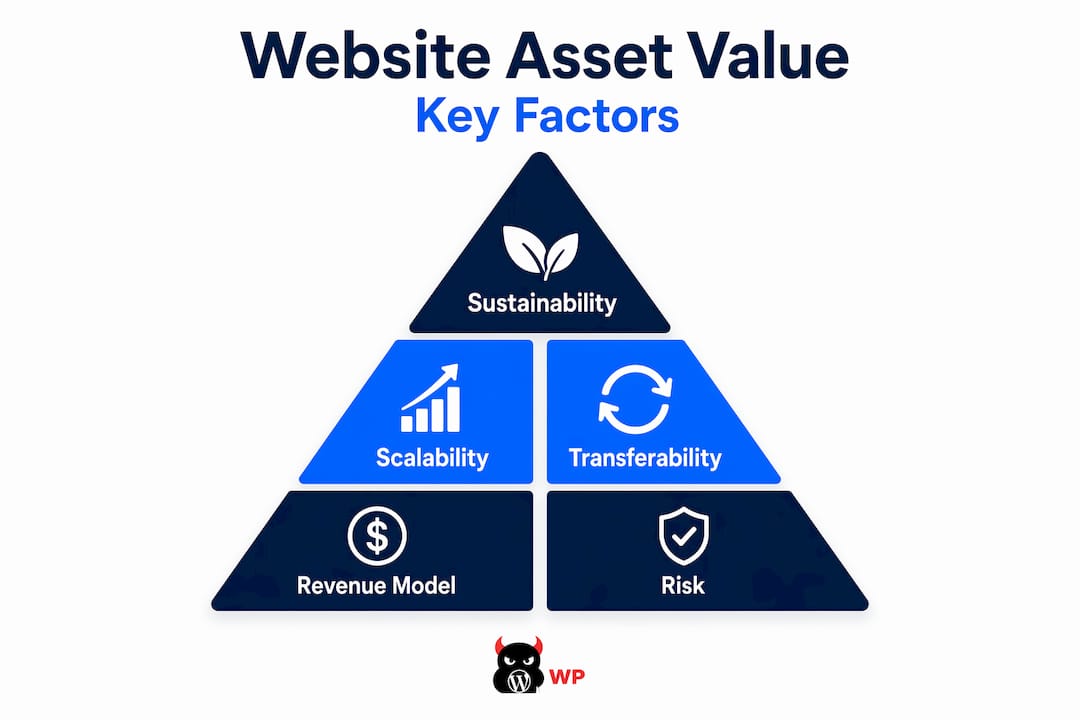
What actually moves the multiple higher or lower comes down to three factors. Sustainability, scalability, and transferability of the revenue are the core variables. A site generating $10,000 per month from diversified organic traffic in a growing niche commands a far higher multiple than one generating the same revenue from a single client relationship or a single paid channel.
Revenue model matters enormously here. SaaS websites with subscription income often command multiples at the high end of the range because the income is predictable and grows without proportional effort. Lead generation sites for service businesses fall in the middle. Ad-supported content sites often land at the lower end due to platform dependency and volatile ad rates.
The risks that compress valuation are equally worth understanding. Heavy reliance on one traffic source, a high workload model where revenue stops when activity stops, and weak conversion infrastructure all pull the multiple down. If monetizing a website is your goal, building redundancy into your traffic sources and automating your lead capture process is not optional. It is what protects the asset’s value.
Understanding the concept is only half the battle. The harder work is execution, and most business owners underestimate the operational complexity involved.
Here is the practical sequence that separates websites that compound in value from those that stagnate:
Build on SEO from the foundation. Organic traffic is the highest-value, lowest-cost revenue driver available to any business. A site designed without SEO structure from day one will always cost more to fix than it would have cost to build correctly. Website design directly impacts both search rankings and the conversion rate once visitors land.
Invest in user experience as a revenue function. Slow pages, confusing navigation, and broken mobile experiences do not just frustrate visitors. They destroy conversion rates and signal quality problems to Google. Every element of your site’s performance is a revenue variable.
Publish content that earns authority over time. One well-researched article ranking on page one for a buying-intent keyword will generate leads every month for years. That is a fundamentally different return profile than any paid campaign.
Integrate digital marketing channels with your website at the center. Social media, email, and paid ads should all funnel back to your website, not replace it. Your site is the only digital real estate you fully own. Types of business websites that excel at this treat every channel as a tributary feeding into a central conversion system.
Track revenue attribution rigorously. If you cannot connect website activity to revenue outcomes, you cannot manage the asset. Google Analytics 4, CRM integration, and conversion tracking are not optional extras. They are the instrumentation panel of your revenue asset.
Treat ongoing management as a revenue function, not a maintenance cost. Security vulnerabilities, plugin conflicts, performance degradation, and outdated SEO structures erode value silently. Professional website management prevents the kind of slow decay that turns a valuable asset into a liability.
Pro Tip: Run a quick test: Google the three most valuable phrases your ideal customer would search. If your website does not appear on page one for any of them, your asset is not working. That gap is both a problem and a clear opportunity.
I have watched hundreds of entrepreneurs make the same mistake. They treat their website as a one-time project instead of a revenue-generating system that requires ongoing investment and management attention.
In my experience, the founders who get the most out of their websites are the ones who stopped asking “How much will this cost?” and started asking “What will this return?” That is not a semantic difference. It completely changes which decisions you make, which partners you hire, and how much patience you extend to long-term strategies like SEO.
The uncomfortable truth I have learned is that most websites are not functioning as assets at all. They are expensive placeholders. They get built, launched, and then largely ignored while the business chases leads through paid channels and referrals. Months go by without a content update. Years go by without a performance audit. The site ages, rankings drop, and the business becomes more dependent on expensive paid traffic to compensate.
What actually changes outcomes is treating your website the way you would treat a piece of commercial real estate. You would not buy a property and leave it unmanaged. You would not ignore a broken HVAC system in a rental unit because fixing it feels like extra expense. The same logic applies here. The complexity behind keeping a website fast, secure, well-ranked, and optimized for conversion is real. It does not manage itself.
The mindset shift from “website as expense” to “website as asset” is not philosophical. It is financial. Make it, and your decisions about where to invest and how to manage your digital presence get sharper immediately.
— Vector
Understanding the theory is one thing. Turning your site into a machine that generates qualified leads every month is another level of execution entirely.
MonsterWP designs, builds, hosts, and manages high-performance WordPress websites built for exactly this purpose. Every site is structured for SEO from day one, optimized for speed and security, and supported with unlimited content updates so your asset keeps growing. Our fixed monthly pricing means no surprise invoices, no bloated agency retainers, and no chaos.
If you are ready to stop treating your website as a sunk cost, explore our custom managed WordPress websites or our full-stack website plus SEO and PPC growth system. This is what a revenue asset looks like in practice.
A website revenue asset is a web property that generates measurable, ongoing economic value through leads, sales, or subscriptions rather than functioning as a static online brochure. When built and managed correctly, it compounds in value over time like any other productive business asset.
Yes, under both IAS 38 and US GAAP ASC 350-40, qualifying website development costs can be capitalized as intangible assets on your balance sheet, provided the recognition criteria are properly documented and met.
Website valuation typically uses a multiple of annual net income, ranging from 3x to 10x, adjusted for revenue sustainability, scalability, and transferability. Sites with recurring revenue models like SaaS or memberships generally command higher multiples than ad-supported or single-channel traffic models.
Subscription and SaaS models typically produce the highest valuations because of their predictable, recurring income streams. Lead generation sites backed by strong organic SEO also rank highly, particularly when traffic is diversified across multiple keyword categories rather than dependent on a single source.
Neglecting security, performance, and SEO maintenance erodes website asset value over time, even when the original build was excellent. Managed website services protect the compounding nature of organic traffic and conversion performance, preserving the asset’s long-term revenue output.
Discover what is measurable digital marketing and learn how data-driven insights can boost your strategy and budget decisions in 2026.

Explore 3 monsterwebsites.com alternatives to help you choose a managed WordPress agency that fits your business needs and budget effectively.