
How to Improve Site Speed Without Breaking Your Site
Unlock the secrets of how to improve site speed effectively. Discover crucial strategies that enhance performance and boost your rankings.


TL;DR:
- Your website is the most powerful tool for local lead generation beyond social media and GBP.
- Optimized features like prominent CTA buttons, short contact forms, and fast load times boost conversions.
- Continuous testing and simplification are essential for a high-converting, DIY-friendly local business website.
Social media gets all the attention. Google Business Profiles get all the praise. But here’s the truth most business owners miss: your website is quietly the most powerful lead-generation tool you own. When built strategically, it doesn’t just sit there looking pretty. It pulls in traffic from every channel, builds trust in seconds, and converts strangers into paying customers around the clock. Websites serve as the central hub for local business lead generation, yet most local sites are still built like digital brochures. This guide breaks down exactly how to fix that and turn your website into a real lead engine.
| Point | Details |
|---|---|
| Central role of websites | A well-built website is essential for capturing and converting local business leads, outperforming social or GBP alone. |
| Conversion-driving features | Prominent CTAs, trust signals, and mobile-first speed are must-haves to turn visitors into real leads. |
| Optimize for local search | Local SEO, paired with clear service pages and GBP integration, brings consistent, high-value traffic. |
| DIY improvements work | Business owners can boost lead gen themselves using practical, agency-free tools and simple fixes. |
| Avoid common pitfalls | Most lead leaks come from slow speed, hidden contacts, or unclear value—easy issues to detect and solve. |
Most local business owners treat their website like a business card. Post it online, share the link, and hope people call. That mindset is costing you leads every single day. A well-built website is not passive. It actively drives traffic, captures interest, and routes qualified prospects straight to you.
Here’s what separates a lead-generating site from a digital brochure:
Social media and GBP are great for visibility. But without a fast, clear website destination, that traffic evaporates. People click, land on a slow or confusing page, and leave. You paid for that attention with time or money, and it produced nothing.
“Websites serve as the central hub for local business lead generation, with click-to-call buttons essential for 60%+ of mobile local searchers.”
That stat matters. Over 60% of mobile local searchers expect a click-to-call button the moment they land. If your site buries the phone number or doesn’t have one at all, you’re handing leads to your competitors.
Websites attract organic traffic via local SEO and convert visitors with optimized CTAs, forms, and trust signals. And the scale of this is significant: 90% of marketers rely on websites for lead conversion. That’s not a trend. That’s a consensus.
The different business website types serve different goals, but for local lead generation, performance sites built around conversion architecture consistently outperform everything else. If you want to understand why website platforms for lead growth matter in 2026, the answer starts with owning your audience, not borrowing it.
Understanding why websites matter is one thing. Knowing exactly which features make them convert is next. Most sites fail not because of bad design but because of missing mechanics.
Here’s what every local business website needs on every service page:
| Feature | Brochure site | Performance (lead-gen) site |
|---|---|---|
| CTA placement | Footer only | Above the fold, every page |
| Contact form | One page | Every service page |
| Mobile speed | 5+ seconds | Under 3 seconds |
| Service pages | One general page | One page per service/keyword |
| Trust signals | None or minimal | Reviews, photos, licenses |
| Click-to-call | Missing | Prominent on mobile |
One service per page is not just good UX. It’s a core SEO strategy. Each page targets one keyword, which means Google can rank it specifically for that search. A single “Services” page tries to rank for everything and ends up ranking for nothing.
Conversion-focused architecture includes clear CTAs, simple contact forms, one-keyword-one-page for SEO, and trust elements. These aren’t optional extras. They’re the foundation.

Understanding how website design impacts leads goes beyond aesthetics. It’s about reducing friction at every step. And effective landing pages follow the same principle: remove everything that doesn’t push the visitor toward contacting you.
Pro Tip: Cut your contact form down to three fields: name, phone number, and service needed. Shorter forms consistently double submission rates compared to long ones asking for address, budget, and project details upfront.
With onsite essentials locked in, the next step is making sure the right people are finding your site, not just stumbling in by accident. Traffic quality matters as much as traffic volume.
| Traffic source | Avg. conversion rate | Avg. cost per lead |
|---|---|---|
| Organic search (local SEO) | 4 to 12% | $0 (time investment) |
| Google Business Profile | 3 to 8% | $0 (free listing) |
| Google Ads (local services) | 5 to 10% | $65 to $145 |
| Social media referral | 1 to 3% | Varies |
Organic traffic converts 4 to 12%, local services ads cost $65 to $145 per lead, and 41% of sites score below 80 on mobile performance. Those numbers tell a clear story: organic and GBP traffic are the highest-value sources, and most sites aren’t even ready to receive them properly.
Here’s how to capture more leads from local search right now:
A key stat that should motivate urgency: 76% of smartphone searchers visit a business within 24 hours of their search. But they bounce immediately if the site is slow or unclear. Speed and clarity aren’t nice-to-haves. They’re the price of entry.
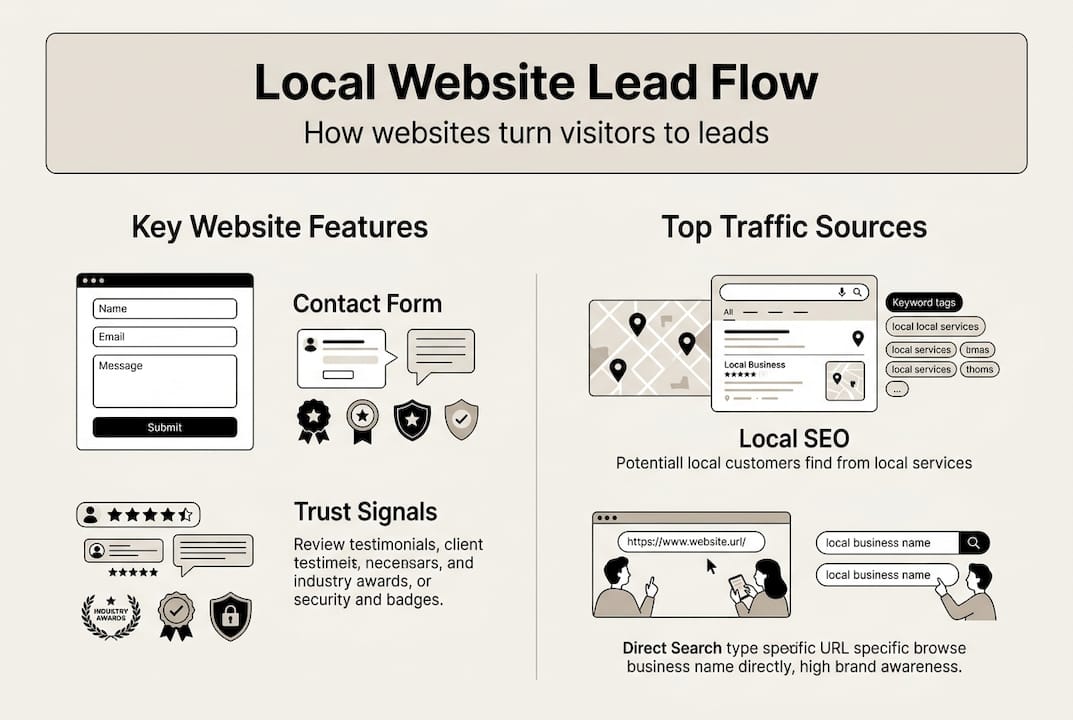
Our local SEO guide breaks this down further, and if you want to understand how SEO drives business growth at a deeper level, the connection between rankings and revenue is direct. Knowing the top SEO ranking factors for small businesses gives you a roadmap to outrank competitors without spending a dollar on ads.
Even the right strategy fails if the site is slow or confusing. Let’s troubleshoot the most common blockers next. These are the lead leaks that silently drain your results every month.
The biggest reasons local business websites lose leads:
“Poor mobile performance, slow speeds, hidden contact info, and vague copy kill conversions, wasting the majority of hard-earned local traffic before a single lead is captured.”
Poor UX and slow speeds kill conversions before they even begin. And the fix doesn’t require a full redesign. Start with the basics.
Actionable fixes you can apply today:
Pro Tip: Test your site on mobile right now. If contact options aren’t obvious within the first scroll, fix that before anything else. Speed and visibility are the two levers that move the needle fastest.
For a deeper look at how custom website design for leads changes outcomes, the difference between a site that leaks and one that converts often comes down to intentional structure, not expensive features. Optimizing websites for conversion is a discipline, not a one-time task.
Now that you know what works and what to avoid, here’s how to apply these lessons to your own business website without the agency price tag. DIY platforms make building or improving your site affordable and fast. You don’t need a $10,000 agency project to compete.
Follow these steps in order:
DIY tools, mobile speed under 2.5s, a clear value proposition, and CTA testing enable agency-free lead gen websites that actually perform.
Pro Tip: Run your site through Google’s free PageSpeed Insights after every major change. Aim for a mobile load time under 2.5 seconds. That single metric has more impact on your lead volume than almost any design decision.
Exploring the right WordPress website types for service businesses helps you pick the structure that matches your goals from day one.
Here’s the uncomfortable truth: even when business owners follow all the advice above, many sites still underperform. And the reason isn’t technical. It’s philosophical.
Most local business owners build websites by looking at big brands for inspiration. Clean layouts, bold imagery, minimal text. It looks sharp. But mega-brand design is built for awareness, not conversion. Local businesses need a different playbook entirely.
The real secret to a high-converting local site is almost boring: simplicity, speed, and instant clarity. Not animations. Not video backgrounds. Not clever taglines. Visitors need to know within three seconds what you do, where you do it, and how to reach you. That’s it.
“Poor user experience wastes 60% of local traffic, even with great marketing.”
Poor UX wastes 60% of local traffic regardless of how much you spend on ads or SEO. The site itself is the bottleneck.
A website is a living tool, not a static business card. The businesses winning at local lead generation in 2026 treat their site like a sales rep that never sleeps. They update it, test it, and optimize it continuously. They add localized proof, like photos from recent jobs in specific neighborhoods. They refine their CTAs based on what actually gets clicks.
The impact of web design on leads is not a one-time conversation. It’s an ongoing discipline that separates businesses that grow from those that plateau.
Your website should be working as hard as you do. If it’s not generating consistent calls, bookings, and inquiries, it’s not a website problem. It’s a strategy problem, and strategy is fixable.
We built MonsterWP specifically for local business owners who are done with overpriced agencies and DIY headaches. Every site we build is fast, mobile-optimized, and structured from day one to generate qualified leads. Starting at $299 per month, you get a fully managed WordPress site with unlimited updates, built-in SEO, and zero long-term contracts. Explore our custom website solutions or browse simple WordPress options designed for service businesses ready to grow. No bloat. No guesswork. Just results.
Prominent CTAs and contact forms drive the most conversions. A visible phone button or short contact form on every service page is the single highest-impact feature you can add.
Aim for under 3 seconds on mobile. Load times over 3 seconds reduce conversions by up to 40%, making speed one of the most direct levers you control.
Yes, absolutely. Your GBP drives traffic, but websites are the central hub where visitors actually convert into leads, bookings, and sales.
A healthy local site converts 5 to 10% of visitors into leads. Organic traffic converts 4 to 12%, making local SEO the highest-value traffic source available to you.
Absolutely. DIY builders and clear value props enable effective, agency-free local sites. Focus on fast load speeds, clear CTAs, and mobile optimization for the strongest results.
Unlock the secrets of how to improve site speed effectively. Discover crucial strategies that enhance performance and boost your rankings.

Unlock your business’s potential with proven social media marketing tips. Boost visibility, attract customers, and thrive without a big budget!