
Local SEO guide: boost your small business visibility
Learn actionable local SEO steps to boost your small business visibility, attract qualified leads, and rank higher without hiring an agency.


TL;DR:
- Regular website updates improve search rankings, user experience, and lead conversion.
- Focusing on technical, content, and design updates strategically maximizes marketing ROI.
- Building a consistent update routine ensures ongoing growth without waiting for perfect redesigns.
Most business owners treat their website like a storefront sign. Once it’s up, it’s done. That mindset is quietly killing your marketing results. The reality is that a website left untouched loses ground fast, in search rankings, in user experience, and in lead generation. Businesses that treat their site as a living, breathing sales tool consistently outperform those that don’t. This article breaks down why regular, strategic website updates are the real engine behind sustained marketing growth, and gives you a clear framework for making updates that actually move the needle on qualified leads.
| Point | Details |
|---|---|
| Updates drive leads | Consistent website updates fuel lead growth by keeping your site visible and relevant to potential customers. |
| Focus on high-ROI pages | Prioritize updates on pages that drive traffic or conversions for the best marketing returns. |
| Adopt an update routine | A set schedule for content, technical, and design updates secures long-term marketing success. |
| Don’t wait for perfect | Making steady improvements beats waiting for costly, large redesigns. |
There’s a stubborn myth in the business world: build a great website once, and it works forever. It doesn’t. Your website is not a brochure. It’s a lead-generating machine, and like any machine, it needs maintenance, tuning, and upgrades to keep performing.
The connection between regular updates and marketing growth is direct. Google’s algorithm rewards fresh, relevant, technically sound websites with better rankings and visibility. When your site stagnates, competitors who are actively improving theirs will climb past you in search results. That’s lost traffic, lost leads, and lost revenue.
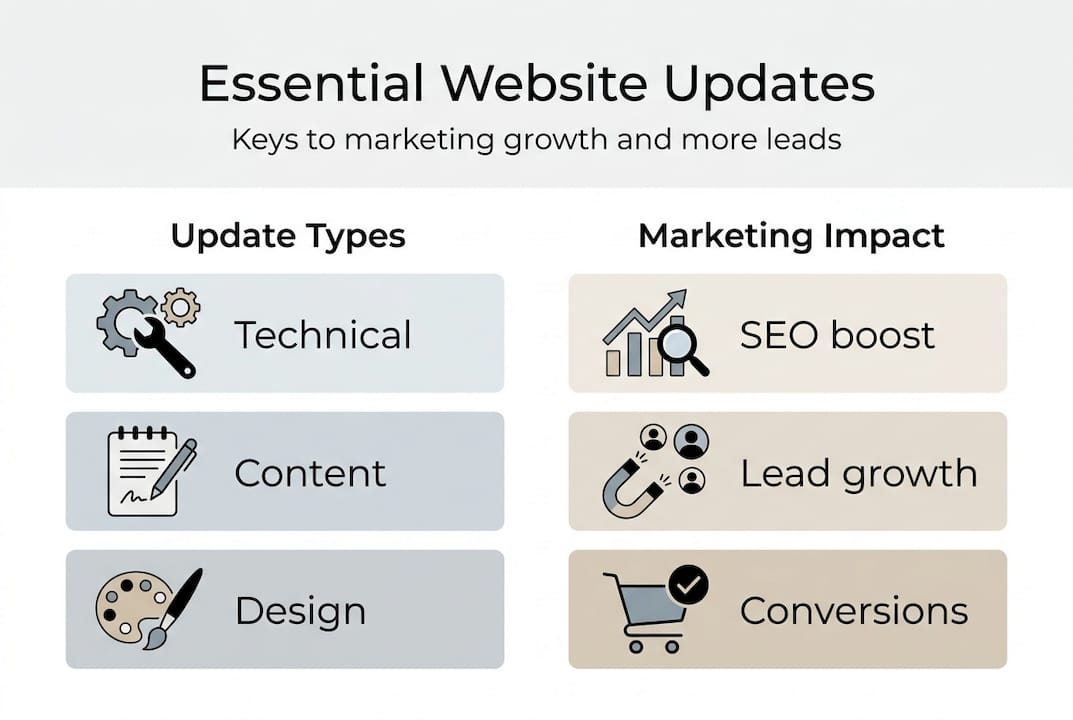
But it goes deeper than SEO. Website design impacts leads in ways most owners underestimate. Outdated CTAs, broken forms, slow load times, and confusing navigation all quietly erode your conversion rate. You might be driving solid traffic and still losing prospects before they ever contact you.
Here’s what regular updates actually protect and improve:
A rapid website updates strategy isn’t about constant redesigns. It’s about consistent, intentional improvements that compound over time.
“Your website should be your hardest-working sales rep. If it hasn’t been updated in six months, it’s probably underperforming.”
The site redesign SEO checklist confirms that effective mechanics include pre-redesign SEO audits, URL redirect planning, Core Web Vitals optimization, content depth improvement, mobile-first design, structured data, and post-launch monitoring to preserve rankings. These aren’t one-time tasks. They’re ongoing disciplines.
Pro Tip: Don’t update blindly. Connect every change to a specific KPI, whether that’s form submissions, time on page, or bounce rate. Updates that don’t move a measurable needle aren’t worth your time.
Not all updates are created equal. Some changes will transform your lead pipeline. Others are just cosmetic noise. Understanding the three core categories of website updates helps you spend your time and budget where it counts.
1. Technical updates
These are the foundation. Speed, mobile optimization, Core Web Vitals, structured data, and security patches all fall here. If your site loads slowly or breaks on mobile, no amount of great content will save your conversion rate.
2. Content updates
This is where most businesses can win fast. Update website content for SEO by adding authority content, refreshing existing pages with current keyword data, improving content depth, and rewriting CTAs that have gone stale. Content depth improvement and structured data are vital mechanics for marketing-driven redesigns and ongoing site performance.
3. Design updates
UI/UX refreshes, improved navigation flows, and mobile-first design changes. These matter most when your analytics show high bounce rates or poor engagement on key pages.
Here’s how each update type stacks up against core marketing metrics:
| Update type | SEO impact | Lead gen impact | Conversion impact | Urgency |
|---|---|---|---|---|
| Technical SEO | Very high | High | High | Immediate |
| Content refresh | High | Very high | Medium | Ongoing |
| CTA optimization | Low | Very high | Very high | Immediate |
| Design/UX refresh | Medium | Medium | High | Quarterly |
| Structured data | High | Medium | Low | Quarterly |
A website redesign drives growth when it combines all three update types strategically. But you don’t need a full redesign to see results. Targeted updates, applied consistently, deliver compounding gains.
One stat worth noting: businesses that regularly update their service pages with deeper content and clearer CTAs often see double-digit improvements in lead form submissions within 90 days. The website redesign process doesn’t have to be massive to be effective. Small, focused changes to high-traffic pages can outperform a full overhaul.
Knowing what to update is half the battle. Knowing what to update first is where most businesses get stuck. Here’s a practical, tiered approach that keeps your focus on ROI instead of busywork.
Step 1: Run a data-driven audit.
Before touching anything, pull your analytics. Identify your top 10 traffic pages, your top 5 conversion pages, and your worst-performing pages by bounce rate. Use data-driven audits to prioritize high-ROI pages first.
Step 2: Map updates to your update schedule.
A tiered schedule keeps things manageable:
Step 3: Focus on high-ROI pages first.
Not every page deserves equal attention. Here’s a quick comparison:
| Page type | Traffic potential | Lead gen value | Update priority |
|---|---|---|---|
| Service pages | High | Very high | First |
| Landing pages | High | Very high | First |
| Homepage | Very high | High | Second |
| Blog posts | High | Medium | Third |
| About us | Medium | Low | Last |
Step 4: Match update type to page goal.
A custom website design boosting leads starts with understanding what each page is supposed to do. Service pages need strong CTAs and fast load times. Blog posts need content depth and internal links. Types of business websites vary, and so should your update strategy.
Step 5: Track, measure, and repeat.
After each update cycle, compare KPIs. Double down on what worked. Cut what didn’t.
Pro Tip: Resist the urge to chase shiny object updates like a new color scheme or fancy animations. Start with the changes that directly affect traffic and lead forms. Those are your revenue levers.
Strategy without execution is just a wish list. The businesses that consistently win online have one thing in common: they’ve built a repeatable update routine and they stick to it.
First, decide who owns website updates. You have three options:
Whatever model you choose, the website updates and growth connection only holds if updates actually happen on schedule.
Here are the non-negotiable update tasks every growth-focused business should have on rotation:
The site redesign SEO checklist recommends a tiered update schedule: weekly content, quarterly audits, and a full redesign every 2 to 3 years. That framework works because it balances momentum with thoroughness.
The right website platforms for lead growth make this routine easier to execute. WordPress, especially with a managed setup, gives you the flexibility to update fast without breaking things.

Pro Tip: Block dedicated time on your calendar for quarterly audits, not just content publishing. Audits are where you find the leaks in your lead pipeline. Skipping them is like ignoring a slow drip in your roof until it becomes a flood.
The biggest pitfall? Obsessing over visual updates while ignoring technical health. A beautiful site that loads slowly or has broken forms will lose leads to an average-looking site that works perfectly.
Here’s the uncomfortable truth we’ve seen play out with hundreds of businesses: the ones waiting for the “perfect” redesign are the ones falling behind. Perfectionism is expensive. Waiting six months to launch a flawless new site means six months of lost rankings, lost leads, and compounding competitive disadvantage.
The businesses that consistently outpace their competitors treat their website like a living sales tool, not a static brochure. They update often, measure relentlessly, and iterate fast. They don’t aim for flawless. They aim for better than last month.
We’ve watched companies triple their lead volume not through massive redesigns, but through a disciplined rapid update mindset applied consistently over 12 months. Small wins compound. A faster load time here, a stronger CTA there, a refreshed service page with current keywords. These changes stack up into a serious competitive edge.
Our challenge to you: check your KPIs this month. Pick one underperforming page. Make one meaningful update. Measure it. Then do it again next month. That’s how real growth happens.
If you’re serious about turning your website into a consistent lead generator, the framework in this article gives you a strong starting point. But knowing what to do and having the bandwidth to execute it are two very different things.
At MonsterWP, we take the guesswork out of website updating entirely. Our fully managed WordPress platform handles everything from technical SEO and Core Web Vitals to content updates and CTA optimization, starting at $299 per month. Whether you need a custom website solution, a full suite of digital marketing services, or an integrated website, SEO, and PPC management package, we build and manage the digital engine so you can focus on running your business. No bloated retainers. No long contracts. Just fast execution and measurable results.
Aim for weekly content updates, quarterly SEO audits, and a major redesign every 2 to 3 years. A tiered update schedule with specific timing for each update type maximizes marketing ROI without overwhelming your team.
Updating critical service or landing pages with stronger content, faster load times, and clear CTAs delivers the fastest lead gen boost. Content depth and technical optimization together create the biggest impact on qualified leads.
Technical updates like improving Core Web Vitals and fixing SEO and site speed often have a greater impact on traffic and leads than purely cosmetic changes. Design matters, but a slow or broken site will underperform regardless of how it looks.
Simple content updates can be managed in-house, but technical SEO, major redesigns, and strategic planning will deliver far better results with expert support. The cost of getting technical updates wrong almost always exceeds the cost of hiring right.
Learn actionable local SEO steps to boost your small business visibility, attract qualified leads, and rank higher without hiring an agency.

Learn how to secure your WordPress site with practical, evidence-backed steps covering plugins, file permissions, database protection, and more for business owners.