
Top 3 GoDaddy.com Hosting Alternatives 2026
Explore the top 3 GoDaddy.com alternatives for reliable hosting solutions. Compare to make an informed decision for your business needs.

TL;DR:
- Digital growth is an affordable, accessible approach for small businesses to increase visibility, leads, and revenue using online channels. Success depends on building a strong website, implementing SEO, creating valuable content, and measuring results through analytics, rather than relying on large budgets or complex tools. Focusing on a clear, systematic plan and avoiding scattered efforts leads to sustainable growth and measurable outcomes within months.
Most small business owners assume digital growth is reserved for companies with massive marketing budgets and dedicated teams. That assumption is costing you leads, revenue, and market share every single day. The reality is that digital growth strategies have never been more accessible or affordable for small and mid-sized businesses. The tools exist. The playbooks are proven. What you need is a clear framework, the right sequence of actions, and the confidence to start. This guide gives you all three.
| Point | Details |
|---|---|
| Digital growth is accessible | Any small business can use online strategies to boost visibility, leads, and revenue. |
| Start with the basics | A strong website, SEO, and focused content form the foundation of all digital growth. |
| Consistency beats complexity | Repeating the right actions over time yields better results than chasing every trend. |
| Avoid common pitfalls | Stay focused, set clear goals, and don’t try to do everything at once. |
| Help is available | Turnkey solutions let you grow online without agency headaches or big budgets. |
Digital growth is the process of using online channels, systems, and strategies to consistently increase your visibility, attract qualified leads, and grow revenue. It is not a buzzword. It is not reserved for tech startups. It is a practical, measurable approach to building your business in the modern marketplace.
As one digital transformation strategies resource puts it, “digital growth involves leveraging online channels to increase brand visibility, customer engagement, and business revenue.” That definition holds true whether you run a plumbing company, a consulting firm, or a local retail shop.
The core pillars of digital growth include:
The biggest misconception we hear from business owners is that investing in digital marketing requires a massive budget or a team of specialists. It does not. What it requires is focus, a clear starting point, and a willingness to commit to a system.
“Digital growth is not about doing everything. It is about doing the right things consistently, in the right order.”
Pro Tip: Before you launch any digital tactic, identify your single most profitable service or product. Make that your digital growth entry point. Master promoting it online before expanding to other offerings.
Traditional marketing still works in certain contexts. A well-placed billboard or a local newspaper ad can generate awareness. But the limitations are real and significant. Traditional channels are largely static. Once you run a print ad, you cannot change the message, retarget the audience, or measure how many people actually called because of it.
Digital vs. traditional marketing is not just a comparison of channels. It is a comparison of philosophies. As the data consistently shows, “digital marketing offers measurable ROI and real-time adjustments, unlike traditional channels.” That flexibility is a game-changer for small businesses operating with lean budgets.
Here is a direct comparison to make this concrete:
| Factor | Traditional marketing | Digital growth |
|---|---|---|
| Targeting | Broad, geographic | Precise, intent-based |
| Tracking | Difficult to measure | Real-time analytics |
| Flexibility | Fixed after launch | Adjust anytime |
| Cost to start | Often high | Can start small |
| Speed to market | Weeks to months | Days to hours |
| Integration | Isolated channel | Connects with sales, CRM, email |
The cost advantages alone are compelling. A Facebook ad campaign can start at $10 per day, targeting your exact customer profile. A Google search campaign lets you pay only when someone clicks. Neither of those options exist in traditional marketing.
Beyond cost, the real power of digital is integration. Your website, your email list, your social media, and your paid ads can all work together as a single, coordinated system. That kind of multiplier effect is what enhancing digital visibility actually means in practice. It is not one channel. It is a connected machine.
“The businesses winning today are not the ones with the biggest budgets. They are the ones with the most connected, consistent digital presence.”
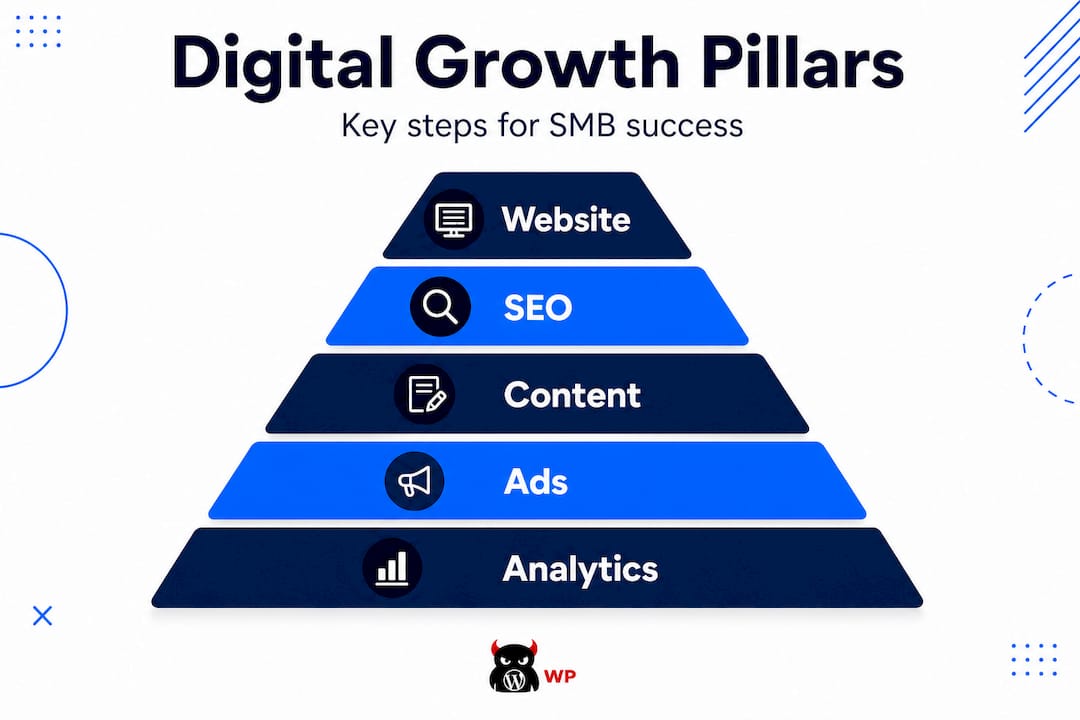
To make digital growth tangible, it helps to break it into five actionable pillars. Each one builds on the last, and together they form a foundation that compounds over time.

A strategic website, SEO, and targeted content are foundational for SMB success in digital growth. This is not opinion. It is consistently supported by data across industries. Your website’s marketing role is not just to look good. It is to convert visitors into leads, 24 hours a day, seven days a week.
Here is how the five pillars work together:
| Pillar | Primary benefit | Time to see results |
|---|---|---|
| Website | Lead capture and conversion | Immediate |
| SEO | Organic search visibility | 3 to 6 months |
| Content | Trust and authority | 1 to 3 months |
| Social media | Brand awareness and engagement | Weeks |
| Analytics | Ongoing optimization | Ongoing |
Explore the full digital marketing checklist to see how these pillars translate into a step-by-step action plan for your business. You can also review digital marketing fundamentals for additional context on how each element functions.
Pro Tip: Do not try to activate all five pillars at once. Pick one core channel, get it working, then add the next. Businesses that spread themselves thin across every platform almost always underperform compared to those that master one channel first.
Knowing the pillars is one thing. Knowing the order to build them in is what separates businesses that gain traction from those that spin their wheels. A phased roadmap helps SMBs steadily scale their online presence, starting with the website and SEO, then layering on more advanced tactics as momentum builds.
Here is the sequence we recommend:
For more detailed lead generation tips at each stage, especially for service-based businesses, it is worth reviewing what works specifically for your industry type.
Pro Tip: Think in quarters, not weeks. Set one meaningful digital growth goal per quarter, execute consistently, and review your results. Small, compounding wins build into significant growth over 12 to 18 months.
Most SMBs do not fail at digital growth because they lack effort. They fail because of avoidable, predictable mistakes. “Lack of focus, unclear targets, and trying too many tactics are the most common setbacks for SMBs starting digital growth efforts.” Knowing what to avoid is just as valuable as knowing what to do.
Here are the most damaging pitfalls and how to sidestep them:
Pro Tip: Set three clear, realistic digital growth targets for the next 90 days. Write them down. Share them with someone who will hold you accountable. Clarity and accountability beat motivation every time.
Here is something we have learned working with dozens of growing businesses: the tool is rarely the problem. The strategy is.
Business owners love the idea of a new platform, a new software, or a new tactic. And we get it. New feels like progress. But we have watched companies pour money into AI-driven ad platforms and sophisticated automation tools while their website was still slow, their messaging was confusing, and their SEO was nonexistent. The technology did not save them. It amplified their existing problems.
The most sustainable digital growth we have ever seen comes from businesses that committed to a simple, repeatable system: build a great website, get it ranked, create content that earns trust, then optimize relentlessly. No shortcuts. No magic tools. Just disciplined execution of the fundamentals.
Website design impact on lead generation is dramatic and often underestimated. A business with a fast, well-designed, conversion-optimized site will consistently outperform a competitor with a bigger ad budget but a broken digital foundation.
The hard truth is this: if you do not have clarity on your goals, your audience, and your core message, no amount of technology will save your digital growth strategy. But once you have that clarity and a solid foundation, the results can be remarkable. The best SMBs we work with are not the ones with the fanciest tools. They are the ones with the clearest systems.
If you are ready to implement digital growth but want to skip the complexity, the overpriced agencies, and the endless back-and-forth, we built MonsterWP specifically for you.
We design, launch, and fully manage high-performance custom WordPress websites starting at $299 per month, built to convert visitors into leads from day one. Every site is optimized for speed, security, and SEO without you lifting a finger. Need to grow your audience and stay visible? Our managed social media packages keep your brand active and engaging across the platforms your customers actually use. And when you are ready to accelerate, our add-on digital marketing services layer in paid advertising, content strategy, and SEO to drive qualified leads at scale. No bloated retainers. No long contracts. Just clear pricing and measurable results.
Start with a well-designed, fast website, set up basic SEO, and define clear goals before adding other channels. A phased roadmap helps SMBs build steadily without spreading resources too thin too early.
Track leads, conversions, and revenue against your marketing spend using analytics tools like Google Analytics. Digital marketing offers measurable ROI and real-time adjustments that traditional channels simply cannot match.
Absolutely. Automation, modern websites, and focused strategies allow small teams to compete effectively. Digital growth involves leveraging online channels in ways that scale without requiring large headcounts or expensive full-time staff.
Avoid chasing every new trend or tool before your fundamentals are solid. Lack of focus and unclear targets are the most consistent growth killers we see, regardless of industry or business size.
Most SMBs start seeing meaningful, measurable results within 3 to 6 months of consistent effort, especially when starting with a strong website and foundational SEO.
Explore the top 3 GoDaddy.com alternatives for reliable hosting solutions. Compare to make an informed decision for your business needs.

Unlock the power of content optimization strategies that drive results. Discover how to enhance rankings, leads, and revenue effectively!