Top 3 GoDaddy.com Hosting Alternatives 2026
Explore the top 3 GoDaddy.com alternatives for reliable hosting solutions. Compare to make an informed decision for your business needs.

TL;DR:
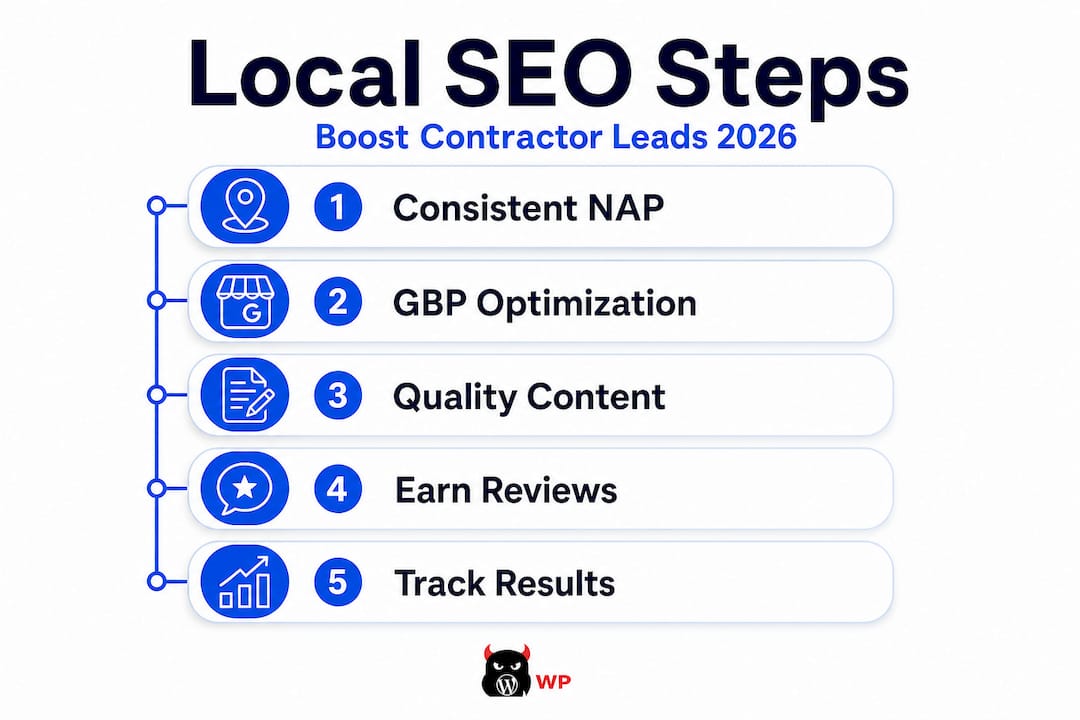
- Many contractors fall behind competitors who rank higher on Google and appear in local pack results.
- Effective local SEO, including optimized Google Business Profiles and accurate citations, is essential to close this gap.
Right now, your competitors are getting phone calls you should be getting. They rank above you on Google, show up in the local map pack, and capture leads before your name even enters the picture. The gap between you and them is not budget or years of experience. It is search engine optimization done right. In this guide, we break down the exact SEO strategies contractors and service-based businesses need to climb local rankings, build credibility online, and generate a steady stream of qualified leads throughout 2026.
| Point | Details |
|---|---|
| NAP consistency matters | Matching business details everywhere is fundamental for local SEO success. |
| Optimize Google Business Profile | A complete, accurate Google Business Profile sharply increases local leads for contractors. |
| Content plus citations | Publishing local, keyword-targeted content and building citations work together to boost search rankings. |
| Directories supplement, not substitute | Angi, HomeAdvisor and similar services bring leads, but should support—not replace—your website and SEO. |
| Monitor and adapt | Track results and update tactics regularly for sustained SEO growth. |
Now that you know why this guide matters, let’s clarify what SEO really means for your contractor business.
SEO is not just a website thing. It’s a visibility system that determines whether Google presents your business to someone searching “roof repair near me” or buries you on page four. For contractors, the most critical channel is local SEO, which governs your presence in local map results, Google’s local pack, and geo-targeted organic search results.
Your Google Business Profile (GBP) is the anchor of that system. Without a complete, well-optimized GBP, you are invisible to the exact customers ready to hire someone today. Following SEO best practices for your profile and website together is how you build a compound visibility advantage.
Key fundamentals every contractor must have in place:
For service-area businesses without a physical storefront, Google’s rules are clear. You must configure service areas in GBP rather than listing a virtual office or P.O. box. Using an unstaffed address can get your profile suspended, which wipes your local visibility overnight.
Pro Tip: If you work across multiple cities, add each city to your GBP service area list. This extends your local footprint without violating Google’s guidelines or needing multiple profiles.
With the basics covered, your next step is to get the foundation rock solid, starting with your GBP and citations.

Think of your GBP as your most valuable digital storefront. Google uses it to decide whether you show up in the “map pack,” which is the top three local results that appear above all organic listings. Those three spots capture the lion’s share of clicks for high-intent, local searches.
Here’s how to optimize your GBP from the ground up:
NAP consistency is not optional. Identical NAP across directories reinforces your GBP authority and tells Google your business is legitimate. Even small variations like “St.” versus “Street” can create confusion and weaken your local rankings.
Use a structured approach when building citations across the web, following a solid local SEO guide to prioritize the most impactful directories first.
| Directory | Priority | Industry fit |
|---|---|---|
| Google Business Profile | Critical | All contractors |
| Yelp | High | All service businesses |
| Angi (formerly Angie’s List) | High | Home services |
| Houzz | Medium | Remodeling, design |
| BBB (Better Business Bureau) | Medium | Trust signal |
| Nextdoor | Medium | Neighborhood services |
“Your GBP is only as strong as the consistency of your business data across the web. One mismatched phone number can undermine months of optimization work.”
Pro Tip: Use a tool like BrightLocal or Whitespark to audit your existing citations and find directories where your business is missing or listed incorrectly. Fixing those gaps is often the fastest win in local SEO.
For contractors applying the 2026 local SEO strategies that actually move the needle, getting citations right is non-negotiable before moving on to content.
With your listings accurate, it’s time to improve your online authority through content and on-page optimization.
Your website does two jobs. It convinces potential clients you’re the right contractor to hire, and it signals to Google that you’re the most relevant result for their search. Most contractor websites do neither job well. Thin content, no location pages, and no clear keyword targeting are the norm, which means the opportunity to stand out is wide open.
Here is a direct comparison of how a weak versus optimized contractor page performs:
| Page element | Weak page | Optimized page |
|---|---|---|
| Page title | “Services” | “Kitchen remodeling in Chicago, IL” |
| Header (H1) | “What we do” | “Trusted kitchen remodeler serving Chicago” |
| Content length | 100 words | 600 to 900 words |
| Schema markup | None | LocalBusiness + Service schema |
| Call to action | None | “Get a free estimate today” |
| Mobile speed | Slow | Under 3 seconds |
Every major service you offer should have its own dedicated page. A roofing company covering three cities needs three city-specific landing pages per service, not one generic “We cover the whole metro area” paragraph. That level of specificity is what drives content SEO strategies that generate real leads.
Critical on-page elements every contractor page needs:
Directory platforms like Angi and HomeAdvisor can supplement your lead flow, but directories as sole strategy is a risky bet. They charge per lead, control the relationship with the customer, and can raise prices or change their algorithm at any time. Your own website and GBP are assets you own and control. Build those first.
Pro Tip: Create a “service area” page for each city or region you cover. Include a short paragraph about the specific neighborhoods you serve, local landmarks, and types of projects you’ve completed in that area. This hyper-local content wins geo-targeted searches that generic pages simply cannot rank for.
Optimizing your website is only half the battle. Building online trust and authority will drive long-term results.
Google ranks local businesses based on three pillars: relevance, distance, and prominence. You control relevance through keywords and content. Distance is fixed by your location. But prominence, which is your reputation and authority online, is where most contractors have the most room to improve.
Here is where reviews become a competitive weapon:
Backlinks are the other side of authority. When a credible local website links to yours, Google treats it as a vote of confidence. Earn backlinks by getting listed in your local chamber of commerce directory, joining trade associations, sponsoring community events, and reaching out to local news outlets after a notable project. Even something as simple as featuring your business in a resource like a guide to professional business cards for contractors can earn a relevant, industry-adjacent link.
| Authority tactic | Effort level | Long-term impact |
|---|---|---|
| Review acquisition system | Low | Very high |
| Local chamber listing | Low | Medium |
| Trade association membership | Medium | High |
| Local press coverage | High | Very high |
| Guest posts on industry blogs | Medium | High |
Understanding the core SEO ranking factors that move the needle most helps you prioritize where to invest your time. And when combined with a strong content strategy, these authority signals feed directly into SEO and lead generation that compounds over time.
Directories like Angi and HomeAdvisor are worth using, but they are supplements, not replacements for organic SEO. Treat them as lead flow insurance while your owned channels grow.
Pro Tip: Create a simple follow-up text message template that thanks clients after a job and asks them to leave a Google review. Businesses that automate this process typically triple their review volume within 90 days.
After building authority, ongoing monitoring and avoiding missteps is critical to sustaining SEO success.
SEO without measurement is guesswork. Most contractors check their Google ranking once a month and call it done. That approach misses the real picture. Rankings are a vanity metric. What matters is calls generated, form fills received, and map views converted into customer actions.
Here’s how to build a simple monthly monitoring routine:
Stat to know: Businesses that maintain NAP consistency across directories consistently outperform competitors in local pack rankings, because every consistent citation acts as a trust signal that Google can verify independently.
Common contractor SEO mistakes that erase months of progress:
Pro Tip: Set a monthly calendar reminder for your SEO audit. Thirty minutes reviewing your GBP Insights, Search Console, and review count every month will keep you ahead of 90% of your competitors who never look at this data at all. Follow a reliable framework to boost business visibility and turn those insights into action.
With these strategies in place, it’s worth shining a light on why relying on shortcuts and lead generation hacks often sabotages long-term progress.
Here’s what we see constantly: a contractor gets tired of waiting for SEO results, so they buy a batch of low-cost leads from a directory, pay for a cheap automated citation blast, or hire someone offering “guaranteed page one rankings in 30 days.” Short-term, they might see a few extra calls. Long-term, these shortcuts quietly destroy what they spent months building.
Buying leads from directories feels like a solution, but you are renting your lead pipeline instead of owning it. The moment you stop paying, the leads stop. Your competitors pay the same platform and get the same leads. You’re bidding against yourself.
Automated citation blasts create inconsistent NAP data at scale, which is exactly the opposite of what Google needs to trust your business. And black-hat SEO tactics, things like keyword stuffing, fake reviews, or link schemes, can trigger penalties that remove you from local rankings entirely. Recovery from a Google penalty can take six to twelve months.
The contractors who build stable, growing businesses treat SEO as an always-on system, not a campaign they run when lead flow drops. They invest consistently in content, reviews, and technical health. They understand that digital marketing for leads works best when every channel reinforces the others.
The businesses winning the local search game in 2026 are not the ones who found a clever hack. They are the ones who stayed consistent while their competitors kept chasing shortcuts.
If implementing every strategy in this guide feels like a second full-time job, that’s because it genuinely is, unless you have the right team behind you.
MonsterWP is built for contractors and service businesses who want a high-performance digital presence without the agency runaround. We build and manage custom WordPress websites that are optimized for local SEO from day one, fast, mobile-ready, and structured to generate real leads. Beyond the website, our digital marketing solutions cover everything from GBP management and citation building to content strategy, paid ads, and review generation systems. No bloated retainers. No long contracts. Just clear pricing and measurable results that protect your revenue and grow your business.
Consistent NAP across directories combined with a fully optimized Google Business Profile remains the single most impactful step for local search visibility. Everything else builds on this foundation.
Yes, by using a properly configured Google Business Profile with defined service areas. Google allows service-area businesses to rank without a storefront, but virtual offices or P.O. boxes will get your profile penalized or removed.
Directories can bridge short-term lead gaps but should supplement, not replace, your organic SEO strategy. Building owned channels like your GBP and website creates a lead engine you control.
Monitor calls, web form inquiries, and your Google Business Profile Insights dashboard monthly. Look for growth in search impressions and direction requests as early indicators that your visibility is improving.
The most frequent error is mismatched business information across platforms. Even minor NAP inconsistencies confuse search engines and erode the trust signals you need to rank in the local map pack.
Explore the top 3 GoDaddy.com alternatives for reliable hosting solutions. Compare to make an informed decision for your business needs.

Unlock the power of content optimization strategies that drive results. Discover how to enhance rankings, leads, and revenue effectively!