Top 3 GoDaddy.com Hosting Alternatives 2026
Explore the top 3 GoDaddy.com alternatives for reliable hosting solutions. Compare to make an informed decision for your business needs.


TL;DR:
- In 2026, local businesses need to focus on citation share, multichannel presence, and AI citation sources rather than just rankings.
- Creating authentic, hybrid content that combines human expertise with AI optimization is essential for building trust and visibility across platforms.
- Building a comprehensive digital authority network through consistent profiles, reviews, structured data, and engaging content surpasses traditional SEO efforts for local success.
Most local service businesses are still playing the old SEO game, chasing a top-three Google ranking like that single number determines whether their phone rings or goes silent. The reality in 2026 is far more interesting, and more rewarding if you adapt. SEO has fundamentally shifted from a traffic-and-rankings race to a visibility game played across AI assistants, answer engines, business profiles, and social platforms all at once. If your business isn’t showing up where AI cites trusted sources, you’re losing leads to competitors who figured this out first.
| Point | Details |
|---|---|
| SEO is now AI-powered | Being cited by AI and answer engines has become more important than classic Google rankings. |
| User trust drives results | Content built for real users and authentic customer signals beats spam or shortcuts. |
| Hybrid content leads | Businesses succeed by blending human expertise with AI-driven content and tools. |
| Multichannel presence wins | Maintaining accurate information and engagement across platforms boosts overall visibility. |
| Action beats theory | Taking consistent, practical steps with content and reputation delivers the biggest SEO wins in 2026. |
Let’s set the stage by understanding how the definition and rules of SEO have changed in recent years.
For most of the past decade, SEO meant one thing: rank higher on Google and watch the traffic roll in. You optimized your title tags, built some backlinks, and hoped your page landed on the first page. Simple enough. That playbook is now only part of the story.
Two new disciplines now sit alongside traditional SEO. Generative Engine Optimization (GEO) is the practice of structuring your content and authority signals so that AI tools like ChatGPT, Google Gemini, and Microsoft Copilot cite your business in their generated responses. Answer Engine Optimization (AEO) targets voice assistants and featured snippet formats, making sure your content directly answers conversational questions users ask aloud or type into AI chatbots.
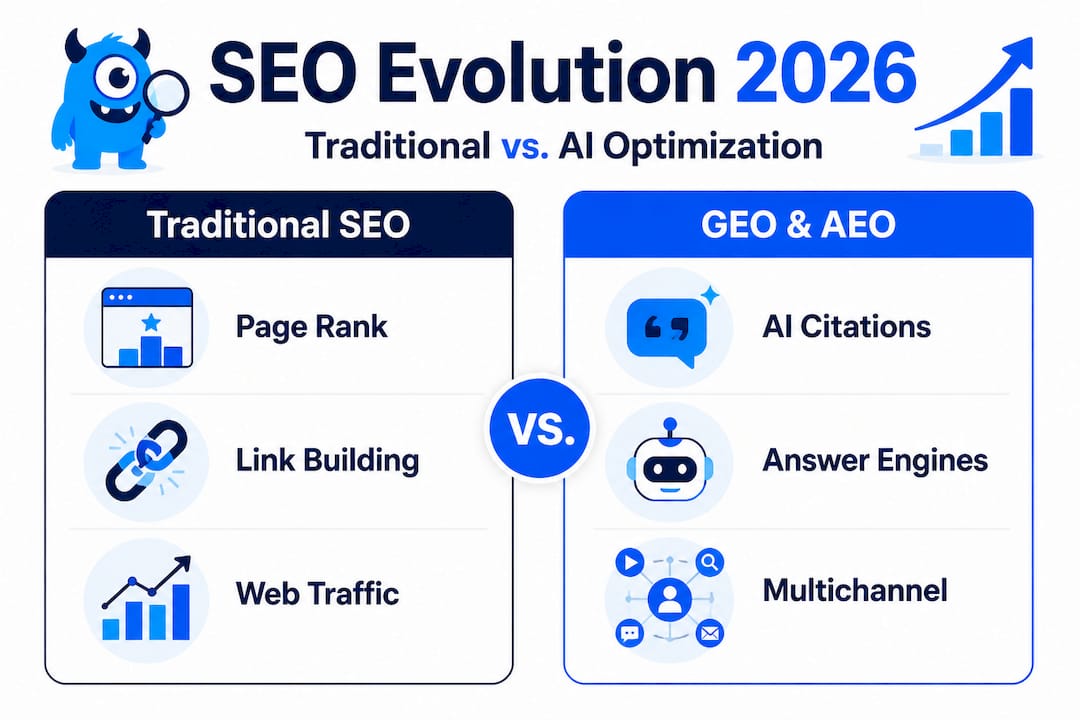
Here’s the shift in plain terms:
| Factor | Traditional SEO | GEO and AEO (2026) |
|---|---|---|
| Primary goal | Rank on page one of Google | Be cited by AI and answer engines |
| Success metric | Traffic and click-through rate | Citation share and multichannel presence |
| Content format | Keyword-optimized pages | Conversational, structured, authoritative content |
| Trust signal | Backlinks and domain authority | E-E-A-T, reviews, consistent listings |
| Channel focus | Website only | Website, profiles, social, review platforms |
The core principle that ties both worlds together is E-E-A-T, which stands for Experience, Expertise, Authoritativeness, and Trustworthiness. Google introduced this framework years ago, but AI engines have made it the primary filter for deciding which businesses deserve a citation or a featured answer. Traditional SEO metrics have shifted toward citation share and multichannel presence, yet the underlying user-first principles remain unchanged.
What does this mean practically? If you run an HVAC company, your goal isn’t just to rank for “HVAC repair near me.” It’s to be the business that ChatGPT recommends when someone asks, “Who’s the most trusted HVAC company in [your city]?” That’s a fundamentally different target, and it requires a different approach. Explore SEO and business growth in 2026 to understand how these shifts translate directly into revenue for local service providers.
Key changes local businesses need to internalize:
With the new context in mind, let’s examine the key ingredients for SEO success in 2026, especially for local service providers.
Local service businesses have always relied on trust. A homeowner doesn’t hire a plumber they’ve never heard of. That trust dynamic now plays out across every digital platform your business touches, and AI engines are watching all of it. Citation share, customer experience signals, and multichannel presence now shape local visibility more than any single ranking factor.
Here’s what you need to prioritize:
Pro Tip: Audit your business listings right now using a free tool like Moz Local or BrightLocal. Find every inconsistency in your NAP data and fix it before it bleeds into AI citation results. This single fix often produces visibility gains within 30 to 60 days.
The top SEO ranking factors for SMBs have expanded well beyond the website itself. Businesses that treat their Google profile, review strategy, and social presence as integral parts of their SEO system consistently outperform those still obsessing over on-page keywords alone. For a detailed roadmap, the SEO best practices for 2026 are worth applying systematically to your entire digital footprint.
Given that content still anchors SEO, the methods to create and distribute it have undergone a fundamental change, shaped by advances in AI.
Content remains the fuel that powers every SEO signal, but the formula for winning content has shifted. Businesses that publish generic, AI-generated articles at scale are seeing diminishing returns. Businesses that blend genuine human expertise with AI-powered production and optimization are climbing fast. That’s the hybrid model, and it’s winning everywhere.
Here’s why it works. AI tools are extraordinary at research, structuring outlines, identifying content gaps, and repurposing existing material across formats. What they can’t replicate is your firsthand experience, your customer stories, your hard-won industry knowledge, and the authentic voice that makes readers trust you. When you combine both, you get content that’s efficient to produce and credible enough to be cited by AI engines. Human and AI hybrid content wins across every major post-2026 algorithm update because it satisfies both machine evaluation and human trust simultaneously.
| Content type | Pure AI-generated | Human only | Hybrid (AI + Human) |
|---|---|---|---|
| Production speed | Very fast | Slow | Fast |
| E-E-A-T signals | Weak | Strong | Strong |
| Scalability | High | Low | High |
| Citation potential | Low | Medium | High |
| Authenticity | Low | High | High |
Here’s how to build a hybrid content system for your business:
Pro Tip: The businesses seeing the biggest gains from hybrid content are those who inject specific numbers and local context into every piece. Instead of saying “we help businesses grow,” say “we helped a Phoenix landscaper increase calls by 40% in three months.” Specificity is the shortcut to trust.
Explore AI SEO trends for SMBs and AI-driven SEO strategies to see exactly how forward-thinking local businesses are putting this model into practice right now.
Now, let’s turn these trends and changes into an actionable playbook for your business.
Understanding the landscape is one thing. Executing on it is another. Here’s a practical, step-by-step plan built specifically for local service businesses that need results without a full-time SEO department.
“User-first content, citation share, and multichannel presence are the pillars of SEO in 2026.” These three pillars work as a system. Strengthen one, and the others amplify. Neglect one, and the system leaks.
Pro Tip: Don’t try to do everything at once. Fix your NAP consistency in month one, build your review system in month two, and launch your content calendar in month three. Staged execution beats overwhelmed inaction every time.
Common pitfalls to sidestep: ignoring negative reviews instead of responding, publishing content that lists services without answering questions, and treating social media as optional. Each of these gaps is a citation signal your competitors are already exploiting. Explore content strategies for SMBs to build a content engine that generates visibility consistently.
Here’s the perspective most SEO guides won’t give you.
Businesses obsessed with their Google ranking position are optimizing for a shrinking audience. That’s the uncomfortable truth. When someone opens ChatGPT and asks for the best electrician in their city, your page-one ranking on Google does nothing. Zero. The AI doesn’t crawl the current search results page and hand over a ranking. It pulls from its training data, live web citations, trusted review platforms, and business profile signals to construct an answer. If your business isn’t woven into those sources, you’re invisible to that conversation.
We’ve seen this play out repeatedly. A local landscaping company with the number-one Google ranking for their primary keyword was losing leads to a competitor ranked fifth, because that competitor had 200 more Google reviews, a fully optimized profile, active social content, and structured data on every service page. The AI assistant recommended the competitor. The top-ranked business couldn’t understand why their phone had gone quiet.
The real opportunity hiding in plain sight is that citation share and multichannel presence are still being ignored by the majority of local service businesses. Most are still focused purely on their website ranking. That means the businesses that shift their energy toward building genuine authority across every platform are picking up market share from competitors who haven’t woken up yet.
This isn’t about abandoning traditional SEO. It’s about understanding that your website is now one node in a larger authority network. Build the full network, and your website ranking improves as a byproduct. Focus only on the website, and you’re fighting with one hand tied behind your back. The digital marketing tips that move the needle in 2026 are almost always the ones that build presence across multiple channels simultaneously.
If you want to put these new SEO rules to work faster, here’s how our team can help.
Knowing the playbook and executing it at scale are two very different things. Most local business owners don’t have the time to manage content calendars, structured data implementations, review systems, and social channels while running their actual business.
That’s exactly why we built MonsterWP. Our fully managed platform handles everything from your custom WordPress website to complete managed SEO and PPC campaigns built around GEO, AEO, and hybrid content strategies. We optimize your website, your profiles, your content, and your multichannel presence as one integrated system, not a collection of disconnected tactics. No bloated retainers. No confusing reports. Just a digital growth engine that generates qualified leads while you focus on serving your customers.
Traditional SEO focused on Google rankings and website traffic, while 2026 SEO is about being cited by AI and answer engines across multiple platforms. Your citation share across AI tools and business profiles now drives more qualified visibility than any single ranking position.
Keep your business information consistent across every platform, create genuinely helpful content that answers real customer questions, and build trust signals through reviews and active profiles. E-E-A-T principles and multichannel presence are the foundation AI engines use to decide which businesses deserve a citation.
Yes, your website remains critical, but it works as one component of a broader multichannel strategy. Human and AI hybrid content published on your site, combined with strong profiles and social presence, is what builds real authority in 2026.
Quality and trust signals dominate. Publishing ten thin articles produces far less impact than publishing two pieces packed with genuine expertise, specific local examples, and structured answers. Hybrid content combining human insight with AI optimization consistently outperforms both pure AI-generated content and infrequent manual publishing alone.
Explore the top 3 GoDaddy.com alternatives for reliable hosting solutions. Compare to make an informed decision for your business needs.

Unlock the power of content optimization strategies that drive results. Discover how to enhance rankings, leads, and revenue effectively!