
Boost digital visibility: Strategies for business growth and leads
Discover what digital visibility means for business growth in 2026. Learn effective strategies to boost your brand’s presence and generate qualified leads.


TL;DR:
- Revenue-focused website features like CTAs, forms, and chatbots increase lead generation and conversions.
- Owning your website’s data and sales processes offers greater long-term business control than relying on social platforms.
- Prioritizing transparent pricing, simple checkout, and personalized experiences boosts online sales and customer trust.
Most small business websites are quietly leaking revenue every single day. Visitors arrive, look around, and leave without taking any action, not because your service is weak, but because your website is missing the features that convert curiosity into contact. The features you choose to build into your site define its revenue potential more than its color scheme, its logo, or even its copy. This article breaks down six high-impact, revenue-focused website features, how to evaluate them, and how to decide which ones fit your specific business model so you stop guessing and start generating qualified leads.
| Point | Details |
|---|---|
| CTAs drive conversions | Clear calls to action and forms consistently increase lead generation and revenue for small businesses. |
| Lead magnets grow lists | Interactive tools and gated content attract email sign-ups, nurturing warm leads for future sales. |
| Chatbots qualify leads | AI-powered chat and analytics boost real-time engagement and help quickly optimize website performance. |
| Transparent pricing reduces abandonment | Displaying clear pricing and simplifying checkout builds trust and prevents lost revenue. |
| Own your revenue channels | A professionally managed website delivers greater long-term value and profit compared to relying on platforms. |
Not every feature that looks impressive actually makes you money. A flashy animated header? Nice. An auto-playing video? Debatable. A well-placed contact form tied to your CRM? Now we’re talking business. Before you add anything to your site, run it through a simple filter: does this feature generate leads, improve conversions, or keep customers coming back?
A revenue-driven feature meets at least one of these three criteria:
Beyond that, you want to evaluate features against four practical criteria. First, visibility: will visitors actually see and use this feature? A form buried on a contact page nobody visits is not a lead-generation tool. Second, engagement: does the feature invite interaction, or does it just sit there? Third, conversion potential: does it directly lead to a measurable business outcome? Fourth, ease of integration: can it connect to your email platform, CRM, or payment processor without a six-month tech project?
Effective CTAs increase conversions, with professional services seeing visit-to-lead rates of 8 to 15% when the right elements are in place. That number is not a fluke. It reflects what happens when a website is built around intent rather than aesthetics. You can review the broader website essentials for 2026 to see how these features fit into a complete growth-ready site.
Pro Tip: Prioritize features that collect emails and enable direct outreach. Follower counts and social shares feel good but do not pay bills. Email lists and phone numbers do.
With your evaluation criteria in place, the first category to prioritize is lead capture. It is the most direct pipeline between a website visitor and your bank account. Get this wrong and every dollar you spend on traffic is wasted.
A strong call-to-action (CTA) is not just a button that says “Contact Us.” It is a specific, benefit-driven prompt that tells the visitor exactly what happens next and why it is worth their time. “Get your free audit,” “Book a 15-minute strategy call,” or “Download the pricing guide” all outperform generic alternatives because they reduce uncertainty. Visitors act when they know what they are getting.
Simple forms are equally critical. The more fields you add, the more friction you create. For most service businesses, a form with a name, email, phone number, and one open-ended question is enough to qualify a lead without scaring them off. Research from Salesforce confirms that lead magnets like calculators and quizzes capture emails for ongoing nurturing, with B2B SMBs typically seeing a visitor-to-lead conversion rate of 1.5 to 2.5%. That might sound modest, but on 1,000 monthly visitors, that is 15 to 25 new leads per month from a single feature.
Lead magnets deserve a dedicated mention because they are chronically underused by small businesses. A lead magnet is any piece of gated content that gives visitors a reason to hand over their email address. Think of a home services company offering a seasonal maintenance checklist, a financial consultant offering a tax-prep guide, or a marketing agency offering a website audit report. These tools work because they provide immediate value in exchange for long-term access. As clear CTAs and contact forms show again and again across industries, the businesses that grow fastest are the ones who never stop collecting contact information.
“Your website should be working as your best salesperson 24 hours a day, 7 days a week.” This is the standard every SMB should hold their site to.
Strong website design and leads go hand in hand, and the most effective lead capture features are baked into the design itself, not bolted on as an afterthought. Well-crafted service pages that drive leads show exactly how this plays out in practice, and if you serve a professional audience, reviewing digital marketing tips for consultants can sharpen your approach further.

Beyond traditional forms, modern engagement tools work nonstop to qualify leads and optimize performance. Forms are passive. Chatbots and live chat are active. That difference matters enormously when a potential customer visits your site at 11 PM with a question that determines whether they book with you or your competitor.
AI-powered chatbots have moved far beyond the clunky pop-ups of the early 2010s. Today’s chatbots can greet visitors by name based on return behavior, ask qualifying questions, route leads to the right team member, and even book appointments directly into your calendar. They do not take breaks, get sick, or miss a lead while they are on lunch. AI chatbots and live chat qualify leads 24/7 while real-time analytics enable quick strategy adjustments, making them a powerful combination for any growth-focused business.
Live chat, on the other hand, puts a real person in the conversation when the stakes are high enough to warrant it. Many businesses use a hybrid approach: the chatbot handles initial screening and answers FAQs, and then a live agent jumps in when the lead is warm enough to close. This setup dramatically shortens purchase cycles because it removes the “I’ll think about it” delay that kills so many deals.
Analytics tools are the third pillar of this category. Without data, you are flying blind. With it, you can see exactly which pages drive the most leads, which CTAs get clicked, where visitors drop off, and which traffic sources bring buyers versus browsers. Here is a quick breakdown of the three tools and what each one does best:
| Tool | Primary function | Best for |
|---|---|---|
| AI chatbot | Automated lead qualification | High-traffic sites, after-hours coverage |
| Live chat | Real-time human engagement | High-value services, complex purchases |
| Analytics platform | Performance tracking and optimization | All business types, ongoing improvement |
Building strong website visibility and qualified leads is a continuous process, and analytics make that process measurable rather than speculative. When you know what is working, you double down. When you see what is not, you fix it fast.
Once you have engaged and qualified leads, optimizing checkout completes the conversion pipeline. This applies whether you are selling a product, a service package, or a booking slot. The goal is to remove every possible reason for a visitor to abandon the process before completing it.
Transparent pricing is the single most underrated trust signal on a business website. Many SMB owners are afraid to publish their rates because they fear losing prospects to lower-priced competitors. The reality is the opposite. Cart abandonment sits at roughly 70% in e-commerce, and a significant portion of that abandonment happens because shoppers encounter unexpected fees or have no pricing context until they are deep into the checkout process. Transparent pricing reduces this friction before it starts.
Simple, intuitive checkout design removes the mechanical obstacles. Every extra step, every required account creation, every slow-loading page represents another opportunity for a potential customer to bail. Best-practice checkout flows include:
Personalization is the final layer. When a returning visitor sees their name, their preferred services, or a recommendation based on past behavior, it signals that your business pays attention. That feeling of being known increases conversion rates and drives repeat purchases. Tools like dynamic content blocks in WordPress can personalize the experience without requiring a custom software build.
Pro Tip: Use Stripe or a comparable payment processor to own your transactions directly. Third-party marketplace platforms often charge 10 to 30% in transaction or listing fees. Processing payments through your own website keeps that margin where it belongs: in your business.
Investing in clear website pricing is one of the fastest ways to build trust and improve conversion rates without changing a single word of your service offering.
With all features explored, it is time to assess which ones deliver maximum impact for your specific goals. Not every feature is right for every business model. A local HVAC company and a B2B SaaS provider need different revenue engines, even if they both want more leads.
Here is a side-by-side comparison of the core revenue-driving features:
| Feature | Best business type | Avg. impact | Implementation effort |
|---|---|---|---|
| Strong CTAs and forms | All business types | High | Low |
| Lead magnets | B2B, consultants, service firms | Medium to high | Medium |
| AI chatbot | High-traffic, service businesses | High | Medium |
| Live chat | High-value services, e-commerce | Medium to high | Low to medium |
| Transparent pricing | E-commerce, service packages | High | Low |
| Personalized checkout | E-commerce, subscriptions | High | Medium to high |
When it comes to prioritizing by business type, here is how we recommend thinking about it:
Exploring the different types of business websites helps clarify which architecture supports these features best, and if you are building from scratch, understanding the principles behind custom website design for leads will save you from costly mistakes later.
Here is a perspective that most web design conversations skip entirely: the platform you build on is as important as the features you choose to add. We talk to business owners every week who have invested thousands into Instagram content, Facebook ads, or marketplace listings, only to watch their reach disappear after an algorithm change or a platform fee increase. That is not a revenue strategy. That is renting visibility from a landlord who can raise the rent or evict you at any time.
Your website is the only digital asset you actually own. The email list it builds, the leads it captures, the sales data it generates: all of it belongs to you. That data compounds in value over time. A two-year-old email list with 3,000 qualified subscribers is worth real money. A social media following of 10,000 on a platform you do not control is a liability disguised as an asset.
Integrated payments make this ownership even more powerful. When you process transactions through your own website rather than through a marketplace or third-party booking platform, you own the customer relationship from the first click to the final payment. You can retarget those customers, upsell them, and build loyalty programs without paying a cut to a platform middleman.
This is why we are so deliberate about the way we build sites. Looking at WordPress site types for service businesses reveals just how flexible and scalable a well-built WordPress site can be, especially when every revenue-driving feature is integrated at the architecture level rather than bolted on as a plugin afterthought. The businesses winning in 2026 are the ones who treat their website as a core business asset, not a digital brochure.
Ready to capture more revenue with less hassle? The features in this article work best when they are built into a site from the ground up, not layered onto a template that was never designed to convert.
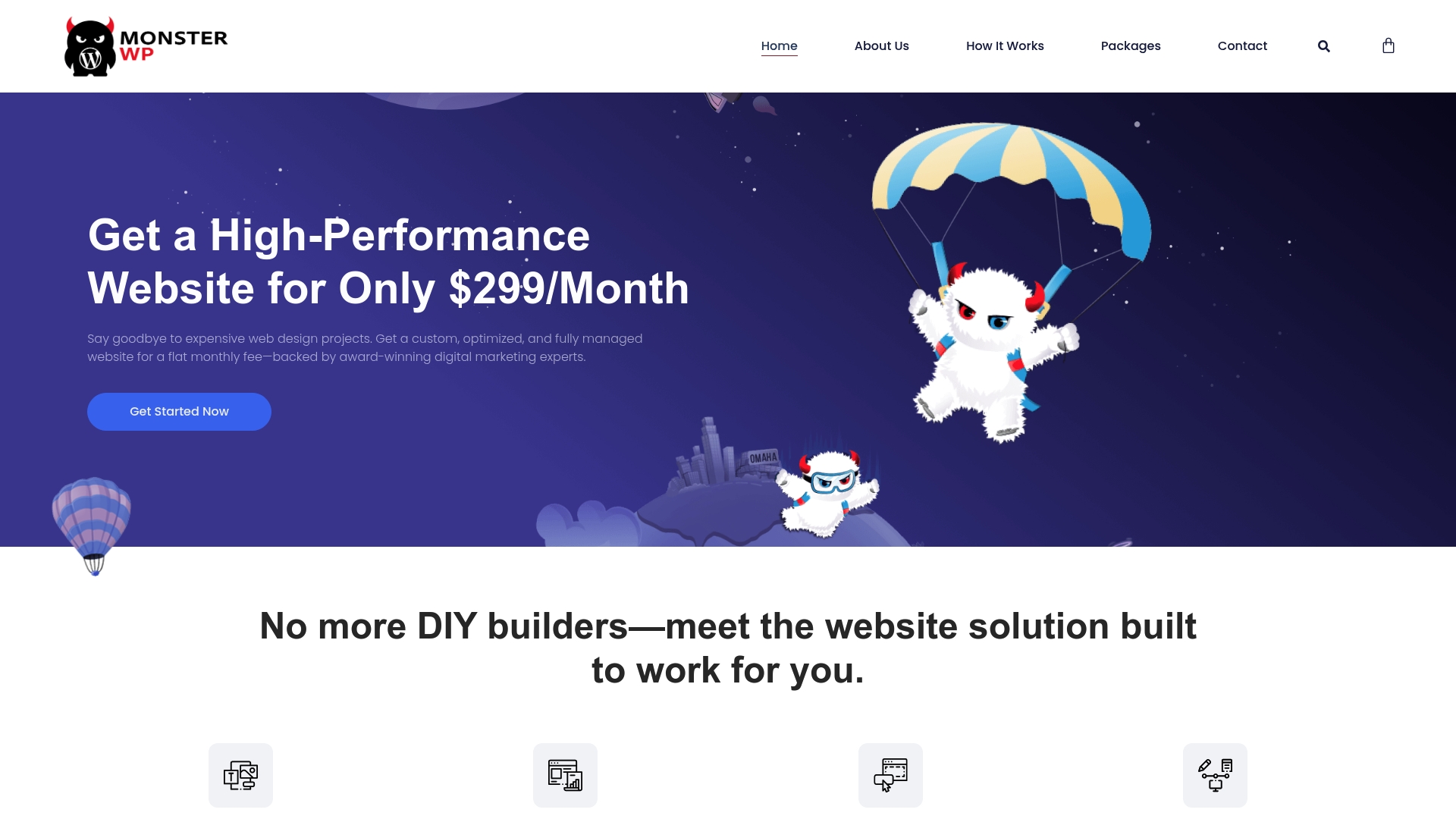
At MonsterWP, we build custom WordPress websites designed specifically to generate leads, qualify traffic, and convert visitors into paying customers. Every site includes Elementor Pro, speed and SEO optimization, and unlimited content updates so your site evolves as your business grows. We also offer fully integrated digital marketing services that extend your reach across search, social, and paid channels. No bloated retainers, no locked-in contracts, just a high-performance website that works as hard as you do.
Clear CTAs and contact forms are widely considered the top drivers of website revenue for SMBs because they create a direct, frictionless path from visitor intent to business contact.
AI chatbots qualify leads 24/7 and enable real-time engagement, which shortens purchase cycles and increases conversion rates even when your team is offline.
With cart abandonment at 70%, transparent pricing and a simple checkout process build the trust visitors need to complete a purchase rather than bouncing to a competitor.
B2B SMBs typically see a 1.5 to 2.5% visitor-to-lead conversion rate from lead magnets such as gated content, calculators, and quizzes, making them one of the most cost-effective list-building tools available.
Owning a website gives you complete control over your data, your leads, and your revenue streams, while social platforms limit your reach through algorithms and charge fees that erode your margins over time.
Discover what digital visibility means for business growth in 2026. Learn effective strategies to boost your brand’s presence and generate qualified leads.

Discover what is SEO visibility and how it can enhance your website’s reach. Learn to capture more organic traffic and generate qualified leads!