Top revenue-driven website features for small businesses
Transform your small business website with essential revenue-driven website features. Unlock potential leads and boost conversions today!
TL;DR:
- Digital visibility now includes AI citations, social feeds, PR mentions, and structured data.
- Consistent, authoritative branding across channels boosts AI recognition and trust signals.
- Combining organic, paid, and credibility-building strategies generates high-quality, sustainable leads.
Most business owners think digital visibility is just about ranking on Google’s first page. That mindset is already outdated. In 2026, visibility means being found in AI-generated answers, showing up consistently in social feeds, getting cited in PR mentions, and building a brand presence that signals legitimacy everywhere your customers look. A unified presence across channels signals legitimacy to AI platforms and search engines alike. This guide cuts through the noise and gives you a practical, channel-by-channel playbook to grow your business’s visibility and generate more qualified leads.
| Point | Details |
|---|---|
| Visibility is multi-channel | Being recognized everywhere online is more important for trust and lead generation than focusing only on SEO. |
| Credibility drives results | AI platforms and customers reward consistent, credible brands with higher visibility and more qualified leads. |
| Mix organic and paid | Success comes from blending steady organic strategies with tactical paid campaigns for balanced growth. |
| Structure matters | Organized, answer-focused content is favored by AI search and helps your business surface in both search and chat responses. |
| Freshness signals legitimacy | Regular updates across channels signal your business is active and trustworthy, boosting digital visibility. |
Digital visibility is the sum of every place your business can be discovered, evaluated, and trusted online. It goes far beyond traditional search rankings. Today, it includes your presence on Google, AI-powered answer engines like ChatGPT and Perplexity, social platforms, PR mentions, review sites, and structured data on your own website.
The old model of SEO was straightforward. You picked keywords, built backlinks, and optimized meta tags. That formula still carries weight, but it no longer tells the full story. Modern AI search visibility is shaped by how well AI systems understand your brand as a trusted entity, not just how many pages you’ve indexed.
Here’s what has fundamentally changed. AI systems, including Google’s Search Generative Experience and ChatGPT, don’t just match keywords. They evaluate whether your brand is a credible, coherent source worth referencing. AI and AEO require entity-based content clusters, attributable sources, and fresh, structured information to determine which brands earn citations in generative answers. If your content is scattered, inconsistent, or keyword-stuffed, you lose.
Understanding the full landscape of AI SEO trends for SMBs is critical for any business owner who wants to stay competitive in this new environment.
Key pillars of modern digital visibility:
| Factor | Traditional SEO | AI-driven visibility |
|---|---|---|
| Primary signal | Keywords and backlinks | Entity trust and structured content |
| Content goal | Rank for search queries | Be cited in AI-generated answers |
| Measurement | Rankings and organic traffic | AI citations, branded searches, and traffic quality |
| Update frequency | Occasional | Consistent and frequent |
| Trust source | Domain authority | PR mentions, reviews, and attributable sources |
The businesses that win in 2026 treat their online presence as a living, breathing system, not a static website. If you want your brand to be the one AI recommends when a potential customer asks for the best service provider in your category, you need to build a presence that earns that recognition. Exploring AI-driven SEO strategies that generate real results can help you understand where to focus your efforts first.
Let’s be direct. More visibility means more revenue. But not all visibility is equal, and that distinction is where most small and mid-sized businesses leave money on the table.

When your business shows up in the right places at the right moment, you capture customers who are actively looking to buy. That’s very different from generic brand awareness. The goal isn’t to be seen by everyone. It’s to be seen by the right people at the exact moment they’re ready to make a decision.
Here’s an eye-opening reality. Social platforms drive 64% of traffic for many businesses, yet that traffic often converts at lower rates compared to website-driven organic leads. Social gets you discovered. Your website converts the lead. Both matter, but they serve different roles in the funnel.
How visibility directly impacts SMB outcomes:
Understanding how website visibility and leads connect is one of the most important things any growth-focused business owner can learn.
| Channel | Traffic volume | Lead quality | Cost over time |
|---|---|---|---|
| Social media | High | Lower | Low initial, grows |
| Organic search (SEO) | Medium | High | Low long-term |
| Paid advertising | High | Medium | High, ongoing |
| AI citations | Growing fast | Very high | Low if earned organically |
| Email and website | Medium | Highest | Low |
The data tells a clear story. AI citations and organic search deliver the highest quality leads over time. Social builds awareness. Paid ads fill short-term gaps. A smart SMB strategy layers all of these channels together rather than betting everything on one.
Visibility score, a traditional SEO metric that runs from 0 to 100%, tells you how often your site ranks for tracked keywords. But in 2026, you also need to track how often your brand is cited in AI-generated answers. That’s a metric most business owners haven’t even started measuring yet, and it represents a massive opportunity.
Staying current with boosting SMB visibility best practices ensures you don’t fall behind competitors who are already building their AI presence.
Knowing why visibility matters is one thing. Building it is another. Here’s a step-by-step breakdown that any business owner can start executing today, without a massive team or a bloated budget.
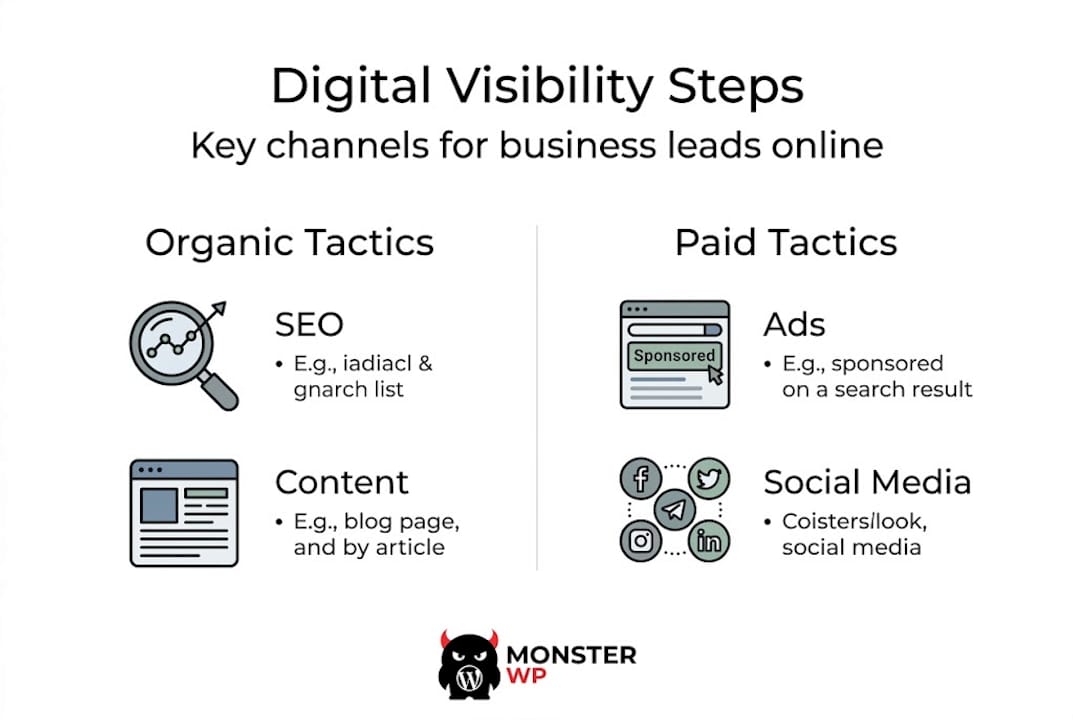
Structured, answer-first content combined with consistent cross-channel presence is the core formula for AI visibility in 2026. That means creating content that directly answers your customers’ most common questions, written in clear language that AI systems can easily parse and cite.
Step-by-step visibility build plan:
Pro Tip: Stop obsessing over keyword density. AI systems penalize thin, stuffed content and reward clarity. Write for your customer first, and structure the content so AI can extract and cite your key points easily. One well-organized, answer-first page outperforms ten keyword-stuffed blog posts every time.
The connection between digital marketing tips and lead generation is strongest when content strategy, web design, and brand consistency work together. And when it comes to your website, the choices you make about AI-assisted web design versus fully managed solutions can dramatically affect how quickly you build visibility.
Avoid the trap of treating each channel as a separate island. Your website, social profiles, PR strategy, and paid campaigns should all reinforce the same brand story. When AI systems see your business mentioned consistently across trusted sources, they start treating you as the authoritative answer to your customers’ questions.
Every business wants immediate results. Paid advertising promises that. But visibility built purely on ad spend is a house of cards. The moment you stop spending, the traffic stops. That’s not a growth engine. That’s a treadmill.
Organic visibility grows steadily and delivers long-term, high-quality leads, while paid visibility provides immediate traffic that fades the moment your budget runs out. Both have a role, but the blend matters enormously.
Organic visibility pros:
Organic visibility cons:
Paid visibility pros:
Paid visibility cons:
| Strategy | Time to results | Lead quality | Cost over 12 months | Sustainability |
|---|---|---|---|---|
| SEO and content | 3 to 6 months | High | Low | Very high |
| AI and AEO content | 3 to 9 months | Very high | Low | Very high |
| Paid search (Google Ads) | Immediate | Medium | High | Low |
| Social media organic | 2 to 4 months | Medium | Low | High |
| Paid social (Meta, LinkedIn) | Immediate | Medium | High | Low |
“Brands that earn trust through credibility, consistency, and attributed mentions are the ones AI platforms reference in generative answers. Paid visibility builds traffic. Earned credibility builds authority.”
The smart play for most SMBs is a blended strategy. Use paid ads to generate leads while you build organic authority. As your organic visibility grows, reduce your dependence on paid spend. Over time, your cost per lead drops and your visibility becomes self-sustaining.
Your website is the anchor of this entire strategy. A high-performance, well-designed site earns trust and converts visitors. It also serves as the hub where all your organic and paid efforts direct traffic. That’s why understanding how website design impacts leads is a business-critical priority, not just a design preference.
Transparency matters too. Businesses that show clear website pricing and straightforward service information earn more trust from both human visitors and AI systems evaluating their credibility.
Here’s an uncomfortable truth most marketing agencies won’t tell you. Businesses spend enormous energy chasing rankings while completely ignoring the trust signals that actually drive lasting visibility. We’ve seen it repeatedly. A business invests heavily in technical SEO tweaks and paid ads but neglects the simple, powerful act of building a coherent, credible presence across the web.
The shift to AI-driven search has made this mistake more expensive than ever. AI platforms are citation engines. They reward brands that are consistently referenced, clearly structured, and editorially trusted. PR and earned mentions build more lasting authority than link-building campaigns built on shortcuts.
“Credible brands don’t just rank higher. They get referenced, recommended, and remembered. In the AI era, that’s the difference between being invisible and being the answer.”
The businesses winning at digital visibility in 2026 are not necessarily the ones with the biggest budgets. They’re the ones who committed to clarity, consistency, and credibility across every touchpoint. If you want real results from AI SEO, start by asking whether your brand looks and sounds trustworthy everywhere a customer or AI system might evaluate it.
Pro Tip: Invest in structured information, clear service descriptions, and genuine PR outreach before you chase the next algorithm update. Credibility is the new backlink.
Building digital visibility that generates consistent, qualified leads takes more than good intentions. It takes a system. That’s exactly what we built at MonsterWP.
We design, launch, and manage high-performance custom WordPress websites optimized for speed, SEO, and AI discoverability from day one. We also provide managed social media marketing and a full suite of digital marketing add-ons including paid ads, SEO, and Answer Engine Optimization. No bloated retainers. No guesswork. Just a clear, affordable system that works. Starting at $299 per month, MonsterWP gives your business the digital engine it needs without the headache of managing it yourself. Get started today.
Digital visibility is how easily your business can be found and trusted across online channels, measured by search rankings, AI citations and website traffic quality, social presence, and branded search volume.
AI platforms prioritize credible, consistent brands, making structured, answer-first content essential for being referenced in AI-generated answers that reach your target customers.
Social platforms are powerful for discovery, but social drives 64% of traffic with lower conversion rates compared to organic website traffic, meaning you need both to generate qualified leads consistently.
Paid ads provide quick wins, but organic visibility is more sustainable and cost-effective over time, delivering compounding authority and lower long-term cost per lead.
You should update your content and profiles regularly because AI platforms require freshness and entity-based consistency to determine which brands earn citations in generative answers.
Transform your small business website with essential revenue-driven website features. Unlock potential leads and boost conversions today!

Discover what is SEO visibility and how it can enhance your website’s reach. Learn to capture more organic traffic and generate qualified leads!