Top revenue-driven website features for small businesses
Transform your small business website with essential revenue-driven website features. Unlock potential leads and boost conversions today!

TL;DR:
- SEO visibility measures your website’s share of total organic search opportunity across multiple keywords.
- It provides a comprehensive view of search presence, beyond rankings or traffic alone.
- Improving visibility involves targeted keyword research, technical SEO, local optimization, and ongoing benchmarking.
Most business owners obsess over one keyword ranking or fixate on monthly traffic numbers, convinced those metrics tell the full story. They don’t. SEO visibility is a percentage-based metric that estimates how much of the total available organic search traffic your website actually captures across a tracked set of keywords. It’s a far more complete picture of your search presence than any single ranking or traffic spike. If you’re serious about generating qualified leads through organic search, you need to understand what SEO visibility is, how it’s measured, what a good score looks like for a small or mid-sized business, and exactly how to improve it.
| Point | Details |
|---|---|
| Visibility is a strategy metric | SEO visibility measures your entire footprint across search, not just individual rankings or clicks. |
| Benchmarks guide growth | Scores of 15-30 percent are strong for SMBs, showing you’re capturing real market share. |
| Improvement is stepwise | Focus on keyword choice, technical fixes, and consistent optimization to steadily raise your visibility. |
| Pair with real results | Use visibility alongside traffic and lead data to see if your SEO is truly working. |
SEO visibility is not a vanity number. It’s a calculated estimate of how often your website appears in front of searchers, expressed as a percentage of the total possible organic traffic opportunity for your chosen keywords. Think of it as a dashboard gauge showing how much of the search highway your business actually occupies.
The metric is built on three core components:
Visibility is calculated by weighting keyword rankings by search volume and expected CTR, producing a score from 0% to 100%. A score of 0% means your site doesn’t appear for any tracked keyword. A score of 100% would mean you rank first for every single keyword in your set, capturing maximum possible clicks.
Here’s a simplified look at how different ranking positions affect the visibility formula:
| Ranking position | Estimated CTR |
|---|---|
| #1 | 27-39% |
| #2 | 15-20% |
| #3 | 10-13% |
| #4-5 | 6-9% |
| #6-10 | 2-5% |
| Page 2+ | Under 1% |
Notice how dramatically the numbers fall after position one. This is why SEO visibility rewards breadth and depth of rankings, not just one hero keyword sitting at the top.
Different tools measure visibility using proprietary methods. SISTRIX, for example, analyzes over one million keywords daily and weights them by volume and click probability. Semrush uses its own database and formula. This means visibility scores are not directly comparable between tools. What matters is tracking your score consistently within the same platform over time.
The key takeaway: SEO visibility is not one ranking. It’s your total search footprint, and without tracking it, you’re flying blind.
Choosing the right keyword set matters enormously here. If you only track five broad keywords, your visibility score won’t reflect your real market opportunity. Smart SMB SEO best practices recommend building a keyword set that includes your core services, location-based terms, and problem-focused phrases your customers actually type into Google.
These three metrics look related on the surface. They’re actually measuring very different things, and confusing them leads to bad decisions.
Here’s a direct comparison to make it clear:
| Metric | What it measures | Scope | Best use |
|---|---|---|---|
| Keyword ranking | Position for one term | Single keyword | Tracking specific pages |
| SEO visibility | Share of search opportunity | Multiple keywords | Overall market presence |
| Organic traffic | Actual visits from search | All organic sessions | Business and revenue impact |
Think of it this way. Your keyword ranking is like knowing you’re standing in a specific aisle of a massive store. Your SEO visibility tells you how many aisles you’re visible in across the whole building. Traffic tells you how many shoppers actually put something in their cart.

Here’s where things get counterintuitive. Visibility can rise even as traffic falls because high visibility doesn’t always equal high clicks, especially when SERP features like featured snippets, local packs, or “People Also Ask” boxes absorb user attention before they ever click a result.
Let’s make this concrete with three scenarios:
Featured snippets: You rank #1 for a high-volume query, and Google pulls your answer into a featured snippet. Your visibility score jumps because you’re occupying a dominant position. But traffic may drop because users get their answer directly on the results page without clicking through.
Local packs: A local service business appears in the Google Map pack for five location-based searches. Their visibility score rises significantly. Clicks from those results go directly to calls or direction requests, not website sessions, so traffic analytics undercount the actual business impact.
Ranking gains across many low-volume keywords: A business moves from position 12 to position 6 across 50 lower-volume keywords. Visibility climbs meaningfully, but traffic barely budges because the volume per keyword is small.
This is exactly why improving business website visibility requires looking at all three metrics together, not just chasing traffic numbers or fixating on a single keyword position.
Bottom line: Visibility is your search market share. Rankings and traffic are individual windows into a much bigger picture. Use all three, but let visibility tell you how healthy your overall presence really is.
Now you understand the metric. So what should you actually be aiming for? This is where most business owners either set the bar too low or get discouraged by comparing themselves to enterprise-level competitors.
Strong visibility scores for SMBs in the U.S. typically fall in the 15% to 30% range. Hitting 30% or above puts you in market leader territory for your niche and keyword set.
Here’s a practical benchmark table for small and mid-sized businesses:
| Visibility score | What it means |
|---|---|
| 0-5% | Just getting started or heavily outranked |
| 5-15% | Growing presence, room to improve |
| 15-30% | Strong performance, competitive position |
| 30%+ | Market leader, dominant local or niche authority |
A few critical points about these benchmarks: your score depends heavily on the competitiveness of your niche and the keyword set you’re tracking. A roofing company in a mid-size city tracking 40 local keywords will hit 20% much more easily than a SaaS startup tracking 200 high-competition national terms. Context is everything.
CTR data reinforces why visibility matters so much for lead generation. Consider that position #1 captures roughly 30% of all clicks for a keyword, while position #5 captures less than 7%. A business with strong visibility across 100 keywords in positions 3 to 5 is generating exponentially more lead opportunities than one with a single keyword ranking at position 1.
Key factors that influence your achievable visibility score:
Understanding SEO ranking factors for SMBs gives you a clear picture of which levers actually move your score in the real world.
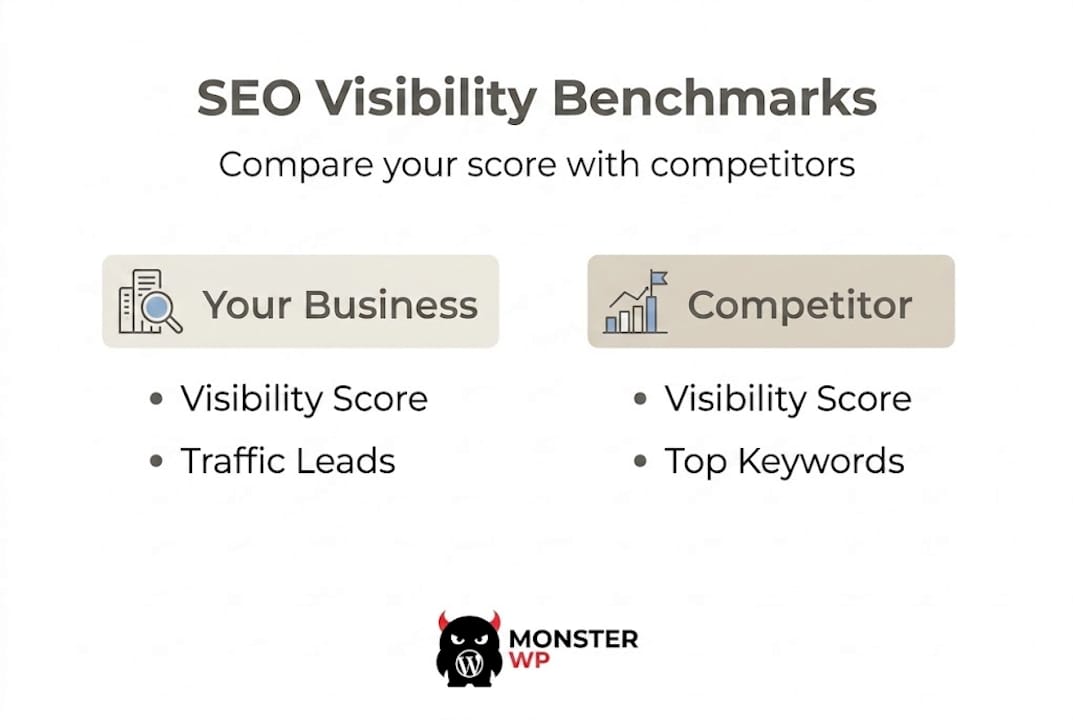
Pro Tip: Don’t compare your visibility score against a global competitor. Instead, track your score against two or three direct local or niche competitors. That comparison tells you exactly where the opportunity gap exists and how fast you’re closing it.
Good benchmarks are only useful if you know how to move the numbers. Here are the practical, prioritized steps that actually improve SEO visibility for U.S. small and mid-sized businesses.
Build a targeted keyword set. Start with 30 to 60 keywords that reflect your core services, service locations, and buyer intent phrases. Avoid only tracking broad vanity terms. Mix in long-tail keywords where competition is lower and purchase intent is higher.
Optimize titles and meta descriptions for CTR. Optimizing titles and metas for click-through rate directly improves visibility scores because higher CTR signals to tools that your position is worth more. Write titles that answer the searcher’s intent clearly and include your primary keyword near the front.
Target featured snippets and SERP features. Structure your content with clear headers, concise answers in the first paragraph, and FAQ sections. Google pulls these into snippets, local packs, and “People Also Ask” boxes, all of which increase visibility.
Fix technical SEO issues. Crawl errors, slow page speeds, broken links, and poor mobile performance all suppress your rankings across every keyword. A technically clean site is the foundation everything else builds on.
Prioritize local SEO through your Google Business Profile. For service businesses, prioritizing local SEO by optimizing your Google Business Profile with accurate categories, services, photos, and regular posts is one of the highest-ROI actions available. Local pack appearances contribute directly to your visibility score and drive phone calls and foot traffic.
Build content clusters around your core topics. Instead of publishing isolated blog posts, create a hub-and-spoke content structure where one detailed pillar page links to supporting articles. This signals topical authority to Google and drives rankings across many related keywords simultaneously.
Track and benchmark quarterly. Pull your visibility score every quarter and compare it against your top two competitors. Note which keyword groups improved or declined and investigate the cause. Consistent local SEO work compounded over time produces the most durable visibility gains.
Validate with Google Search Console. Cross-reference your visibility score trends with Search Console’s impressions and average position data. When both sources agree, you can trust the trend. When they diverge, investigate for algorithm changes or tracking issues. This connection between visibility tools and SEO for business growth is where strategy meets real results.
Pro Tip: After each quarterly review, identify your three lowest-performing pages in the visibility tracking set and run a focused optimization sprint: update the content, improve the title, add internal links, and check for technical issues. Small, consistent improvements across many pages outperform one-time overhauls on a single page.
Here’s the uncomfortable truth we see repeatedly. Business owners get access to a visibility score, watch it climb, and treat it as proof that everything is working. Then they wonder why their phone isn’t ringing more.
Visibility is a compass, not a destination. Used alongside actual lead and traffic data, visibility becomes a powerful strategic guide. Used in isolation, it creates a false sense of progress.
The most common mistake is tracking the wrong keywords. If your visibility score is built around broad, high-volume terms that your business realistically cannot rank for, the score will look flat for months. Worse, if you track only informational queries that attract researchers rather than buyers, high visibility produces zero leads.
Our recommendation is to build two keyword sets. One tracks your full market presence, broad and aspirational. The other tracks only buyer-intent and local keywords directly tied to your services. Monitor both, but make decisions based on what’s happening in the second set.
Cross-referencing visibility with actual leads closes the loop. If your buyer-intent visibility is rising and your leads are flat, the problem is likely on your website, weak calls to action, slow load times, or poor conversion design. If your visibility is flat but leads are growing, you may be capturing traffic from sources your tracking tool doesn’t cover, such as branded searches or referral traffic.
The businesses that win at SEO treat content for SEO success as a system, not a set of one-off tactics. Visibility is the scorecard for that system. Use it wisely.
Understanding SEO visibility is one thing. Turning that knowledge into consistent rankings, qualified leads, and real revenue growth is where execution matters.
At MonsterWP, we build high-performance custom WordPress websites optimized for speed, technical SEO, and conversion from day one. But we don’t stop at the website. Our managed SEO and PPC solutions are built to move your visibility score in the right direction, with structured content strategies, local SEO, and competitor tracking included. We also offer complete digital marketing services across Google, Meta, LinkedIn, and TikTok for businesses ready to accelerate growth across every channel. No bloated retainers. No long contracts. Just a clear system that works.
Monthly tracking helps you catch algorithm shifts or ranking drops early, while quarterly reviews are ideal for strategic decisions. Monitoring visibility trends alongside technical fixes ensures you’re always moving in the right direction.
Visibility rises when you gain more rankings or appear in SERP features like featured snippets or local packs, even if those features reduce direct clicks to your site. Visibility can increase while traffic falls because users sometimes get answers without clicking through.
Absolutely. Appearing in local packs and optimizing your Google Business Profile both contribute to visibility, particularly for service-based businesses targeting a specific geography. Prioritizing local SEO is one of the most efficient visibility improvements available to SMBs.
It’s theoretically possible but virtually unachievable in practice. A score of 100% requires ranking #1 for every single keyword in your tracked set, which is nearly impossible in any competitive market with more than a handful of keywords.
Transform your small business website with essential revenue-driven website features. Unlock potential leads and boost conversions today!

Discover what digital visibility means for business growth in 2026. Learn effective strategies to boost your brand’s presence and generate qualified leads.