
2026 Digital Marketing Trends Guide for Growth
Unlock the future with our 2026 digital marketing trends guide. Discover AI personalization, GEO, and more strategies for lasting growth!


TL;DR:
- Content quality and relevance are the primary drivers of SEO rankings in 2026.
- Regularly refreshing and optimizing content enhances visibility and maintains rankings; AI should assist, not replace, human expertise.
- Focusing on search intent, demonstrating expertise, and building credibility are essential for sustainable SEO success for small businesses.
Most business owners assume SEO is a technical puzzle: fix your site speed, earn a few backlinks, and watch the rankings climb. That thinking is costing you traffic. The reality is that content quality drives rankings more than almost any other factor. Google’s algorithm has evolved to reward pages that genuinely answer questions, demonstrate real expertise, and earn user trust. This article breaks down exactly why content is your most powerful SEO asset, how to optimize it without a massive budget, and what mistakes to avoid as AI tools flood the web with generic material.
| Point | Details |
|---|---|
| Quality trumps quantity | Google rewards content that matches user needs and showcases real expertise rather than just producing more pages. |
| Refresh to rank | Updating existing content can significantly boost SEO rankings and prevent performance decay. |
| AI is a tool, not a substitute | AI can help with drafts or ideas but human review and topic expertise are essential for top SEO results. |
| Small budgets, big wins | SMBs can excel by focusing on long-tail keywords, content clusters, and authentic stories to build trust and relevance. |
Technical SEO matters. A slow, broken site will never rank well. But once your technical basics are solid, content becomes the decisive factor. Google’s job is to match searchers with the most relevant, trustworthy answer. Your content is the only thing that proves you have that answer.
“Content must align with search intent, demonstrate E-E-A-T, and provide genuine user value to rank well.” — Moz SEO Learning Center
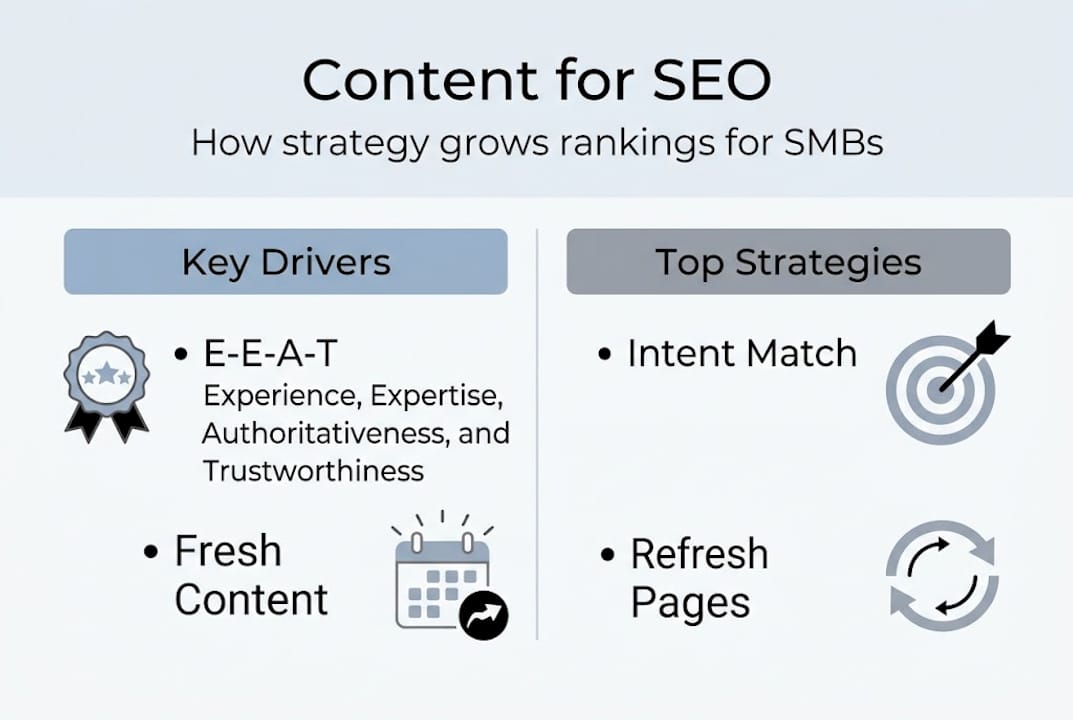
E-E-A-T stands for Experience, Expertise, Authoritativeness, and Trustworthiness. Google’s quality raters use this framework to evaluate pages, especially for competitive or sensitive topics. It’s not a direct ranking signal you can toggle, but it shapes how Google interprets your entire site. Pages that clearly demonstrate real-world experience and cite credible sources consistently outperform pages stuffed with keywords.
Understanding E-E-A-T principles is critical because it shifts your mindset from “how do I trick the algorithm” to “how do I actually help my audience.” That shift is where sustainable rankings come from.
Here’s what Google actually rewards in content:
Thin content, keyword stuffing, and pages that don’t match what searchers expect are the fastest routes to ranking nowhere. SEO content isn’t limited to blog posts either. Your service pages, FAQ sections, case studies, and even image alt text all contribute to your overall content footprint. Understanding SEO ranking factors helps you prioritize where to focus your energy first.
Knowing why content matters is one thing. Knowing how to actually optimize it is where most business owners get stuck. The process isn’t complicated, but it does require consistency.
The key mechanics of optimization include keyword research, on-page structure, content freshness, and formatting for scannability. Here’s a practical sequence to follow:
One of the most overlooked mechanics is intent-matching. Google categorizes search queries into four types: informational (“how does X work”), navigational (“MonsterWP login”), commercial (“best WordPress platforms”), and transactional (“buy WordPress hosting”). Writing a transactional page when someone wants informational content is a guaranteed way to lose rankings, even if your technical SEO is perfect.
| Content type | Search intent | Example query |
|---|---|---|
| Blog post / guide | Informational | “How to improve SEO” |
| Service page | Commercial / transactional | “WordPress SEO services” |
| FAQ page | Informational | “What is E-E-A-T” |
| Landing page | Transactional | “Get a free SEO audit” |
Content freshness is another underrated lever. Pages that haven’t been updated in 18 months often experience slow traffic decay as fresher competitors take over. Following solid SEO best practices includes scheduling regular content reviews, not just publishing and forgetting.

Pro Tip: Connect your Google Search Console data to a simple spreadsheet. Flag any page that has dropped more than 20% in impressions over 90 days. Those are your highest-priority refresh targets.
Content optimization also directly supports SEO for business growth by turning passive readers into qualified leads when your content matches what buyers are actively searching for.
Big brands have content teams, agency retainers, and unlimited budgets. You probably don’t. The good news is that smart, focused content strategy beats brute-force content production every time.
Affordable strategies that work for SMBs include using free tools, targeting long-tail keywords, refreshing existing content, and building content clusters. Here’s what that looks like in practice:
The data behind content refreshing is striking. Content expansion of 31 to 100% yields an average gain of 8 ranking positions, and regular updates reduce traffic decay by 87%. That means your existing content library is a gold mine most SMBs are ignoring.
| Strategy | Time investment | Ranking impact | Cost |
|---|---|---|---|
| Long-tail keyword targeting | Low | High for niche terms | Free |
| Content refresh | Medium | High (up to +8 positions) | Free to low |
| Content cluster building | Medium to high | Very high over time | Low |
| AI-assisted drafting | Low | Medium (needs human edit) | Low |
Exploring digital growth strategies alongside content work amplifies your results. And if you’re unsure where to start, updating website content on your highest-traffic pages is the single fastest win available to most business owners.
Pro Tip: Before creating any new content, run your existing pages through Google Search Console. Sort by impressions. Find pages ranking on page 2 (positions 11 to 20). Those pages are your best refresh candidates because Google already trusts them.
AI writing tools have made content production faster and cheaper. They’ve also made the web noisier and less trustworthy. Google has noticed, and the penalties are real.
AI-only content ranks 23% lower than human-written content, and pure AI content earns 61% fewer backlinks. That’s not a small gap. It means businesses that publish unedited AI output are actively damaging their SEO, not helping it.
The risks go deeper for certain topics. YMYL stands for “Your Money, Your Life.” It covers content about health, finance, legal advice, and safety. Google applies its strictest scaled AI content penalties to these areas, and businesses that publish thin or programmatically generated YMYL content have seen 60 to 90% traffic losses after algorithm updates.
Here’s what to avoid:
“Programmatic, scaled content generation without added value is now actively penalized, with some sites losing 60 to 90% of their organic traffic after core updates.” — Contextual SEO Guidelines
The right approach is to treat AI as a research assistant, not a ghostwriter. Use it to generate outlines, identify questions your audience is asking, and speed up first drafts. Then bring in human expertise, real examples, and editorial judgment before you publish. Exploring AI vs. human content performance and reviewing AI content strategies can help you find the right balance for your business.
Here’s the uncomfortable truth most content advice skips: speed without substance is a trap. The conventional push to “publish more, publish faster” has flooded the web with forgettable content that ranks briefly, earns no links, and converts nobody.
We’ve seen it repeatedly. Businesses that invest in fewer, better pieces consistently outperform those chasing volume. Hybrid AI-assisted content that combines AI’s research speed with genuine human expertise is both scalable and effective. That’s the model that wins.
Regularly optimizing existing content is no longer optional. It’s a strategic advantage, especially as AI-driven search engines like Google’s SGE and Bing Copilot pull answers from pages that demonstrate clear expertise and up-to-date information.
The real differentiator in 2026 is visibility of expertise. Businesses that show their credentials, cite real sources, and write for actual humans rather than algorithms are the ones building durable rankings. AI gives you speed. Human judgment gives you trust. Combine them, and you have a content engine that compounds over time.
You now have a clear picture of what drives rankings in 2026: content that matches intent, demonstrates expertise, and gets refreshed regularly. The strategy is proven. The question is execution.
At MonsterWP, we build and manage affordable custom WordPress websites that are optimized for SEO from the ground up. Every site includes structured content, speed optimization, and ongoing support so your rankings grow without you babysitting the process. Need more than a website? Our digital marketing add-ons include content strategy, SEO management, and paid advertising built for SMB budgets. No bloated retainers. No long contracts. Just a digital engine that works.
Content aligned with search intent that demonstrates real expertise and trustworthiness consistently outperforms content optimized purely for keywords or technical signals.
Quarterly reviews are ideal, but at minimum, update key pages annually. Regular updates reduce traffic decay by 87%, making refreshes one of the highest-return SEO activities available.
Not on its own. Pure AI content ranks 23% lower and earns far fewer backlinks than human-edited content, so always layer in real expertise before publishing.
Absolutely. By targeting long-tail keywords and content clusters, SMBs can build strong topical authority in specific niches that larger, more generalist sites simply can’t match.
Unlock the future with our 2026 digital marketing trends guide. Discover AI personalization, GEO, and more strategies for lasting growth!

Discover what is predictable pricing in web services and learn how fixed costs can empower your SMB’s budget. Gain financial control today!