
Top 3 GoDaddy.com Hosting Alternatives 2026
Explore the top 3 GoDaddy.com alternatives for reliable hosting solutions. Compare to make an informed decision for your business needs.


TL;DR:
- Most service businesses fail to utilize structured data effectively on their websites, missing out on improved search visibility and higher click-through rates. Implementing relevant schema types like LocalBusiness, Service, FAQPage, and Review enhances search results with rich snippets, building trust and attracting qualified leads. Success depends on aligning content, schema, and overall authority, as well as ensuring accurate, visible information to future-proof SEO efforts.
Most service businesses are leaving serious money on the table. Fewer than 1 in 3 small service companies use structured data correctly on their websites, meaning they miss out on rich search features that drive higher click-through rates and more qualified leads. If you run a law firm, cleaning service, consulting company, or any other service business, this isn’t a technical problem reserved for developers at large corporations. It’s an opportunity you can act on right now. This guide breaks down exactly what structured data is, which types matter most for your business, and how to implement it so Google and AI search engines work harder for you.
| Point | Details |
|---|---|
| Structured data clarifies your services | It helps search engines understand your business and display enhanced listings in search results. |
| Right schema fuels lead generation | LocalBusiness, Service, FAQ, and Review schema can increase inquiries and trust from customers. |
| Map goals to schema types | Align schema markup with your key lead drivers, such as contact forms, reviews, or service offerings. |
| Authority trumps perfection | Focus on content credibility and relevance, not just error-free markup, to earn rich search features. |
Structured data is code you add to your website that speaks directly to search engines. Instead of leaving Google to guess what your page is about, you spell it out explicitly using a standardized vocabulary. The result? Google understands your content faster and can present it in richer, more attractive formats in search results.
The backbone of structured data is schema.org, a collaborative project supported by Google, Bing, and Yahoo. As schema.org vocabulary helps search engines interpret content for more effective presentation, it acts as a universal translator between your website and every major search engine. Think of it as labeling every item in your house before a visitor arrives. They don’t have to figure out what’s in each drawer. They already know.
For service businesses specifically, structured data does something powerful: it turns a plain blue link in search results into a rich, informative entry that builds trust before a prospect even clicks.
“Structured data doesn’t just help search engines read your content. It enables them to present your business more authoritatively, which directly affects how many people choose to click on your result over a competitor’s.”
Here’s what structured data can visibly do for your search results:
Every one of these features is powered by schema markup working behind the scenes. And every feature increases the chance that a searcher chooses you over the competitor listed right next to you. You can learn more about how schema markup and lead generation work together to build a sustainable pipeline.
Now that you know how powerful structured data can be, let’s look at the specific types that drive results.
Not all schema types are created equal. Some are built for e-commerce. Others are designed exactly for companies like yours. For service-based companies, schema types relevant to lead generation typically include LocalBusiness and its variants, Organization, Service, FAQPage, HowTo, and Review with aggregate ratings.
Here’s a breakdown of how each type maps to real business outcomes:
| Schema type | Best for | Lead generation benefit |
|---|---|---|
| LocalBusiness | Service companies with a location or service area | Triggers local pack results and map listings |
| Service | Individual service pages | Describes offerings directly to search engines |
| FAQPage | Pages with common client questions | Expands listing real estate in search results |
| Review / AggregateRating | Any page with testimonials | Displays star ratings in SERPs to build trust |
| HowTo | Process-driven or educational content | Rich results that attract problem-aware prospects |
| Organization | Company-wide identity | Powers Knowledge Panel and entity recognition |
Each of these serves a different purpose in your funnel. LocalBusiness establishes you as a real, trusted entity in your area. Service schema tells Google precisely what you offer. FAQPage and HowTo schema capture users who are in the research phase and have specific questions. Review schema does the persuasion work before a user ever lands on your page.
Selecting the right schema starts with understanding your page’s purpose. Here’s how to approach that decision:
Pro Tip: Match schema types to landing page content intent. A page with a form and service details should use Service schema. A page that answers FAQs should use FAQPage schema. Using the wrong schema type for a page’s purpose can disqualify you from rich result eligibility entirely.
The way your schema interacts with your overall site structure also matters. Understanding what website types for lead generation work best gives you a foundation to build schema around pages that are already designed to convert. And when website design and lead capture are aligned with your schema strategy, the whole system works harder together.
Having identified the right schema types, the next step is applying them in a way that search engines can actually use and reward.
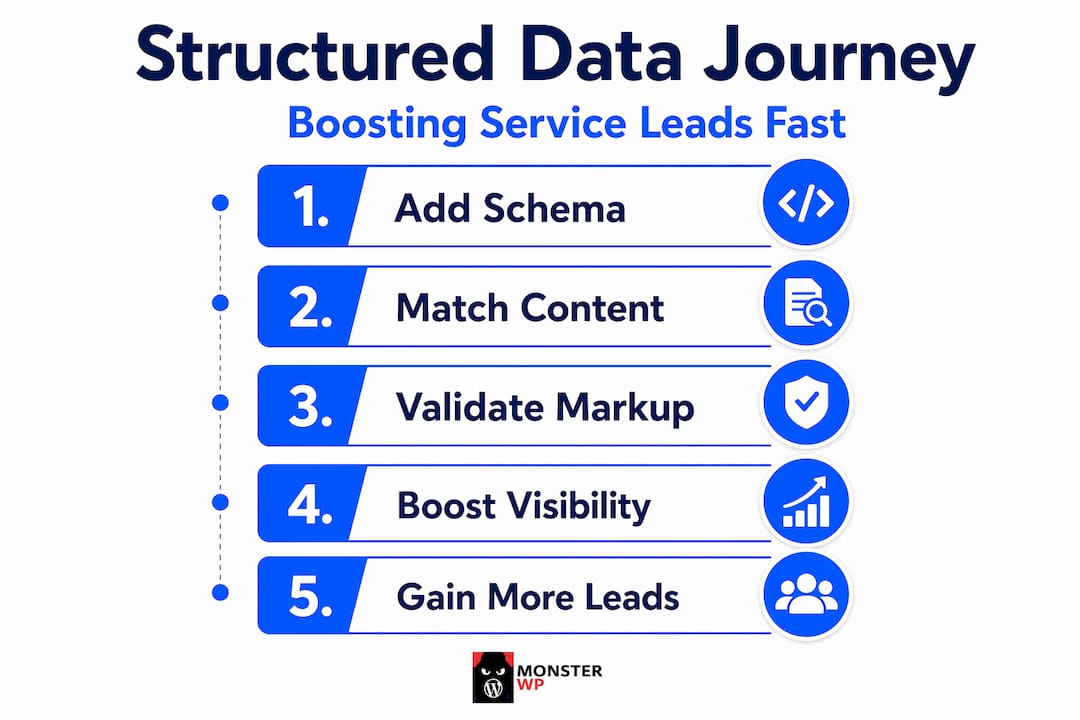
Implementation sounds intimidating, but breaking it down into steps makes it manageable. The goal is to map your business goals to the schema types that can surface rich or extractable attributes, such as FAQ for Q&A-rich pages, LocalBusiness and Organization for entity consistency, and review ratings where legitimately present. Then validate eligibility and completeness before scaling sitewide.
Here’s a step-by-step process to get structured data working on your service site:
| Business goal | Recommended schema type | What it unlocks |
|---|---|---|
| Drive local calls and bookings | LocalBusiness + Service | Local pack, phone number, hours in SERP |
| Build trust with new visitors | Review + AggregateRating | Star ratings displayed in search |
| Rank for research-phase queries | FAQPage + HowTo | Expanded FAQ or step-by-step rich results |
| Establish brand authority | Organization | Knowledge Panel presence and entity linking |
| Promote specific services | Service | Rich service descriptions in search results |
Two of the most common mistakes we see from service businesses are mismatched markup and invisible content. If your schema says you have 47 five-star reviews but your page shows no reviews, Google may disqualify the markup entirely. Always ensure what you’ve coded in the schema is visible and accurate on the actual page.

Pro Tip: Always ensure visible page content matches your schema. Google’s eligibility system rewards pages where the markup reflects real, accurate, visible information. Schema that describes content that doesn’t exist on the page is a fast track to penalties, not rankings.
Solid content strategies for SEO also support your structured data by ensuring the actual page content is strong enough to be worth surfacing in rich results. Schema and content quality are not separate strategies. They reinforce each other.
Proper implementation is the backbone of structured data, but for service businesses, entity consistency and AI search visibility add extra layers of opportunity.
Search engines have evolved far beyond simple keyword matching. They now think in terms of entities, meaning specific people, places, organizations, and concepts that have distinct identities and relationships. Your business is an entity. When Google sees consistent information about your entity across your website, your Google Business Profile, your directory listings, and your structured data, it gains confidence in your business and ranks you more prominently.
Some teams use structured data as part of entity linking and semantic clarity, and report measurable uplift in AI Overview visibility and increased bot visits after implementing entity-level schema. This means structured data isn’t just about today’s Google. It’s about positioning your business for AI-powered search, voice search, and whatever search formats emerge next.
“Entity consistency isn’t a bonus feature of structured data. It’s the infrastructure that makes your business recognizable and trustworthy to AI-driven search systems at every touchpoint.”
Here’s what to focus on to maintain strong entity consistency across your entire web presence:
For local service businesses, this consistency directly feeds into local SEO performance. Our local SEO guide shows exactly how to align these signals for maximum impact in your city or region.
AI search tools and Google’s AI Overviews pull from authoritative, well-structured sources. When your site has clean entity schema and consistent data signals, you’re far more likely to be cited, surfaced, or referenced in those AI-generated answers. That’s not a future opportunity. It’s happening right now.
Understanding these advanced benefits, let’s take a clear-eyed look at the realities of structured data in practice.
Here’s a perspective that most SEO guides won’t give you. The internet is full of tutorials telling you how to format JSON-LD correctly, which required fields to include, and how to avoid validation errors. That technical checklist matters, but it’s not the whole game. In fact, obsessing over perfectly error-free markup while ignoring content quality and trust signals is one of the biggest mistakes we see service businesses make.
The truth is that eligibility for rich results is a combination of validity, content depth and authority, and contextual trust, not error-free markup alone. Google uses structured data as a signal. But it weighs that signal against the overall authority and quality of your page. A technically flawless schema on a thin, low-authority page won’t get you the rich results you want.
What actually moves the needle is alignment. Your schema should reflect real expertise. Your reviews should be genuine. Your FAQ answers should be thorough and useful, not keyword stuffed. When your schema and your content tell the same honest, authoritative story, search engines reward that alignment with better placements and richer results.
Pro Tip: Prioritize clarity, authority, and legitimacy over technical obsession. Get your markup right, yes. But spend equal energy on ensuring the content behind the markup is actually worth surfacing. A strong page with solid schema beats a perfect schema on a weak page every time.
We’ve seen service businesses chase perfect validation scores while their actual service pages lack depth, testimonials, or credibility signals. Their competitors with slightly imperfect markup but genuinely helpful content consistently outrank them. That tells us everything. The SEO best practices that actually boost visibility for small and mid-sized businesses are rooted in content quality and trust, not technical gymnastics.
Structured data is a tool for conveying meaning. Use it to tell Google exactly who you are, what you do, and why your business is credible. That’s the version of structured data that generates real leads.
Structured data done right is a growth engine. But getting the strategy, implementation, and content alignment working together takes time and expertise that most business owners simply don’t have to spare.
At MonsterWP, we build high-performance WordPress websites with structured data, SEO, and lead generation baked in from day one. No guesswork. No bloated agency fees. Every site we build through our custom website solutions includes schema markup, speed optimization, and an SEO foundation designed to rank and convert. If you’re ready to pair your website with a full growth strategy, our digital marketing packages combine SEO, structured content, and paid advertising into one clear, measurable system. Fast execution. Real results. No long contracts.
Start with LocalBusiness or one of its variants, as these are the foundation for local relevance and lead capture for service companies operating in a specific area.
Apply structured data where it directly reflects page intent and visible content, especially on service, contact, and FAQ pages, since implementation should mirror page intent and visible content to avoid eligibility failures.
Use Google’s Rich Results Test or the Schema Markup Validator to confirm your markup is valid and eligible for search enhancements, then monitor Google Search Console for active rich result appearances.
Yes, expert evidence shows that structured data supports entity clarity and teams report measurable uplift in AI Overview visibility and voice search results after implementing entity-level schema for local services.
Explore the top 3 GoDaddy.com alternatives for reliable hosting solutions. Compare to make an informed decision for your business needs.

Unlock the power of content optimization strategies that drive results. Discover how to enhance rankings, leads, and revenue effectively!