
What Is a Website Revenue Asset? A Guide for Business Owners
Discover what is a website revenue asset and how it can transform your business. Learn to turn your site into a valuable income-generating tool!


TL;DR:
- Effective digital marketing measurement requires defining KPIs aligned with business goals and using incremental testing to determine true impact. Relying on vanity metrics or incomplete attribution can mislead budget decisions and obscure genuine performance insights. Building a reliable measurement framework involves proper tools, strategic goal setting, and continuous evaluation to drive profitable growth.
Most marketers are drowning in data and starving for insight. Understanding what is measurable digital marketing separates businesses that spend confidently from those that guess, hope, and get surprised at the end of the quarter. Measurable digital marketing means defining success through quantifiable, business-aligned KPIs and using those signals to drive real budget and strategy decisions. It is not about collecting every number your dashboard will display. It is about knowing which numbers actually connect to revenue, and having the systems in place to trust what they tell you.
| Point | Details |
|---|---|
| KPIs beat raw metrics | Link every marketing number to a business objective or it is just noise filling a dashboard. |
| Incrementality is the real test | Platform-reported ROAS can flatter your campaigns. Incrementality testing reveals what would have happened without the ad. |
| Vanity metrics waste budgets | Clicks and impressions feel productive but rarely connect to profit without deeper funnel tracking. |
| Measurement needs a cadence | Reviewing data too infrequently or at the wrong intervals leads to slow, costly decisions. |
| Tools only work with strategy | Google Analytics and CRM systems are only as useful as the KPI framework behind them. |
Measurable digital marketing means defining success through quantifiable goals and tracking KPIs to assess campaign effectiveness over time. That definition sounds simple. The execution is where most businesses fall apart.
Digital channels offer something traditional media never could: a near-complete audit trail of customer behavior. Every click, scroll, form submission, and purchase can be logged and attributed. But that abundance of data creates a trap. When everything is trackable, teams often track everything, and mistake volume for clarity.
The foundation of measurable online marketing is goal alignment. Your marketing goals must connect directly to business strategy. A local law firm running Google Ads should not be measuring brand awareness reach as a primary KPI. It should be tracking cost per qualified lead, conversion rate from landing page visits, and the ratio of marketing spend to new client revenue. The KPI set needs to fit the business model.
Here is the distinction that matters most in digital marketing analytics: a metric is any number you can collect. A KPI is a metric tied to a decision. Page views are a metric. Cost per acquisition tied to your target profit margin is a KPI. Treating one like the other is expensive.
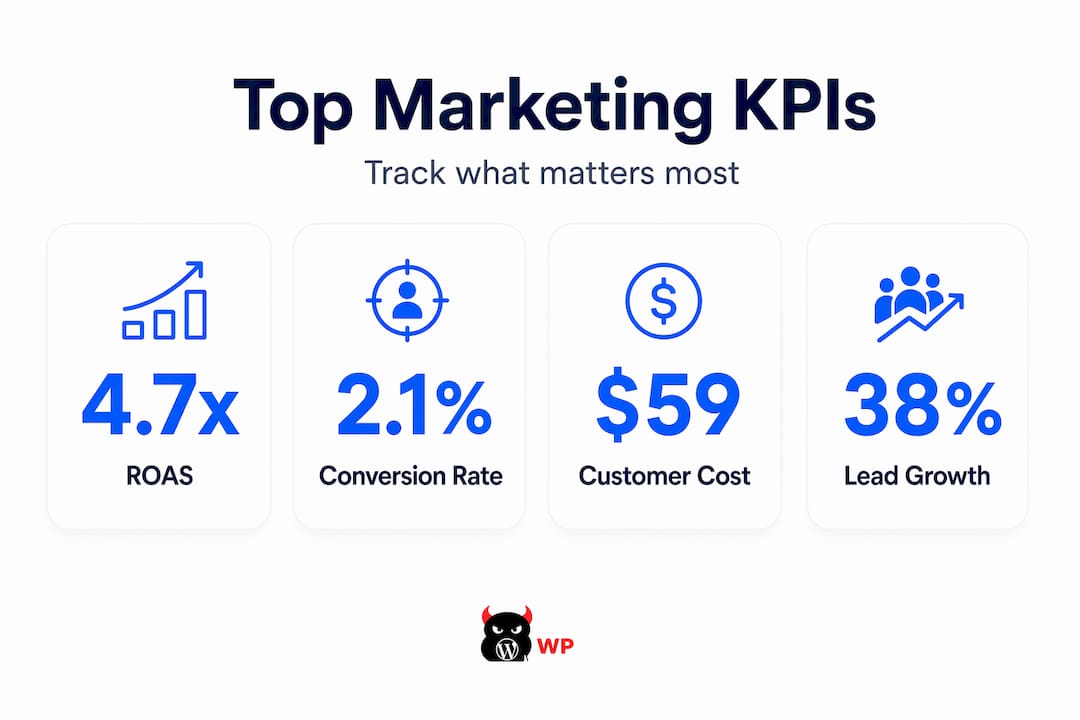
Common KPIs worth tracking include:
Marketing analytics collects and interprets data from these channels to understand what works and where leads originate. Google Analytics remains the baseline tool for most businesses, but it only provides value when the goals and events inside it are configured to reflect actual business outcomes. Out of the box, it tells you about traffic. Properly configured, it tells you about money.
Pro Tip: Set up goal tracking in Google Analytics that mirrors your sales funnel stages. A contact form submission is worth far more as a tracked conversion than a session duration benchmark.
Here is where most measurable digital marketing discussions stop too early. Platform ROAS, the number Google or Meta reports inside their ad dashboards, is not the same thing as the actual impact your advertising had on revenue.
Incremental ROAS (iROAS) measures how many sales would have occurred without the ads running. If your Google Shopping campaign reports a 4x ROAS but 60% of those buyers were going to purchase anyway through organic search, your true incremental ROAS is far lower. Optimizing on the platform number alone means you are congratulating yourself for sales that were already happening.
This is the core argument for incrementality testing. The two most practical methods are:
The marketing measurement flywheel, a framework that combines platform ROAS, CRM data, incrementality, and marginal ROAS, gives you a layered picture of performance. Each data source answers a different question. Platform ROAS optimizes in-engine bids. CRM data connects ad spend to actual closed revenue. Incrementality confirms causal impact. Marginal ROAS reveals whether adding more budget to a channel still returns profitable results.
“Measurement methods should be question-driven: use platform ROAS for in-engine optimization, but incrementality tests to confirm causal impact for channel budget decisions.” — Search Engine Land
Pro Tip: Run your first geo-lift test on your highest-spend channel. The results will almost always surprise you and frequently redirect budget to higher-impact placements.
Understanding causality is not academic. It is the difference between growing a profitable business and growing a busy one.
Even experienced marketers fall into these traps. Recognizing them early is the fastest path to reliable digital marketing performance metrics.
Optimizing for vanity metrics. Treating metrics like clicks as KPIs without linking them to business objectives leads to campaigns that look healthy and generate little revenue. A high click-through rate on an ad that sends traffic to a poorly converting page is not a win.
Building dashboards for appearance. A dashboard full of green arrows feels reassuring. It is not a strategy. If your reporting does not connect to a decision, it is decoration. Every metric on your dashboard should have an owner and a threshold that triggers action.
Ignoring attribution complexity. Most customers touch multiple channels before converting. Last-click attribution, which credits the final touchpoint before a sale, systematically undervalues awareness channels like display and social. This skews budget toward closing channels and starves the top of the funnel.
Misaligning measurement cadence with decision cycles. Reviewing ad performance daily can cause over-optimization and reactive changes that damage campaigns with statistical noise. Reviewing it monthly means missing signals that required action two weeks ago. Your review frequency should match how quickly you can and should make changes.
Skipping funnel-level tracking. Tracking CAC and conversion efficiency while linking touchpoints to profit distinguishes volume growth from profitable growth. If your lead volume is climbing but CAC is rising faster than revenue per customer, the business is moving backward while the dashboard glows.
Knowing how to measure digital marketing is only half the job. The other half is applying what you learn to change what you do next.

Start with SMART KPIs. Every KPI should be specific, measurable, attainable, relevant, and time-bound. “Increase leads” is not a KPI. “Reduce CPL by 20% on paid search within Q3 through landing page testing” is a KPI. The specificity forces you to design a measurement system around the objective, not retrofit data to a vague goal.
From there, use analytics to identify channels driving results and channels burning budget. The question is never just “what is performing well?” It is “what is performing well and would stop performing if I reduced spend?” That distinction requires incrementality context.
Budget reallocation should follow the measurement flywheel outputs. If a channel shows strong platform ROAS but weak incremental contribution, reduce spend there and test the freed budget in underinvested areas. This is how you grow marketing efficiency without simply cutting.
A/B testing is not optional at this level. It is how you generate causally valid data on creative, copy, landing pages, and offer framing. Every test should have a hypothesis, a success metric, and a minimum sample size before you read results. Calling a test after three days is not testing. It is guessing with extra steps.
Here is how common KPIs stack up across objectives:
| Objective | Primary KPI | Secondary KPI |
|---|---|---|
| Lead generation | Cost per lead (CPL) | Lead-to-close rate |
| E-commerce sales | ROAS | Cart abandonment rate |
| Brand awareness | Reach and frequency | Branded search lift |
| Customer retention | Repeat purchase rate | Net promoter score |
| Content performance | Organic traffic growth | Conversion rate from content |
For small business digital growth, the table above should serve as a starting point for KPI selection, not a definitive list. Your business model determines which combinations matter most.
No measurement strategy survives without the right infrastructure underneath it.
Google Analytics 4 (GA4) is the baseline. It tracks user behavior across your site, supports goal configuration, and integrates with Google Ads for closed-loop reporting. It is free and powerful, and most businesses use only a fraction of its capability.
CRM platforms such as HubSpot or Salesforce close the loop between marketing activity and actual revenue. Without CRM integration, you can see leads generated but not leads closed, which makes CAC calculations unreliable.
Beyond those foundations:
The right attribution model for your business depends on your sales cycle length and channel mix. Short cycles with direct response goals can work with data-driven attribution in GA4. Long B2B cycles with multiple stakeholders often require custom CRM-based attribution mapping.
For digital marketing checklist purposes, confirming your tracking stack is correctly configured should happen before any campaign launch. A misconfigured pixel or broken goal event silently corrupts months of data.
I have seen more marketing budgets wasted on impressive-looking dashboards than on genuinely bad advertising. The bad advertising is at least trying to reach customers. The beautiful dashboard is just telling people what they want to hear.
The uncomfortable truth about measurable digital marketing is that most organizations are not set up to use measurement correctly. They track everything, analyze selectively, and optimize for the metrics that feel controllable. The result is that spend concentrates in channels where attribution is easiest to claim, not channels where impact is highest.
What I have learned is that the question “did this work?” is almost never answered by a single metric. Effective measurement couples aligned KPIs with clear objectives so metrics drive decisions rather than just reporting. That requires somebody to ask hard questions when the data looks good, not only when it looks bad.
The businesses that get this right treat their measurement framework the way engineers treat infrastructure. They build it deliberately, audit it regularly, and resist the temptation to add new data sources without retiring old ones that add noise. They also invest in incrementality testing even when it feels counterintuitive to turn off ads to prove they work.
If you are managing digital partnerships for your business, insist that any agency or partner you work with can explain their incrementality methodology. If they cannot, their ROAS numbers are probably flattering them.
— Vector

At Monsterwp, we built our entire platform around one idea: your website and marketing should generate measurable results, not just activity reports. Every custom WordPress website we deliver is configured from day one with proper analytics, goal tracking, and conversion architecture in place. You are not starting from scratch trying to figure out why GA4 is not recording leads.
Beyond the site, our managed social media marketing and digital marketing add-ons are built around KPIs that connect to your business outcomes, not vanity numbers. No bloated retainers. No guessing whether your spend is working. Just clean infrastructure, fast execution, and results you can actually point to.
Measurable digital marketing is the practice of defining success through quantifiable, business-aligned KPIs and using data to assess and improve campaign performance over time. It goes beyond collecting metrics to focus on numbers that directly inform budget and strategy decisions.
The most critical digital marketing performance metrics are conversion rate, customer acquisition cost (CAC), return on ad spend (ROAS), and cost per lead (CPL). The right KPIs depend on your specific business model and campaign objective.
Incrementality measures how many conversions would have happened without your advertising. It is tested through geo-lift tests or holdout groups, and it reveals whether platform-reported ROAS reflects genuine causal impact or sales that would have occurred anyway.
Only include metrics in your dashboard if they are tied to a decision or threshold that triggers action. If a number going up or down would not change what you do, it is a vanity metric and it does not belong in your KPI framework.
Different attribution models credit conversions to different touchpoints, which directly affects how you allocate budget across channels. Last-click attribution systematically undervalues awareness channels, while data-driven attribution gives a more accurate picture of multi-touch customer journeys.
Discover what is a website revenue asset and how it can transform your business. Learn to turn your site into a valuable income-generating tool!

Explore 3 monsterwebsites.com alternatives to help you choose a managed WordPress agency that fits your business needs and budget effectively.