
Social Media Marketing Tips for Small Business Growth
Unlock your business’s potential with proven social media marketing tips. Boost visibility, attract customers, and thrive without a big budget!


TL;DR:
- Small businesses now account for 27% of US digital ad spend, growing rapidly due to smarter, more affordable tools.
- Digital marketing outperforms traditional methods in cost, targeting, and measurability, enabling SMBs to compete effectively.
- A strategic, data-driven approach with realistic timelines and prioritized channels delivers sustainable growth results.
Small businesses are no longer sitting on the sidelines of digital advertising. SMBs now account for 27% of US digital ad spend, a market worth $98 billion in 2025, growing at twice the overall market rate. That’s not a coincidence. It’s a signal. Digital marketing has stopped being the exclusive playground of Fortune 500 companies with massive budgets and dedicated marketing departments. Today, the tools are smarter, the costs are lower, and the results are measurable. If you’re a small or mid-sized business owner wondering whether digital marketing is worth the investment, this guide will give you a clear, honest answer.
| Point | Details |
|---|---|
| Digital is growing fast | Small and mid-sized businesses are increasing digital ad spending twice as fast as the overall market. |
| Better targeting and ROI | Digital marketing offers cost-effective campaigns, precise targeting, and measurable results for SMBs. |
| Combine digital and traditional | A hybrid approach sometimes works best for reaching local customers or older demographics. |
| Start simply and scale | Use AI tools and managed services to launch campaigns without building a full in-house team. |
Something fundamental has shifted in how American businesses compete for customers. Not long ago, a local business had to outspend larger competitors just to get noticed. TV spots, radio ads, print campaigns — all of it favored the brands with the deepest pockets. That era is over.
The rise of AI-powered platforms has fundamentally changed the cost and complexity of running effective marketing campaigns. Automated bidding, audience targeting, and content generation tools have made it possible for a two-person operation to compete with a regional chain. The barrier to entry has collapsed.
Here’s what’s driving the surge in SMB digital adoption right now:
“The biggest shift isn’t just that digital is cheaper. It’s that it’s smarter. AI tools are doing in minutes what used to take a full marketing team days to figure out.”
The numbers back this up. SMB digital ad spend is growing at 22% year over year, twice the overall market rate. Meta alone sees 38% of its SMB spend from small businesses. Google Search isn’t far behind. These platforms are built to work for businesses of every size, and the data proves that smaller companies are catching on fast.
Understanding AI in digital marketing also helps explain why this growth is accelerating. Smarter tools mean less guesswork, fewer wasted dollars, and faster results. For a business owner who’s already stretched thin, that matters enormously.
Understanding this shift sets the stage for a deeper look at the real-world advantages digital marketing holds over traditional approaches.
Let’s get direct about this. Traditional marketing isn’t dead, but it’s expensive, hard to measure, and increasingly inefficient for most SMBs. Digital marketing, by contrast, gives you control, visibility, and accountability that print and broadcast simply can’t match.
Digital outperforms traditional on three critical dimensions: cost, targeting, and measurability. A Google Ads campaign can be launched for a few hundred dollars, targeted to a specific city, and tracked down to the exact keyword that drove a sale. A newspaper ad costs more, reaches a broad and largely unqualified audience, and gives you zero data on how many people acted on it.

Here’s a direct comparison:
| Factor | Digital marketing | Traditional marketing |
|---|---|---|
| Cost | Low to moderate, scalable | High, often fixed |
| Targeting | Precise (demographics, behavior, location) | Broad, limited control |
| Measurement | Real-time, revenue-linked | Difficult, often estimated |
| Speed | Campaigns live in hours | Weeks of lead time |
| Flexibility | Adjust anytime | Locked in once published |
| Trust factor | Building (improving with reviews) | Strong with older audiences |
That said, traditional marketing builds trust in specific contexts, particularly for older demographics and hyper-local audiences. A community newspaper ad or a direct mail piece can still move the needle for a dentist’s office or a local hardware store. The key is knowing your audience.
A hybrid approach often makes sense. Run Google Ads and local SEO to capture people actively searching for your services. Use a targeted mailer or local event sponsorship to build brand recognition in your community. The role of your website in this mix is critical. It’s the hub that every channel points back to.
Pro Tip: Don’t chase vanity metrics. Impressions and likes feel good but they don’t pay the bills. Track cost per lead, cost per acquisition, and revenue generated. Those are the numbers that tell the real story. Your digital marketing services should always be evaluated against business outcomes, not platform-specific engagement stats.
With these direct comparisons in mind, the next step is translating digital marketing’s advantages into specific results your business can realistically expect.
Expectations matter. Too many business owners either expect overnight miracles or dismiss digital marketing because they don’t see results in the first 30 days. The truth sits somewhere more nuanced and more encouraging.
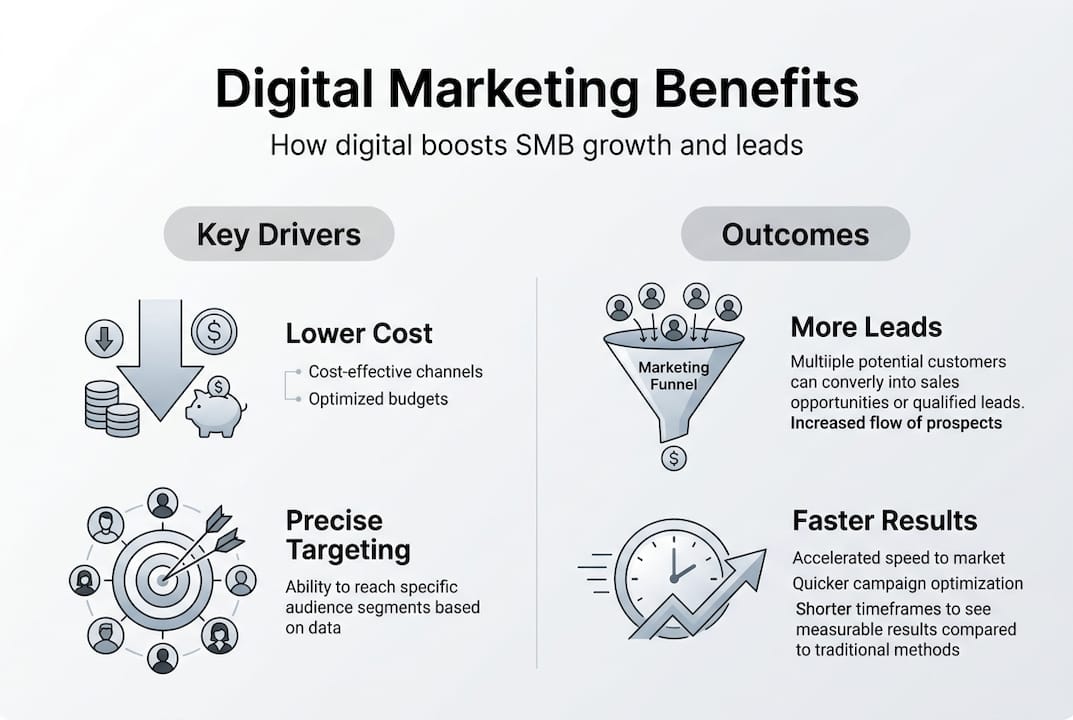
Here’s a realistic snapshot of what well-executed digital marketing can deliver for an SMB:
| Channel | Typical timeline | Expected outcome |
|---|---|---|
| Google Ads (PPC) | 1 to 4 weeks | Immediate lead flow, higher CAC initially |
| Local SEO | 3 to 6 months | Sustained organic traffic, lower CAC over time |
| Social media ads | 2 to 6 weeks | Brand awareness, retargeting, direct conversions |
| Content marketing | 4 to 9 months | Authority building, long-term organic growth |
| Email marketing | 2 to 4 weeks | High ROI on existing customer base |
SMB digital spend is rising twice as fast as the overall market because business owners are seeing real returns. This isn’t speculative. It’s reflected in budget decisions made by millions of small companies across the country.
Here are the most common gains SMBs report after six months of consistent digital marketing:
Explore proven growth strategies and learn how to increase local visibility to start building a realistic roadmap for your business.
Pro Tip: Set a 90-day benchmark, not a 30-day one. Most digital channels need time to gather data and optimize. Cutting campaigns too early is one of the most expensive mistakes SMBs make.
Knowing what outcomes to expect allows you to make smarter decisions about how to put digital marketing to work in practice.
Knowing digital marketing works is one thing. Knowing where to start without wasting money or burning out is another. Here’s a practical framework that works for most SMBs.
Step 1: Define your business goal first. Are you trying to generate leads, drive foot traffic, grow an email list, or increase e-commerce sales? Your goal determines your channel. Don’t pick a platform and then figure out what you want from it.
Step 2: Start with high-impact, proven channels.
Step 3: Set a realistic budget. Most experts suggest 7 to 10% of gross revenue for marketing. If you’re starting fresh, even $1,000 to $2,000 per month can generate meaningful results when spent strategically.
Step 4: Decide between DIY and managed services. AI tools are reducing complexity and cost, making it easier than ever to run basic campaigns yourself. But if your time is better spent running your business, a managed service pays for itself quickly.
Step 5: Track everything against revenue. Use Google Analytics 4, your CRM, and platform-specific dashboards. Connect ad spend to actual sales, not just clicks.
Here’s what to prioritize if you’re working with a limited budget:
Pro Tip: Avoid the trap of spreading your budget across six channels at once. Concentration beats dilution every time. Master one channel, prove the ROI, then expand.
Once you know what to do next, it’s just as vital to maintain perspective and avoid common pitfalls when pursuing digital marketing.
Most digital marketing guides treat digital as the automatic answer to every business problem. We disagree with that framing. Digital is powerful, but it’s not a silver bullet.
Here’s what we’ve seen repeatedly: business owners go all-in on digital, chase the latest platform trend, and then wonder why their revenue hasn’t moved. The problem isn’t the channel. It’s the lack of strategy underneath it.
Pure digital risks ad fatigue and privacy issues that erode performance over time. If your audience skews older or is deeply local, ignoring traditional touchpoints is a mistake. A smart mix, anchored in data and adjusted regularly, outperforms any single-channel obsession.
The other thing most guides miss: measurement discipline. Clicks and impressions are easy to celebrate. Revenue is harder to trace but it’s the only metric that matters. Every dollar you spend on digital should be evaluated against a business outcome, not a platform dashboard number.
Our advice is simple. Start with your top growth strategies, measure ruthlessly, and resist the urge to pivot every time a new platform promises explosive results. Consistency and clarity beat novelty every time.
You now have a clear picture of why digital marketing works and how to approach it without the overwhelm. The next question is execution. That’s where most SMBs get stuck.
At MonsterWP, we built our platform specifically for business owners who want results without the complexity of managing an in-house team or paying bloated agency retainers. Our digital marketing plans cover everything from SEO and paid ads to managed social media marketing and managed SEO and PPC. Clear pricing. Fast execution. No long contracts. If you’re ready to turn your digital presence into a lead-generating machine, we’re ready to build it with you.
Most experts recommend allocating 7 to 10% of gross revenue, but SMB digital spend is rising fast because measurable ROI makes it easier to justify and scale. Start with manageable campaigns and adjust based on actual results.
Not always. Digital outperforms traditional on cost, targeting, and tracking, but a hybrid approach can benefit local businesses or those serving older demographics who respond better to traditional touchpoints.
Paid ads like Google Search can generate leads within days, while SEO and content strategies typically take three to six months to build strong, sustainable momentum.
No. AI tools are lowering complexity and cost across the board, and managed service providers like MonsterWP make it possible for even very small teams to run high-impact digital programs without hiring in-house.
Unlock your business’s potential with proven social media marketing tips. Boost visibility, attract customers, and thrive without a big budget!

Discover what is website analytics and how it drives real business insights. Transform your data into actionable strategies today!