
Top 3 GoDaddy.com Hosting Alternatives 2026
Explore the top 3 GoDaddy.com alternatives for reliable hosting solutions. Compare to make an informed decision for your business needs.
Most business owners treat their website like a storefront window display, something you change once a season and leave alone. That belief is costing you leads. The reality is that businesses running frequent, focused website updates consistently outperform competitors who treat their site as a static brochure. This guide breaks down exactly how rapid updates fuel lead generation, what agile methods actually look like in practice, and how to avoid the traps that turn speed into chaos. If you want your website to work harder without rebuilding it from scratch every year, keep reading.
| Point | Details |
|---|---|
| Speed drives growth | Rapid website updates let you respond faster to customers and win more leads. |
| Agile methods work | Short sprints and iterative testing deliver quicker, safer improvements to your site. |
| Manage risks smartly | Avoid scope creep and automation mistakes by balancing speed with careful review. |
| Consistent beats big changes | Ongoing updates often bring better results than rare, full-site redesigns. |
Your website is not a finished product. It is a living tool, and the businesses that treat it that way win more customers. Quick, targeted updates let you respond to shifting customer needs, capitalize on seasonal trends, and fix friction points before they drain your conversion rate. Speed to market is not just a startup advantage. It matters deeply for small and mid-sized businesses competing against bigger players with larger budgets.
Here is what most people get wrong: they assume more updates mean more risk. In practice, the opposite is true. Small, frequent changes are easier to test, easier to reverse, and easier to measure than massive overhauls. The managed website benefits that come from a proactive update schedule include faster SEO gains, better user experience, and stronger lead flow over time.
Top-performing website operators do not guess. Agile methodologies like iterative sprints and MVP builds accelerate updates and learning, allowing businesses to run hundreds of improvements per year rather than waiting for a big redesign to fix everything at once. That kind of velocity compounds. Each test teaches you something, and those lessons stack up into a serious competitive edge.
Here are the core benefits you unlock with rapid website updates:
The connection between rapid iteration and lead generation with updates is not theoretical. It is measurable, and businesses that commit to it see results within weeks, not quarters.
“A website that never changes is a website that slowly loses ground. Your competitors are testing. Are you?”
Pro Tip: Do not spread updates evenly across your entire site. Focus on your highest-traffic pages first, your homepage, your main service or product pages, and your primary contact or booking page. That is where rapid iteration pays off the fastest.
Once you understand why speed matters, the next question is how to execute it without creating a mess. Agile methodology, originally built for software development, translates powerfully to website management. The core idea is simple: work in short cycles, ship something usable, measure the result, and improve.
Iterative sprints of 2 to 4 weeks and MVP (minimum viable product) builds allow faster deployment and fail-fast testing. Instead of spending three months perfecting a new landing page, you build a solid version in two weeks, launch it, and let real visitor behavior tell you what to fix next.

Here is a practical comparison of agile versus traditional update cycles:
| Factor | Agile update cycle | Traditional update cycle |
|---|---|---|
| Update frequency | Every 2 to 4 weeks | Every 6 to 12 months |
| Testing approach | Continuous A/B testing | One-time post-launch review |
| Risk level | Low per change | High per change |
| Learning speed | Fast and ongoing | Slow and delayed |
| Cost per update | Lower and predictable | Higher and unpredictable |
For efficient content updates that actually move the needle, follow these steps to bring agile into your workflow:
The fail-fast model works well for low-stakes updates like copy changes, button colors, and image swaps. For higher-stakes changes like pricing pages or checkout flows, a fail-smart approach is smarter. That means staging the change, testing it with a segment of your traffic first, and only rolling it out fully once the data supports it. Understanding professional website management means knowing when to move fast and when to be deliberate.
Agile brings speed, but speed without discipline creates new problems. Many SMBs start strong with rapid updates, then run into avoidable issues that slow them down or damage their site’s performance. Knowing these pitfalls in advance puts you ahead.
Here are the most common traps:
Over-frequent changes can cause scope creep, cost overruns, and poor quality for businesses with tight budgets. That is not an argument against rapid updates. It is an argument for structure. The fix is not to slow down. It is to build a gating process.
Here is how to implement smart gating for your update workflow:
Pro Tip: For high-stakes updates like a product launch page or a new pricing structure, use a fail-smart approach. Test with 20% of your traffic first. Only roll out to everyone once the numbers confirm it is working.
“Speed is an asset. Recklessness is a liability. The difference is process.”
Reviewing automated update quality regularly keeps your site healthy and your lead pipeline intact, even as you move fast.
Knowing what can go wrong, you need to pick the right strategy for where your site is right now. There is no universal answer. The right choice depends on your goals, your budget, and how well your current site is performing.
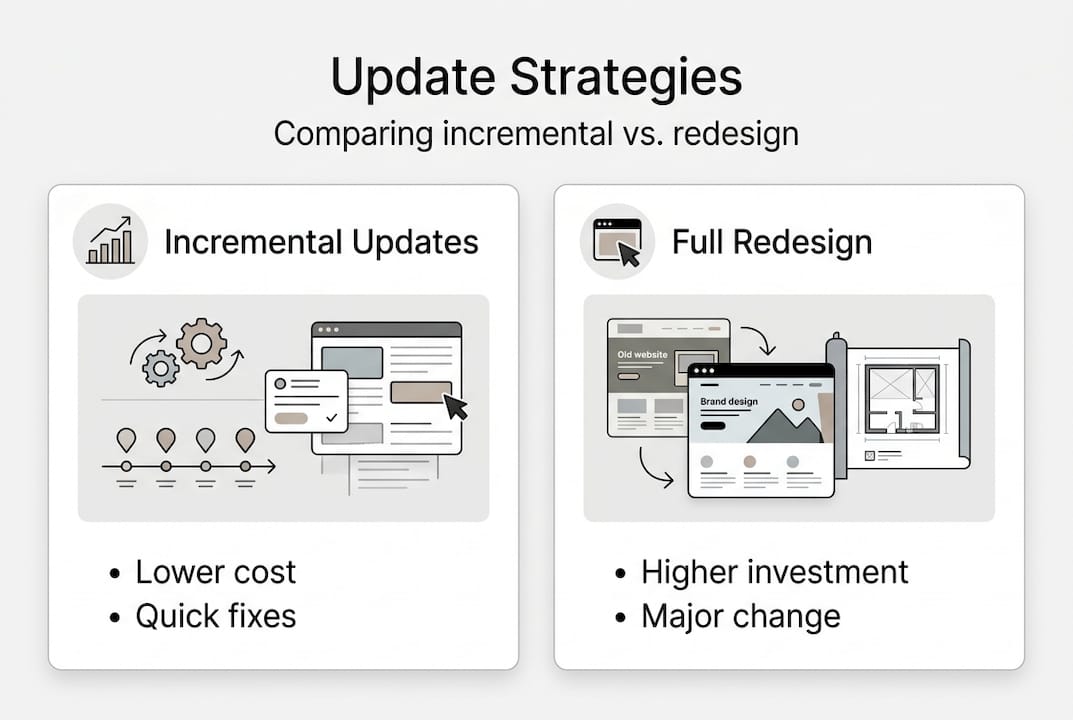
Consistent improvements and major redesigns both impact user experience and business goals differently. Here is a direct comparison:
| Factor | Incremental updates | Full redesign |
|---|---|---|
| Cost | Lower, spread over time | Higher, concentrated upfront |
| Risk | Low per change | High, all at once |
| Speed of impact | Immediate on targeted pages | Delayed until full launch |
| Best for | Active, performing sites | Outdated or broken sites |
| SEO disruption | Minimal | Significant if not managed |
For most SMBs, a step-by-step redesign is only necessary every three to five years. In between, consistent incremental updates keep your site sharp and competitive without the cost or disruption of a full overhaul.
Use these factors to decide which path fits your situation:
The best path for redesign for growth is usually a hybrid: keep iterating on what works, and redesign only the sections that are genuinely holding you back.
Here is what years of hands-on projects have taught us, and it is not what most people expect to hear. The biggest bottleneck in website agility is almost never the technology. It is the approval process.
We see it constantly. A business invests in a great CMS, sets up a staging environment, and builds a solid update workflow. Then a simple homepage tweak sits in someone’s inbox for three weeks waiting for sign-off. The platform is fast. The people are slow.
Most SMBs obsess over whether to use JAMstack or WordPress, when the real question is: who owns the decision to publish, and how fast can they act? Clarity on roles and a defined review loop matters more than any tool you choose.
The businesses that move fastest are the ones with a short, clear approval chain and a post-launch review habit. They publish, they check the data, and they move again. That rhythm, not the platform, is what creates real website agility. Explore content efficiency tips to build that rhythm into your workflow starting today.
Putting all of this into action is easier with the right partner behind you.
At MonsterWP, we built our platform specifically for business owners who want to move fast without breaking things. Our fully managed WordPress sites come with unlimited content updates, rapid revisions, and a team that handles execution so you are not stuck waiting on a developer. Every site is built for speed, security, and SEO from day one. Whether you need a custom website built to your exact specs or want to get live fast with a flat fee website solution, we make iteration effortless. No bloated retainers. No long contracts. Just a lean, high-performance digital engine that grows with your business.
Aim for small updates monthly and larger improvements quarterly to stay competitive. Top site operators run over 200 tests per year, which shows how much consistent iteration compounds over time.
Frequent updates can cause issues if not planned, but agile sprints and data reviews keep quality and clarity high. Over-frequent scope changes hurt cost and quality, which is why structured sprints and staging environments are essential.
Incremental updates quickly address specific issues, while full redesigns work best for major strategy or brand shifts. Consistent vs. radical redesigns each impact user experience differently depending on your site’s current state.
Agile CMS platforms, modular WordPress designs, and JAMstack setups all accelerate updates safely. JAMstack offers speed and easy scaling, while a well-managed WordPress CMS offers flexibility and faster iteration without developer dependency.
Explore the top 3 GoDaddy.com alternatives for reliable hosting solutions. Compare to make an informed decision for your business needs.

Unlock the power of content optimization strategies that drive results. Discover how to enhance rankings, leads, and revenue effectively!