
Top 3 GoDaddy.com Hosting Alternatives 2026
Explore the top 3 GoDaddy.com alternatives for reliable hosting solutions. Compare to make an informed decision for your business needs.


TL;DR:
- Most “no contract” web services refer to month-to-month billing, not a lack of legal enforceability, so obligations still apply. Business owners should read terms carefully, as cancellations often require notice, and data or support limitations may exist; true flexibility depends on service quality. Selecting a provider with transparent scopes and accountability ensures you benefit from flexible, high-value website management without long-term commitments.
Most business owners hear “no contract” and immediately feel relieved. No long-term commitment, no getting trapped, total freedom to walk away whenever you want. That’s the dream. But here’s the reality: online contracts are still legally binding documents, and “no contract” in the web services world refers to the commercial term length, not a free pass from rules. Understanding this distinction before you sign up can save you from real headaches down the road.
| Point | Details |
|---|---|
| No lock-in flexibility | No-contract web services let you pay monthly so you’re not committed long term. |
| Terms still apply | You must still follow binding terms and conditions, even without a formal long-term contract. |
| Provider features vary | Always confirm what’s included—some options don’t cover advanced optimization or marketing. |
| Watch for limits | Flexible plans may come with usage restrictions or minimum notice periods to cancel. |
Let’s clear up the confusion right away. When a web service provider says “no contract,” they’re telling you something specific: you’re not locked into a 6-month or 12-month minimum commitment. You pay month to month. You can cancel when your billing cycle ends. That’s it. That’s the whole promise.
What it does NOT mean is that there are zero rules. It does not mean you can demand a full refund after three weeks because you changed your mind. It does not mean the provider has no legal claims over you. Every web service, no matter how flexible, operates under a terms of service agreement. The moment you click “I agree” or enter your payment details, you’ve entered a legally enforceable relationship. The key nuance here is that the “no contract” model refers to commercial term length, not a lack of legal enforceability.
Here are the most common misconceptions business owners walk in with:
“No contract” is about freedom from long-term obligation, not freedom from all obligation. Read the terms. Always.
This matters because your website is the front door to your business. Misunderstanding what you agreed to can mean downtime, lost data, or surprise bills at the worst possible time.
Once you understand what “no contract” actually means, the model itself is refreshingly simple. Here’s how the typical process flows for a business owner getting started:
What still remains binding throughout that process? Quite a bit. Your payment obligation for the current billing cycle, the data privacy policy, acceptable use rules, and any migration or export conditions all hold firm. Providers such as those using month-to-month billing make it easy to get started without a binding commitment, but they still enforce their standard terms right up until your last day as a customer.
The best use cases for this model include monthly website maintenance packages, pay-as-you-go marketing services, and managed hosting for businesses going through growth or transition phases. If you’re testing a new offer, launching a seasonal campaign, or just starting out, month-to-month makes a lot of sense. It gives you room to breathe while your business finds its footing.

You can explore simple WordPress site plans as an example of how flexible billing can work alongside professional-grade website management.
Pro Tip: Always read the cancellation clause before you sign up. Even the most flexible provider may require 30 days notice, a formal cancellation request, or payment for the remainder of a partial billing cycle. Knowing this upfront prevents frustration later.
Now that you know how these flexible services work, let’s put them side by side against the traditional long-term contract model. No-contract hosting is functionally month-to-month, and the differences are real.
| Feature | No-contract (month-to-month) | Traditional contract (annual+) |
|---|---|---|
| Minimum commitment | None. Cancel after any cycle. | 12-24 months typical. |
| Monthly cost | Slightly higher per month | Lower per month, but locked in |
| Flexibility | High. Adjust or exit easily. | Low. Penalties for early exit. |
| Risk level | Low upfront risk | Higher if provider underdelivers |
| Support quality | Varies by provider | Often tied to contract value |
| Ideal for | New businesses, testing, scaling | Stable businesses with known needs |
| Negotiation leverage | Lower (you can leave, but so can pricing) | Higher (you can lock in current rates) |
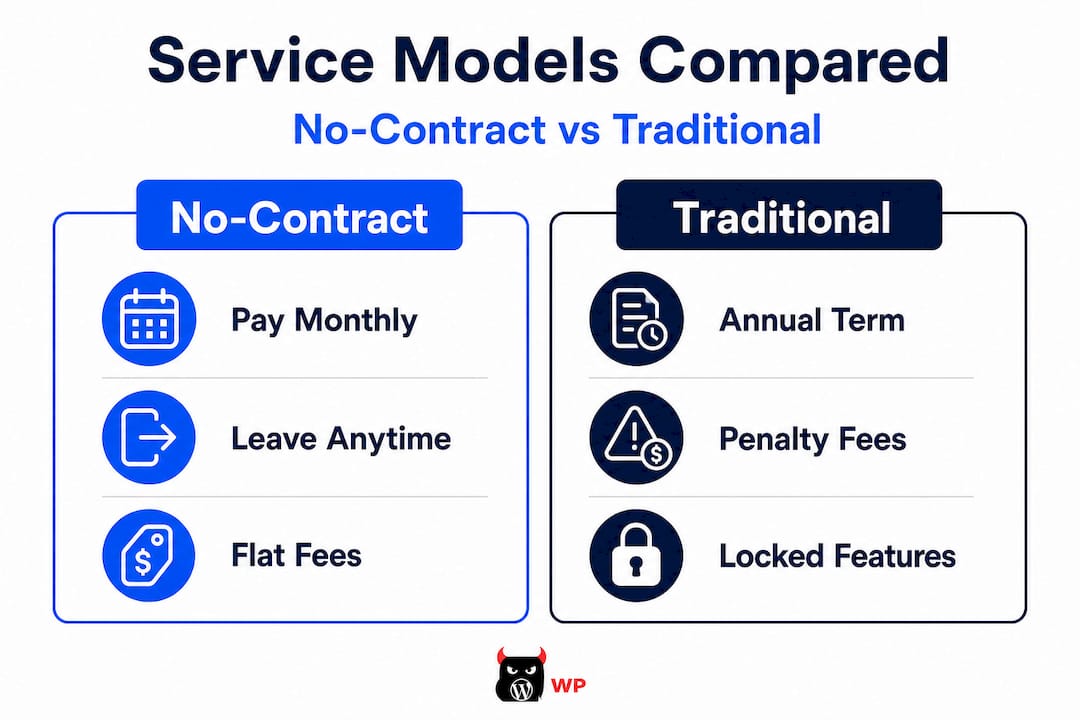
Who benefits most from no-contract services? Startups and growing businesses that can’t predict their needs 12 months out. Local businesses testing a new service area. Teams launching a campaign with a defined end date.
Who might still benefit from a traditional contract? An established business with stable traffic and predictable monthly needs may actually save money locking in an annual rate. If you have a long-standing relationship with a provider you trust, a discounted annual plan is worth considering. The fixed rate protects you from price increases, and some providers reserve their best support tiers for contracted clients.
The key is knowing what you’re optimizing for: flexibility or savings. Most growing businesses lean toward flexibility first. That’s why fully managed WordPress services built around flexible billing have become increasingly popular with founders who want results without the red tape.
Flexibility is only valuable if the provider behind it is solid. Not every “no contract” offer is created equal, and some of the most enticing pitches hide serious gaps in service quality, scope, or support.
Here’s a practical checklist of questions to ask before you commit your business to any provider:
Warning signs to watch for: vague or missing terms of service, no clear cancellation policy listed on the website, and promises that sound too broad to be real. If a provider claims to do everything for a suspiciously low monthly fee with no limitations whatsoever, that’s a red flag.
A useful exercise is comparing what two or three providers actually list in their plan details. You’ll quickly see that “no-contract web service” is a broad label. One provider might include weekly backups, security monitoring, and unlimited revisions. Another might include only basic hosting and a once-monthly check-in.
You can find transparent flat-fee website solutions that spell out exactly what’s included at each tier, which takes the guesswork out of the process entirely.
Pro Tip: Ask specifically whether the plan includes proactive optimization tasks like speed improvements, Core Web Vitals monitoring, and on-page SEO updates. These are the things that actually move the needle on your lead generation, and many basic no-contract plans quietly leave them out.
Flexibility is a real advantage. But it also lulls some business owners into a false sense of security. Here’s where things go wrong.
Assuming total flexibility covers everything. Month-to-month billing does not mean you can demand changes outside your plan scope, dispute a charge you agreed to, or skip payment and face zero consequences. Providers can still impose resource limitations and fully enforceable terms under month-to-month or no-contract models.
The most common pitfalls include:
One stat worth noting: a significant portion of basic hosting plans enforce hard usage caps on storage, bandwidth, or plugin access even in no-contract arrangements. Busting those limits can mean throttled performance or sudden overage charges.
To avoid buyer’s remorse, always request a full written scope before signing up. Compare what’s explicitly included versus what’s implied. And when in doubt, test the support responsiveness before you’ve fully migrated your business assets over. You can explore custom website options that pair transparent pricing with clearly defined service scope.
Here’s what we’ve seen after working with hundreds of business owners: the phrase “no contract” is often more marketing than substance.
Providers know that the moment you hear “no commitment,” your guard drops. You stop scrutinizing the plan details. You stop asking about what happens when something breaks. You sign up quickly because you think the risk is low. And that’s exactly the trap.
We’ve watched business owners jump from one no-contract provider to the next, chasing flexibility, only to realize they’d been paying for basic hosting while their competitors were actively ranking, generating leads, and converting traffic. The website existed. But it wasn’t working.
True flexibility isn’t just about being able to leave. It’s about getting full-service results without being locked into a bad deal. Those are very different things. A provider who charges you month to month but quietly delivers minimal work is technically “no contract,” but they’re absolutely failing you.
The businesses that win with no-contract models are the ones who hold their providers accountable every single month. No annual renewal to hide behind means the provider has to earn your business every billing cycle. That’s actually a powerful dynamic when you use it. Ask for reporting. Ask for results. Demand clarity on what was done and what it moved.
That’s the spirit behind real flat-fee models: pricing that’s clear, deliverables that are defined, and a relationship built on monthly results rather than contractual lock-in. When a provider has to perform to keep you, they perform.
If this article has made one thing clear, it’s that flexibility and quality aren’t mutually exclusive. You can have a high-performance, fully managed website with no long-term commitment, if you choose the right partner.
MonsterWP is built for exactly this. We offer custom website packages designed for business owners who want professional results without bloated agency contracts. Our flat-fee WordPress designs give you a clear monthly rate, full service scope, and no surprise billing. No annual lock-in. No fine-print traps. Just a fully managed WordPress platform that generates leads, ranks in search, and keeps your business moving forward. See our plans and take the next step today.
No-contract web services remove long-term commitments, but you’re still bound to the provider’s terms and may owe fees if you break those rules, since providers operate under fully enforceable terms of service and consent mechanisms.
You can usually leave after each billing cycle, but check for notice periods or data export restrictions, as month-to-month billing still requires you to follow the provider’s cancellation terms.
Basic no-contract plans may not cover ongoing optimization, advanced support, or extras beyond routine upkeep, since no-contract maintenance plans are often limited to routine site tasks rather than advanced growth features.
They mean essentially the same thing: both indicate you’re not locked into a long-term agreement, and no-contract web hosting is functionally identical to month-to-month hosting in how billing and cancellation work.
Explore the top 3 GoDaddy.com alternatives for reliable hosting solutions. Compare to make an informed decision for your business needs.

Unlock the power of content optimization strategies that drive results. Discover how to enhance rankings, leads, and revenue effectively!