
Top 3 GoDaddy.com Hosting Alternatives 2026
Explore the top 3 GoDaddy.com alternatives for reliable hosting solutions. Compare to make an informed decision for your business needs.


TL;DR:
- Unclear pricing from web agencies causes project delays, trust erosion, and increased costs for small and mid-sized businesses. Transparent, upfront pricing builds trust, speeds decision-making, and reduces project friction by clearly outlining costs and deliverables. Vendors who openly disclose all fees and policies foster better relationships, lower churn, and simplify digital growth efforts.
Hidden fees. Vague estimates. “Contact us for pricing.” If you’ve ever tried to hire a web agency and felt like you needed a decoder ring just to understand what you’d actually be paying, you’re not alone. For small and mid-sized business owners, pricing confusion isn’t just annoying, it’s genuinely costly. It delays projects, burns time, and erodes trust before a single line of code gets written. Clear, upfront pricing increases trust and removes the friction that slows decisions and stalls growth. This article walks you through why unclear pricing damages your outcomes, what transparent pricing actually looks like, and how to choose vendors who respect your time and budget.
| Point | Details |
|---|---|
| Reduces confusion | Clear pricing removes uncertainty and helps you make faster, more confident decisions. |
| Builds long-term trust | Transparent pricing shows vendors value your relationship and reduces the chance of surprise charges. |
| Speeds up approvals | Predictable costs smooth your internal budgeting, making it easier to get started. |
| Filters the right partners | It lets you qualify vendors quickly and avoid wasted cycles with agencies that aren’t a fit. |
Many owners are left guessing about what they’re really paying for. That guesswork isn’t harmless. It creates real financial and operational damage that compounds over time.
The most immediate problem is surprise fees. You sign a contract at one price, then discover setup fees, hosting add-ons, revision charges, and “priority support” tiers that weren’t mentioned in the original pitch. These aren’t rare edge cases. They’re built into the business model of many agencies and software providers. They count on your commitment before revealing the true cost.
Budget anxiety is the silent project killer. When your finance team can’t see a clear cost breakdown, approvals slow to a crawl. Some projects get shelved entirely, not because the ROI wasn’t there, but because the proposal was too murky to justify. According to business buying trends research from Forrester, buying cycles are growing longer and more complex, which means pricing confusion hits harder than ever.
Pricing transparency can reduce churn by eliminating “surprise charges” and giving buyers the confidence they need to budget and get internal approval.
Here’s a snapshot of what murky pricing actually costs businesses:
| Consequence | What it looks like | Business impact |
|---|---|---|
| Surprise invoices | Charges not mentioned in proposals | Cash flow disruption |
| Project delays | Approval bottlenecks from unclear costs | Slower time to market |
| Scope disputes | Mismatched expectations | Wasted hours and legal friction |
| Vendor churn | Abandoning providers mid-project | Lost setup investment |
| Reduced trust | Clients questioning every line item | Damaged long-term relationship |
The frustrations that show up most often in web design insights include:
“Pricing confusion is frequently cited as a top churn driver, because customers who feel surprised by charges don’t just leave, they leave angry and warn others.”
Why website pricing matters for your growth strategy isn’t a minor administrative concern. It’s the foundation of every client relationship. Get it wrong and you’re fighting an uphill battle from day one.
Now that we’ve reviewed the risks of unclear pricing, let’s see how clear, transparent pricing flips the script and delivers real business value.
The difference between opaque and transparent pricing shows up fast. Consider this side-by-side comparison:
| Factor | Opaque pricing | Clear pricing |
|---|---|---|
| Decision speed | Slow, requires multiple calls | Fast, self-service evaluation |
| Budget approval | Difficult, incomplete data | Straightforward, predictable numbers |
| Project kickoff | Delayed by negotiation | Immediate once committed |
| Support disputes | Frequent, costly | Rare, quickly resolved |
| Vendor trust | Low, always questioning motives | High, built from first contact |
| Churn risk | Elevated | Significantly reduced |
Clear, upfront pricing increases trust in a meaningful way. When you can see exactly what you’re buying, you’re not spending energy second-guessing the vendor. You’re spending it on your actual business.

For SMBs specifically, transparent pricing acts as a qualification filter. Transparent pricing lets serious buyers self-select and prevents wasted sales cycles for both parties. That’s efficient. You stop chasing proposals that were never going to fit your budget. You focus on vendors who are genuinely the right fit.
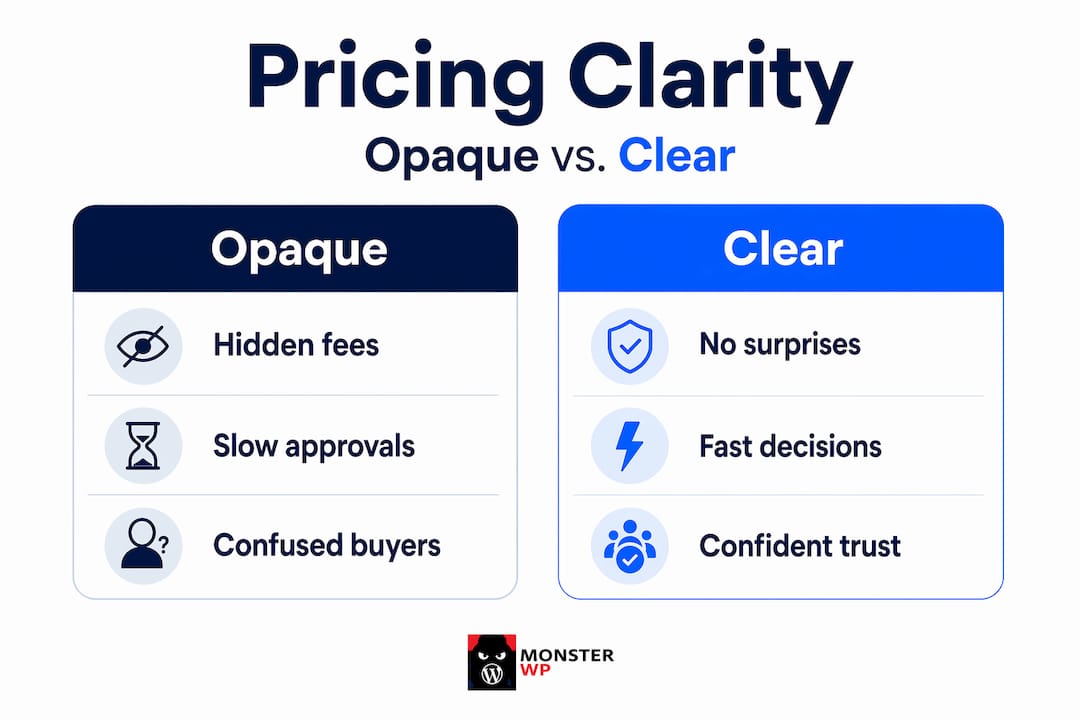
The State of Business Buying 2026 report from Forrester confirms that buyers at every level are demanding more predictability. They’re not just looking for lower prices. They want clarity on what they’re buying and confidence that the number won’t shift after they commit.
Pro Tip: Before engaging any vendor, look for three things on their pricing page: a visible base price, a clear list of what’s included at each tier, and an explicit statement about what costs extra. If those three elements aren’t there, expect friction ahead.
Here’s how to qualify vendors by pricing clarity before you invest time in a relationship:
Understanding SEO pricing follows the same logic. A vendor confident in their offering has no reason to hide the numbers. Flexible web solutions with no long contracts are a direct response to exactly this problem.
Understanding the advantages is one thing. Recognizing transparent pricing up front is another. Here’s how to spot the real deal and avoid common red flags.
A genuinely transparent pricing page does specific things well. It doesn’t just list a number. It contextualizes that number so you can make a real decision without a sales call. Good pricing model features include:
“When selecting vendors, look for pricing pages that disclose all fee types, map tiers to deliverables and limits, and make billing units understandable so you can forecast costs and get internal approval.”
Some platforms are experimenting with highly specific structures. A per-request pricing structure is one example where billing units are granular and clear, giving buyers precise cost predictability for each action. That level of transparency is exactly the right direction.
Red flags, on the other hand, are easy to spot once you know what to look for. Watch out for:
Pro Tip: Prioritize vendors who publish prices and rules before asking for your name or email. If you have to submit a contact form just to see what something costs, that vendor is putting their interests ahead of yours from the very first interaction.
The best top website features for revenue-generating sites start with trust. Pricing clarity is how that trust is established before a single conversation happens.
Not all pricing models are created equal. Here’s what to keep in mind for more complex or cutting-edge offers.
Some service categories make transparent pricing genuinely harder. AI-powered services, usage-based software as a service, and bundled agency packages all introduce variables that are difficult to nail down in a single flat fee. But difficulty isn’t an excuse for opacity. It’s an argument for more explanation, not less.
Where transparent pricing is hardest to find:
Transparent pricing is especially important for outcome-based models because buyers need clear value attribution to justify spend and avoid deal stalling. When a vendor charges based on results, you need to know exactly how “results” are defined and measured before you commit.
Here’s a striking data point: 53% of business buying is now shaped by procurement professionals, not just the end-user stakeholders. That means pricing opacity doesn’t just slow down the founder’s decision. It creates a second gauntlet with a finance or operations team who requires clear terms before approving any vendor. Predictable pricing cuts through both layers of friction at once.
To navigate edge cases, look for vendors who offer:
SMB visibility best practices apply here too. Vendors who are serious about helping you grow treat pricing transparency as a feature, not a liability. If you’re evaluating AI-driven or value-based pricing models, double down on your due diligence. The more complex the model, the more clarity you need before signing.
Most pricing transparency guides stop at “demand clear pricing.” That’s useful but incomplete. The deeper lesson is about what pricing opacity actually signals.
When a vendor hides their pricing, they’re often not just protecting negotiation leverage. They’re revealing something about how they operate. Vendors who are confident in the value they deliver have no reason to obscure their numbers. Opaque pricing can reflect genuine complexity or scope variability, and that’s fair. But the better vendors explain that complexity openly rather than hiding behind a “contact us” button.
Here’s the angle most guides miss. The biggest cost of unclear pricing isn’t the overage charge on month three. It’s the time you lose. Weeks spent on back-and-forth proposals, approval cycles that restart because costs shifted, and projects delayed while you wait for a final number all compound into a significant opportunity cost. You’re not just paying more. You’re growing slower.
Real trust doesn’t come from a vendor who shows you impressive case studies and then makes you call to learn the price. It comes from a vendor who is so confident in their offer that they put the number right on the page. That confidence is a signal worth paying attention to.
We’ve seen this play out with the $299 WordPress model we built. Publishing a flat monthly rate up front wasn’t just a marketing decision. It was a commitment to the kind of relationship we wanted with our clients. No surprises. No negotiation theater. Just a clear offer you can evaluate on your terms.
Pro Tip: If a deal feels slower or more complicated than it should, ask the vendor directly: “Can you walk me through every cost I could see in year one?” A confident, specific answer is a green light. Hesitation or deflection is a stop sign.
If unclear pricing has been slowing down your growth, that frustration stops here.
At MonsterWP, we built everything around the principle that you shouldn’t need a sales call to understand what you’re buying. Our custom website plans are flat-fee, fully managed, and priced so you can evaluate, approve, and get started without a single proposal negotiation. Our flat fee WordPress model means you know your monthly investment from day one, with no hidden hosting fees, no surprise revision charges, and no contract traps. We also offer managed social media marketing with the same transparent, no-guesswork pricing. Fast execution, measurable results, and pricing that respects your time.
Watch for missing pricing pages, vague descriptions like “custom quote,” or sudden requests to “contact sales” before sharing actual costs. Transparent pricing lets serious buyers self-select and prevents wasted sales cycles, so any vendor avoiding that process should raise an immediate flag.
No. Transparent pricing means you understand exactly what you’re paying for, not necessarily that the rate is the lowest available. Clear pricing can signal value confidence because it ties fees to measurable outcomes and removes buyer uncertainty about what they’re getting.
Some agencies avoid publishing prices to preserve negotiation flexibility or because project scopes genuinely vary, but this often adds friction and slows your buying process. Some vendors use opaque pricing to protect deal room rather than to reflect real complexity, which ultimately works against the buyer.
Yes, because it cuts surprise fees, reduces project delays, and limits wasted back-and-forth in the buying process. Pricing transparency reduces churn by eliminating surprise charges and giving buyers the budget confidence they need to commit and stay committed long term.
Explore the top 3 GoDaddy.com alternatives for reliable hosting solutions. Compare to make an informed decision for your business needs.

Unlock the power of content optimization strategies that drive results. Discover how to enhance rankings, leads, and revenue effectively!