
2026 Digital Marketing Trends Guide for Growth
Unlock the future with our 2026 digital marketing trends guide. Discover AI personalization, GEO, and more strategies for lasting growth!


TL;DR:
- Local business marketing focuses on promoting products and services within a specific geographic area through digital and traditional methods that foster community trust. Building foundational assets like Google Business Profiles, local SEO, and reviews is essential before investing heavily in paid advertising to ensure sustainable growth. Integrating online and offline efforts, tracking revenue-driven actions, and nurturing community relationships create a powerful, synergistic system for long-term local business success.
Local business marketing is the targeted promotion of products or services to customers within a specific geographic area, using a blend of digital and traditional methods that connect businesses authentically with their communities. Unlike broad national campaigns, this approach zeroes in on the people most likely to walk through your door, call your number, or book your service. The US Chamber of Commerce identifies Google Business Profile, local events, and community sponsorships as the foundational starting points for any business serious about local growth. Get these right, and everything else compounds.

Local business marketing is defined as a strategic system of online and offline tactics designed to increase a business’s visibility, trust, and customer engagement within its geographic community. The industry term most professionals use is local marketing, though you’ll also hear neighborhood marketing or hyperlocal marketing when the focus narrows to a single district or zip code. All three describe the same core idea: show up where your nearby customers are looking, both on their phones and in their daily lives.
The reason it matters is simple. A customer searching “best plumber near me” or “coffee shop downtown Austin” is not browsing casually. They have intent. They want to act. Local marketing positions your business to capture that intent at exactly the right moment, before a competitor does. According to Search Engine Land, the most effective local marketing creates an “offline plus online synergy,” meaning your digital presence and your physical community involvement reinforce each other constantly.
For small to mid-sized businesses, this is not a nice-to-have. It is the growth engine. Big-box retailers and national chains spend millions on brand awareness. Your advantage is proximity, personality, and trust. Local marketing is how you turn those advantages into revenue.
Effective local marketing operates across several channels simultaneously. No single tactic wins alone. Here is how the major components break down:
Pro Tip: Before spending a dollar on paid ads, confirm your Google Business Profile is fully optimized, your reviews are active, and your website loads in under three seconds. Paid traffic sent to a weak foundation is money wasted.
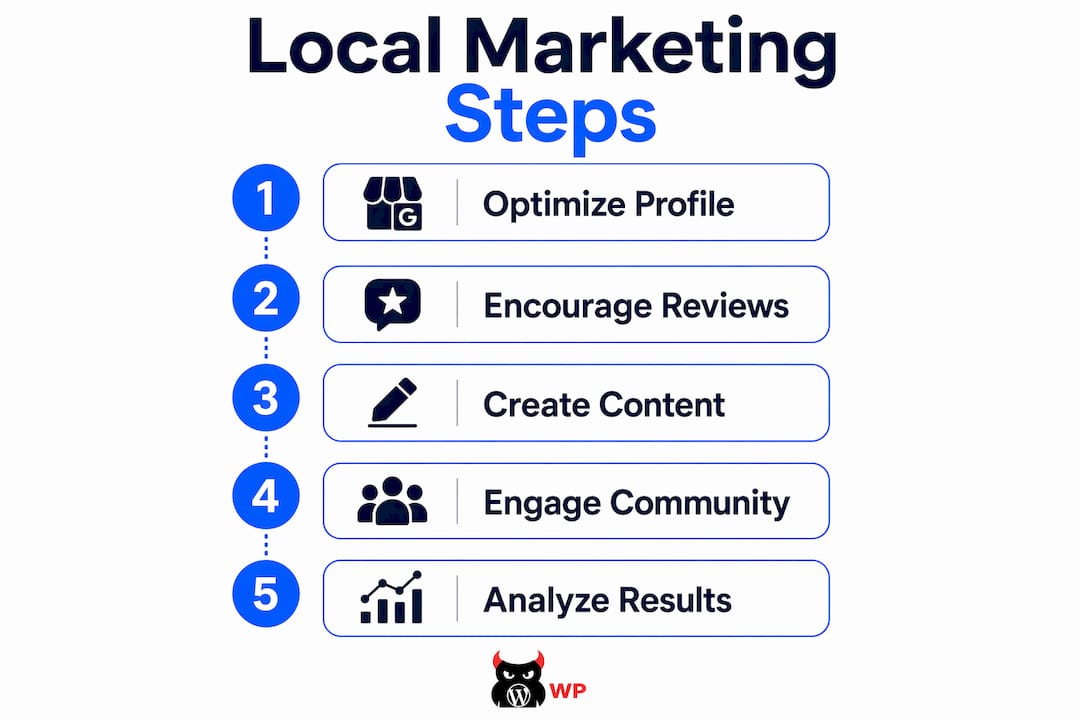
The Google Local Pack is the three-business block that appears at the top of local search results, above organic listings. Ranking in the Local Pack increases traffic by 126% and user actions by 93%. That is not a passive visibility boost. It drives calls, direction requests, and bookings directly from the search results page.
Google ranks Local Pack results using three factors: relevance, distance, and prominence. Relevance means your profile and website clearly match what the searcher wants. Distance is geographic and largely fixed. Prominence is where most businesses have room to grow. It is built through reviews, citations, backlinks, and the overall authority of your online presence.
| Local ranking factor | What it means | How to strengthen it |
|---|---|---|
| Relevance | Your profile matches the search query | Complete every GBP category and attribute |
| Distance | Proximity to the searcher | Cannot be changed; focus on the other two |
| Prominence | Authority and reputation signals | Build reviews, citations, and local backlinks |
| Review velocity | Frequency of new reviews arriving | Ask every satisfied customer for a review |
| Website content | Location-specific pages and keywords | Create dedicated landing pages per service area |
Review velocity is a critical factor in Local Pack prominence. A business with 200 reviews and no new ones in six months will lose ground to a competitor with 80 reviews that earns five new ones per week. Recency signals activity and trust.
Locally relevant website content also matters more than most owners realize. Dedicated local landing pages that reference specific neighborhoods, landmarks, and customer testimonials outperform generic service pages in both rankings and conversion. This is not about stuffing city names into paragraphs. It is about creating pages that genuinely serve a local audience.
Pro Tip: Track your local marketing performance using calls, form submissions, and direction requests as your primary metrics. Impressions and clicks are secondary. Unifying campaigns around revenue actions rather than vanity metrics is what separates growing businesses from stagnant ones.
The benefits of local marketing extend well beyond more website visitors. The most tangible payoff is lower customer acquisition cost over time. When your business is embedded in the community, word-of-mouth referrals, repeat customers, and organic search traffic do the heavy lifting. You spend less to acquire each new customer than a competitor relying purely on paid ads.
Trust is the currency of local commerce. Customers who perceive your business as part of their community are more loyal, more forgiving of occasional mistakes, and more likely to refer friends. The US Chamber of Commerce cites studies showing customers’ genuine willingness to travel further and pay slightly more for businesses they trust locally. That is a direct competitive advantage over national chains that can never replicate authentic community presence.
“Local businesses perceived as part of their community build stronger employee morale and customer loyalty.” — US Chamber of Commerce
The internal benefit is underrated. Employees at businesses with strong community ties report higher morale and lower turnover. When your team sees the business sponsoring a local youth sports league or partnering with a neighborhood nonprofit, it creates pride in the work. That pride shows up in customer interactions. The cycle reinforces itself.
Finally, local marketing gives small businesses a structural advantage over big-box retailers and e-commerce giants. Amazon cannot sponsor your town’s 5K race. Walmart cannot send a handwritten thank-you note. These human touchpoints are yours to own, and they build the kind of loyalty that no algorithm can buy.
The most effective local marketing does not treat digital and traditional channels as separate budgets. It treats them as one system. A business that runs a booth at a local farmers market and simultaneously promotes that appearance on Instagram, sends an email to its list, and updates its Google Business Profile with photos from the event is creating compounding visibility. Each channel amplifies the others.
Local partnerships multiply this effect. A referral arrangement with a complementary business, a co-sponsored community event, or a feature in a local publication all generate the kind of trust signals that paid advertising cannot manufacture. Combining optimized online discovery with offline community presence creates a foundation that compounds over months and years, not just during a campaign window.
| Channel type | Strengths | Best used for |
|---|---|---|
| Google Business Profile | Immediate local search visibility | Capturing high-intent searchers |
| Local SEO | Long-term organic traffic | Sustainable discovery without ad spend |
| Community events and sponsorships | Trust, brand recognition, word-of-mouth | Building loyalty and referral networks |
| Social media (organic) | Engagement, personality, community feel | Staying top-of-mind between purchases |
| Paid ads (Google, Meta) | Speed, reach, targeting precision | Accelerating results after foundations are set |
Paid advertising fits into this system as an accelerant, not a foundation. Starting with paid ads before building Google Business Profile, reviews, and a credible website is the most common and costly mistake local business owners make. The ad drives traffic; the weak foundation loses it. Build the asset base first, then use paid channels to pour fuel on what is already working. For social media specifically, small business social strategies that prioritize community engagement over follower counts consistently outperform pure broadcast approaches.
Local business marketing succeeds when foundational assets like Google Business Profile, reviews, and locally optimized website content are built first, then amplified through community presence and targeted paid advertising.
| Point | Details |
|---|---|
| Define your foundation first | Google Business Profile, reviews, and local SEO must be solid before paid ads deliver real returns. |
| Local Pack visibility drives action | Ranking in the top three local results increases calls and direction requests by over 90%. |
| Reviews are a ranking signal | Review velocity matters as much as total count; consistent new reviews signal active trust. |
| Offline and online reinforce each other | Community events, sponsorships, and partnerships amplify digital visibility and build loyalty no ad can buy. |
| Track revenue actions, not vanity metrics | Calls, bookings, and form submissions are the only metrics that connect local marketing to actual growth. |
Here is what I have seen consistently: business owners treat paid advertising as the starting line when it is actually the finishing touch. They spend $1,500 a month on Google Ads, send traffic to a website that loads slowly, has no local landing pages, and has a Google Business Profile with three photos from 2021. Then they conclude that “digital marketing doesn’t work for us.”
The real problem is sequence. Local marketing functions like a funnel shaped by intent. The Google Local Pack captures customers who are ready to act right now. But you only earn that position through prominence, and prominence is built through reviews, citations, and content over time. There is no shortcut that bypasses that work. Paid ads can buy placement, but they cannot buy trust, and trust is what converts.
The other pattern I see is businesses treating online and offline as separate departments. The owner who is brilliant at community relationships but ignores their Google Business Profile is leaving the most high-intent traffic channel unattended. The owner who obsesses over their website but never shows up at a local chamber event is missing the referral network that would make their SEO work twice as hard. These channels are not competitors. They are multipliers.
Local marketing in 2026 is also evolving with AI-powered search. Platforms like Google’s AI Overviews and tools like Perplexity are pulling local business information from structured, well-maintained online profiles. The businesses that built strong foundational assets two years ago are now getting cited in AI answers without paying for it. That is the compounding payoff of doing the unglamorous work early.
— Vector
Local marketing only works when your digital foundation is solid. A slow website, a poorly structured page, or missing schema markup can quietly kill your Local Pack rankings regardless of how many reviews you earn.
MonsterWP builds and manages high-performance WordPress websites starting at $299 per month, custom-built with Elementor Pro, optimized for speed, security, and local SEO from day one. Every site we launch includes the technical structure that local search demands: fast load times, proper schema, and location-optimized content architecture. We also offer managed social media marketing to keep your community presence active without adding to your workload. Stop patching a broken foundation. Get a custom website built for local growth and let MonsterWP handle the technical engine while you focus on your community.
Local business marketing is the practice of promoting your products or services specifically to customers in your geographic area, using a combination of Google Business Profile, local SEO, community events, and targeted advertising. The goal is to increase visibility and trust among nearby customers who are ready to buy.
Local SEO targets location-based search queries and optimizes your presence in Google’s Local Pack and Maps results, while general SEO focuses on broader organic rankings. Local SEO relies heavily on Google Business Profile optimization, local citations, and review management rather than just website content alone.
Paid advertising without foundational assets sends traffic to a weak destination, wasting your budget. A fully optimized Google Business Profile with active reviews converts that same traffic at a dramatically higher rate, making every ad dollar work harder.
Neighborhood marketing, sometimes called hyperlocal marketing, narrows the geographic focus to a single district, block, or zip code rather than a full city or region. It uses the same tools as local marketing but with tighter targeting, often relying more heavily on community events, door-to-door outreach, and hyper-specific social media geo-targeting.
Track calls, direction requests, form submissions, and bookings as your primary success metrics. Unifying local campaigns around these revenue actions rather than impressions or follower counts gives you a clear picture of what is actually driving growth.
Unlock the future with our 2026 digital marketing trends guide. Discover AI personalization, GEO, and more strategies for lasting growth!

Discover what is predictable pricing in web services and learn how fixed costs can empower your SMB’s budget. Gain financial control today!