
2026 Digital Marketing Trends Guide for Growth
Unlock the future with our 2026 digital marketing trends guide. Discover AI personalization, GEO, and more strategies for lasting growth!


TL;DR:
- Predictable pricing transforms variable web service costs into fixed expenses, enabling SMBs to plan growth confidently.
- Models like flat-rate, tiered, and hybrid pricing offer different levels of stability, with hybrid often providing optimal flexibility.
Predictable pricing in web services is defined as a billing structure where your costs are fixed, forecastable, and tied to flat fees, subscriptions, or committed capacity rather than fluctuating with every request, gigabyte, or API call. For small and mid-sized businesses, this distinction is not academic. Pay-as-you-go pricing can cause customer spend to vary dramatically month to month, making it nearly impossible to build a reliable digital budget. Platforms like AWS Reserved Instances, Render’s fixed-plan hosting, and Stripe’s subscription billing models each offer a version of this stability. Understanding how these models work, and where they break down, is the difference between a web budget you control and one that controls you.
Predictable pricing is the industry term for what many business owners simply call “knowing what you’ll pay.” The formal concept sits within the broader category of cost predictability, a financial planning principle that treats recurring technology expenses as stable operating costs rather than volatile variables. In web services specifically, it shows up as flat-rate subscriptions, tiered plans with defined usage caps, and hybrid models that combine a fixed base fee with controlled variable charges.
The contrast with pure usage-based billing is sharp. IaaS pricing charged on usage rather than a fixed fee makes costs less predictable, especially when traffic spikes or background processes run unchecked. A business paying $200 per month on a calm month can face a $1,800 bill after a product launch or a viral social post. That kind of volatility does not belong in a growth plan.
The core value of predictable pricing is financial control. When you know your web services cost $X per month, you can allocate budget to hiring, marketing, or inventory without holding a cash reserve for surprise invoices. That stability compounds over time, making it easier to plan quarters, not just months.
Three primary structures define how predictability is built into web service pricing. Each has a distinct risk profile and suits different business sizes and usage patterns.

Flat-rate subscription pricing charges a single fixed monthly or annual fee regardless of how much you use the service. This is the purest form of cost predictability. You know the number before the month begins. The trade-off is that low-usage months mean you are paying for capacity you are not consuming.
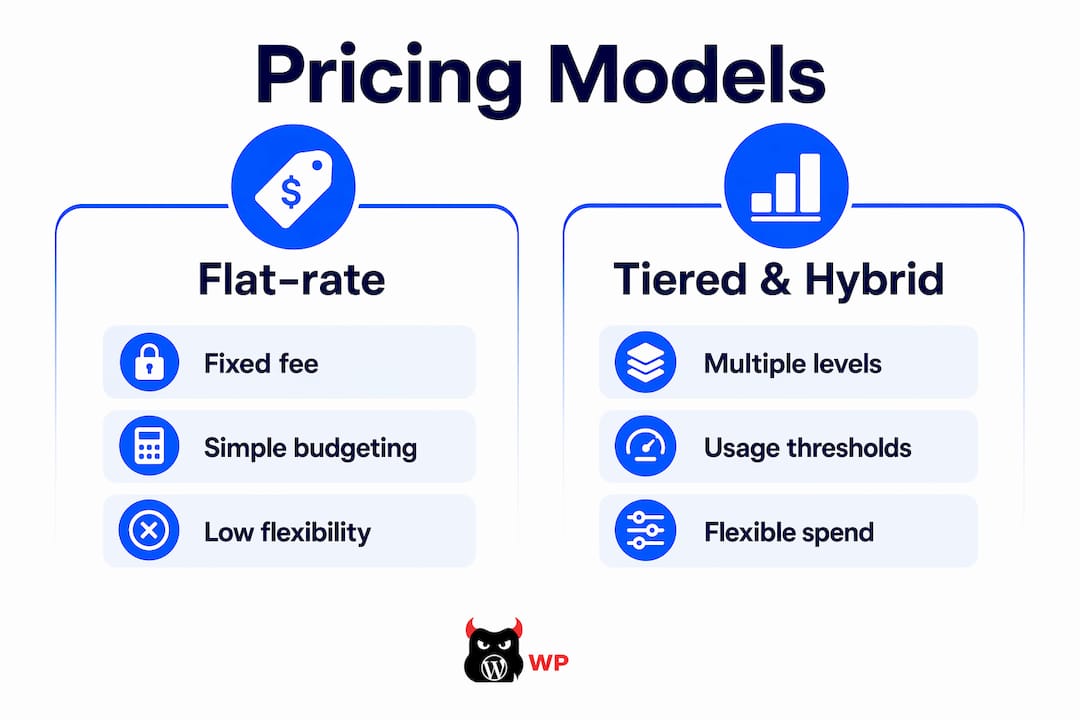
Tiered pricing offers multiple defined levels, each with a set price and a corresponding feature or usage ceiling. Moving between tiers is predictable because the thresholds are published. The risk is tier creep: growing into a higher tier mid-cycle without realizing it until the invoice arrives.
Hybrid pricing combines a fixed recurring base fee with variable usage charges above a defined threshold. Over 60% of SaaS companies now use hybrid pricing because it balances revenue predictability for the vendor with growth flexibility for the customer. For SMBs, this model works well when the base fee covers normal operations and the variable component only activates during genuine growth periods.
| Model | How it works | Best for | Key risk |
|---|---|---|---|
| Flat-rate subscription | One fixed monthly fee, no usage tracking | Stable, predictable workloads | Overpaying during low-usage periods |
| Tiered pricing | Set price per tier with defined feature or usage caps | Growing businesses with clear usage patterns | Unexpected tier upgrades mid-cycle |
| Hybrid pricing | Fixed base fee plus variable charges above a threshold | Scaling businesses with variable traffic | Variable component growing faster than expected |
The right model depends on your usage consistency. Businesses with steady, predictable traffic benefit most from flat-rate plans. Businesses with seasonal spikes or rapid growth often find hybrid pricing the better fit, provided the variable ceiling is clearly defined.
Predictable pricing is not just a billing policy. It is an engineering decision. The mechanisms that make costs forecastable are built into the infrastructure layer, and understanding them helps you evaluate vendor promises critically.
Reserved or committed capacity is the most direct technical tool. AWS Reserved Instances, for example, let you prepay for set compute capacity over one to three years, locking in both the resource and the price. This removes the exposure to on-demand rate fluctuations entirely. The predictability is structural, not just contractual.
Autoscaling with cost ceilings is the mechanism that separates modern predictable platforms from legacy pay-as-you-go models. Render’s fixed-plan hosting, for instance, caps autoscaling at defined cost ceilings, preventing the 5 to 10x cost increases that hyperscaler pay-as-you-go models can produce during traffic spikes. The ceiling converts usage volatility into a controlled, bounded expense. That is a fundamentally different financial posture.
Transparent metering and reporting cadence is the third pillar. HashiCorp’s HCP billing, for example, updates usage and balances hourly with a roughly 30-minute delay, with final bills settled at month-end. That frequency gives finance teams real-time visibility rather than a month-end surprise. Vendors who report usage only at billing time are not offering predictable pricing. They are offering a fixed rate card with unpredictable consumption.
Pro Tip: Before signing any web service contract, verify three things: the exact billing unit (per second, per GB, per request), whether there is a hard cost ceiling on autoscaling or usage overages, and how frequently spend data is updated in your dashboard. These three factors determine whether “predictable pricing” is a real structural guarantee or just marketing language.
The benefits of predictable pricing extend well beyond avoiding surprise invoices. They affect how confidently you can grow.
The trade-offs are real and worth naming directly. Flat-rate plans can mean overpaying during low-traffic months. Tiered plans can lock you into a higher tier before you are ready. And PAYG models offer genuine fairness for businesses with highly variable or seasonal usage, where a flat fee would consistently overcharge them.
The common misconception is that predictable pricing means lower quality or less flexibility. It does not. It means the cost structure is designed for financial control. The service quality is a separate variable entirely.
Effective budgeting for web services starts before you sign a contract. The pricing page is not the full picture.
Map your actual usage patterns. Before evaluating any pricing model, document your current traffic volumes, storage consumption, and API call frequency. This tells you which tier or hybrid threshold aligns with your real workload, not your optimistic projection.
Audit for hidden cost drivers. Platform as a Service costs can fluctuate unpredictably when background processes, inefficient code, or untracked third-party service calls increase usage without triggering any visible alert. Ask vendors specifically which background processes count toward your billing unit.
Demand explicit cost ceilings. Any vendor offering autoscaling should be able to tell you the maximum monthly cost under any traffic scenario. If they cannot, the pricing is not predictable regardless of what the rate card says.
Use vendor-provided forecasting tools. The AWS Pricing Calculator, for example, lets you model reserved versus on-demand costs across different usage scenarios before committing. Running these projections takes less than an hour and can save thousands annually.
Treat hybrid pricing as a budget line item with a controlled variable. Hybrid pricing frameworks allow SMBs to budget the fixed base fee as a committed expense and set an internal ceiling on the variable component. If the variable portion exceeds your internal ceiling two months in a row, that is a signal to move to the next tier, not a crisis.
Pro Tip: When evaluating vendors, ask for a sample invoice from a client with similar usage patterns. Rate cards describe the pricing structure. Actual invoices reveal what customers really pay, including data transfer fees, support add-ons, and overage charges that never appear in the headline price.
Understanding web service pricing at this level of detail is what separates businesses that scale confidently from those that get ambushed by their own growth. The risks of variable pricing contracts are well-documented, and the businesses that avoid them are the ones that asked the right questions before signing.
Predictable pricing in web services works because it converts variable technology costs into fixed operating expenses, giving SMBs the financial control they need to plan and grow without fear of surprise invoices.
| Point | Details |
|---|---|
| Definition is structural | Predictable pricing is an engineering and billing decision, not just a marketing claim. |
| Three core models exist | Flat-rate, tiered, and hybrid pricing each offer different levels of predictability and flexibility. |
| Cost ceilings are non-negotiable | Autoscaling without a hard cost ceiling is not predictable pricing, regardless of the rate card. |
| Hidden costs are the real risk | Background processes and untracked service calls undermine predictability more often than unclear pricing does. |
| Hybrid pricing suits most SMBs | A fixed base fee with a capped variable component gives SMBs budget stability and room to grow. |
I have watched too many small business owners treat web service pricing as a back-office detail, something to sort out after the site is live and the campaigns are running. That is exactly backwards. The pricing model you agree to on day one determines how much financial stress you carry for the next two to three years.
The shift from capital expenditure to predictable operating expense in IT is one of the most significant structural changes in how SMBs manage technology. When web infrastructure was on-premise hardware, costs were lumpy and infrequent. Now they are monthly, and the difference between a flat-fee model and a usage-based model can be the difference between a business that scales and one that stalls because the CFO froze the web budget after two volatile quarters.
My honest observation is that hybrid pricing is where most mature SMBs land, and for good reason. It gives you a predictable floor and a defined ceiling, which is all most finance teams actually need. The pure flat-rate model is cleaner, but it penalizes growth. Pure pay-as-you-go is fair in theory but brutal in practice when a single traffic event rewrites your monthly P&L.
The vendors worth trusting are the ones who can show you a worst-case invoice, not just a best-case rate card. If a vendor hesitates when you ask that question, that hesitation is your answer.
— Vector
The web services industry has a broken pricing problem. Agencies quote one number and bill another. Hosting platforms advertise low rates and bury the overages. The result is a budget that never quite matches the invoice. MonsterWP was built to end that cycle. Our custom WordPress websites start at $299 per month, flat. No usage overages. No surprise retainers. No renegotiations when your traffic grows. Every site includes design, hosting, security, speed optimization, and unlimited content updates under one fixed monthly fee. If you are tired of web services that cost more every time your business does well, see exactly what $299 gets you and decide for yourself.
Predictable pricing in web services is a billing model where costs are fixed or forecastable, typically through flat-rate subscriptions, tiered plans, or hybrid structures with defined usage caps. It contrasts with pay-as-you-go models where monthly costs fluctuate based on actual consumption.
Hybrid pricing combines a fixed base fee with variable usage charges above a set threshold, allowing businesses to budget the base fee as a committed expense while capping the variable component. Over 60% of SaaS companies now use this model because it balances predictability with growth flexibility.
Background processes, inefficient code, and untracked third-party service calls are the most common sources of unexpected costs, even on platforms with clear rate cards. Auditing these factors before signing a contract is the most effective web service cost management step most SMBs skip.
Reserved Instances lock in set compute capacity over one to three years at a discount, making them cost-effective for businesses with stable, predictable workloads. For businesses with variable or seasonal traffic, a hybrid plan with a cost ceiling is usually a better fit.
Ask for three specifics: the exact billing unit, whether there is a hard cost ceiling on autoscaling, and how frequently spend data is updated in your dashboard. Vendors who cannot answer all three clearly are not offering genuine pricing predictability.
Unlock the future with our 2026 digital marketing trends guide. Discover AI personalization, GEO, and more strategies for lasting growth!

Discover why branding matters online and how it drives business growth. Learn to shape perceptions and boost your revenue effectively!